
How to Buy Large Abstract Art Without Overwhelming a Room
TL;DR
Large abstract art does not overwhelm a room because it is large.
It overwhelms a room when the scale, colour, placement or emotional tone feels disconnected from the space around it.
A well-chosen large abstract canvas can actually make a room feel calmer, softer and more cohesive because it reduces visual clutter and creates a stronger focal point. The key is choosing artwork that works with the atmosphere of the interior rather than fighting against it.
Scale matters, but so do colour relationships, negative space, wall placement, architecture, lighting and emotional tone.
Large art should feel grounded inside a room, not like it crash-landed there after an identity crisis and a very aggressive Pinterest search.
For collector-grade large-scale works, explore Selected Works or request access to the private Collector’s Vault.
Definition: what counts as large abstract art?
Large abstract art generally refers to oversized or statement-scale artwork designed to create a strong visual presence within a space. This often includes large canvas prints, oversized framed works or collector-grade abstract pieces intended to anchor a room emotionally and architecturally rather than simply decorate a small wall area.
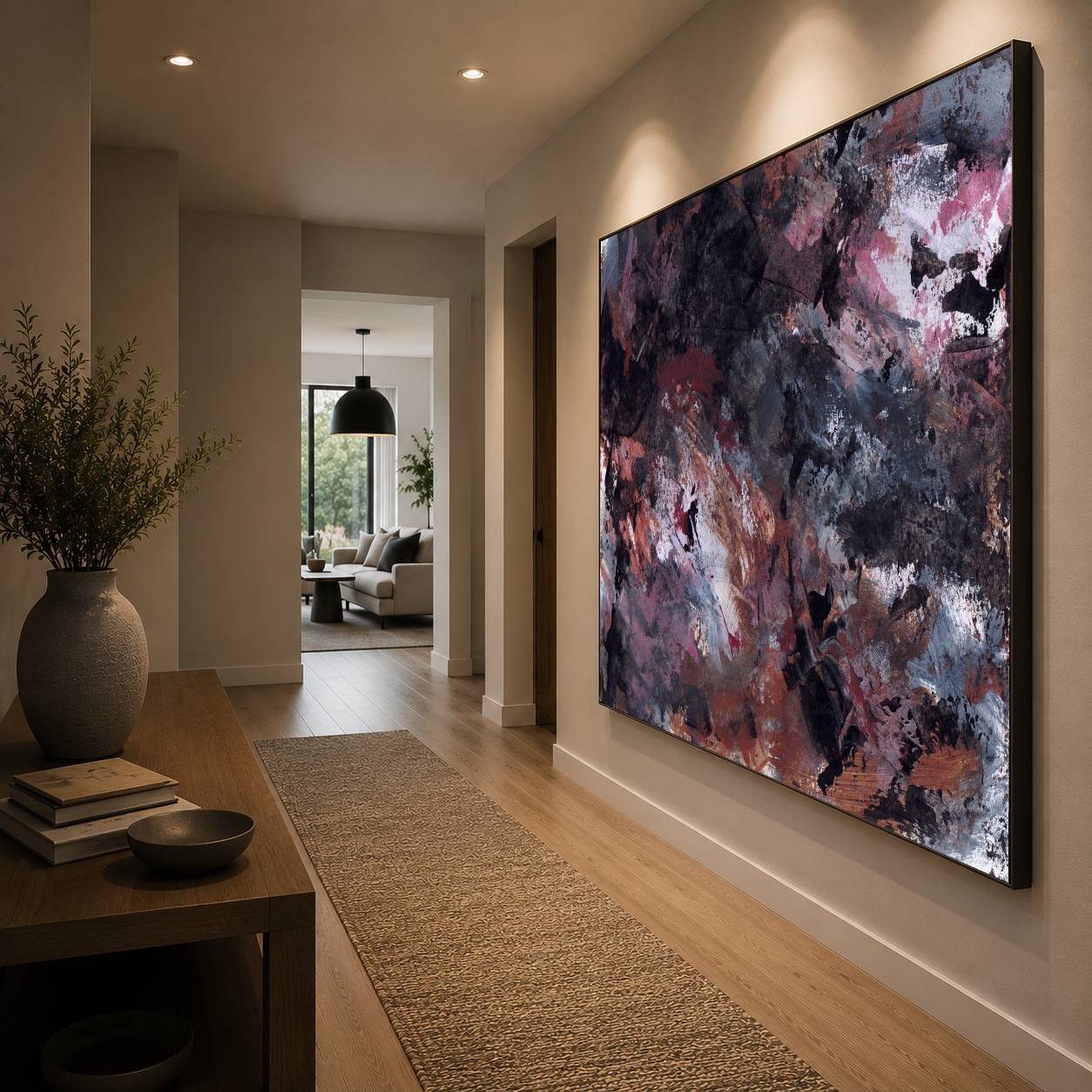
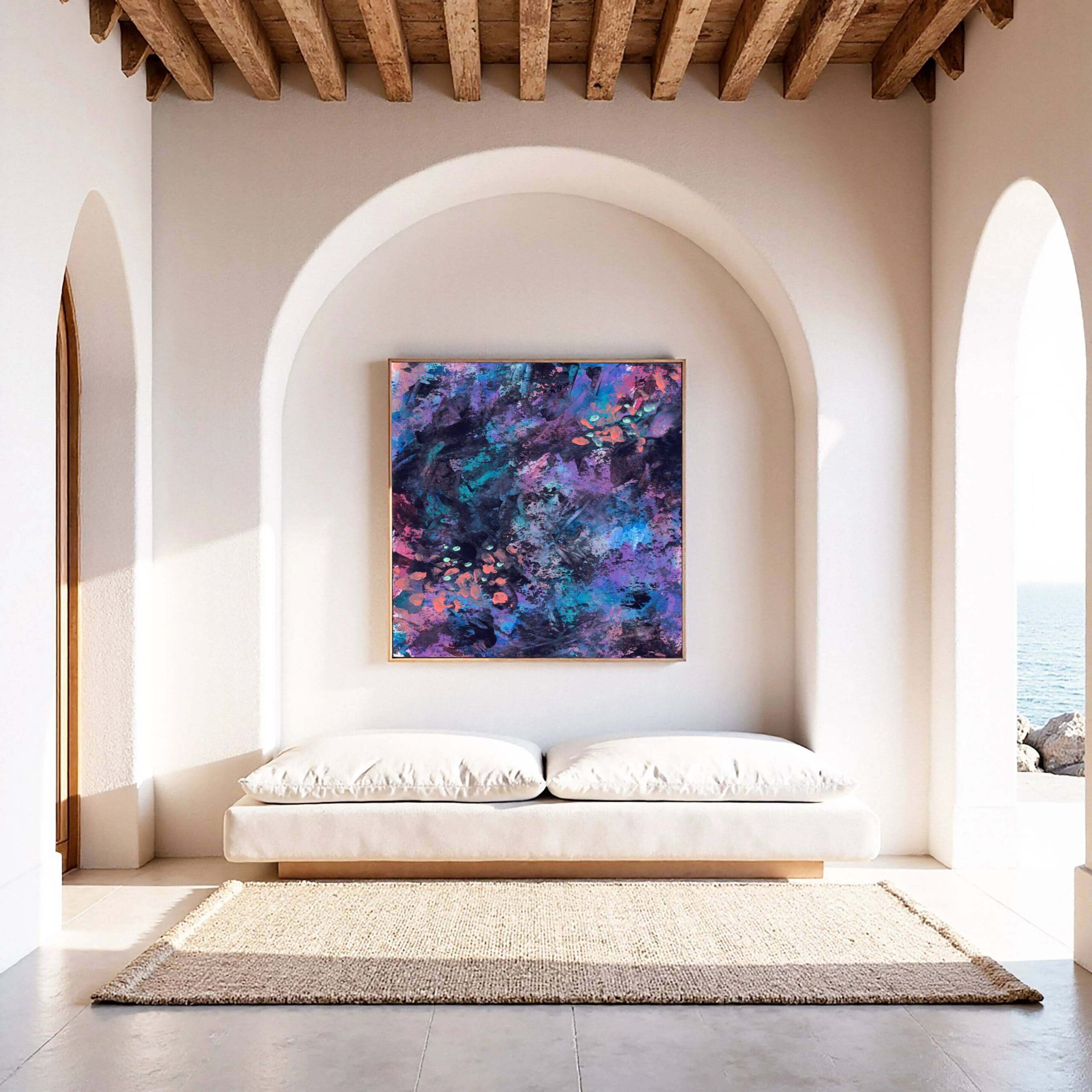
Why people are often scared of large artwork
Many people love large abstract art in galleries, hotels, beautifully designed interiors or architect-designed homes, but panic slightly when it comes to bringing it into their own space.
The fear is usually the same. “What if it overwhelms the room?”
Which is understandable because oversized artwork has presence. It changes the visual balance of a space immediately. A large abstract piece cannot really hide politely in the background, pretending to be a decorative afterthought while everyone ignores it beside a fern.
But interestingly, most rooms are not ruined by artwork being too large. They are usually weakened by artwork being too small.
Tiny prints floating awkwardly above large furniture often create far more visual tension than one properly scaled artwork ever would. Small pieces can make a room feel fragmented because the eye never settles properly. The wall still feels empty even though technically something is hanging there.
Large abstract art tends to work better because it creates cohesion. It gives the eye somewhere to land. It anchors the room emotionally and visually.
This is one reason Why Large Canvas Prints Work So Well in Modern Interiors resonates with so many collectors and interior-conscious buyers. Large-scale artwork changes spatial feeling in a way that smaller decorative pieces often cannot achieve.
The issue is not size alone. It is a relationship.
Why oversized art can actually make a room feel calmer
People often assume that large artwork automatically creates visual intensity.
In reality, oversized abstract art frequently creates a calmer atmosphere because it reduces clutter and simplifies the visual experience of the room.
One substantial piece often feels quieter than multiple smaller pieces competing for attention.
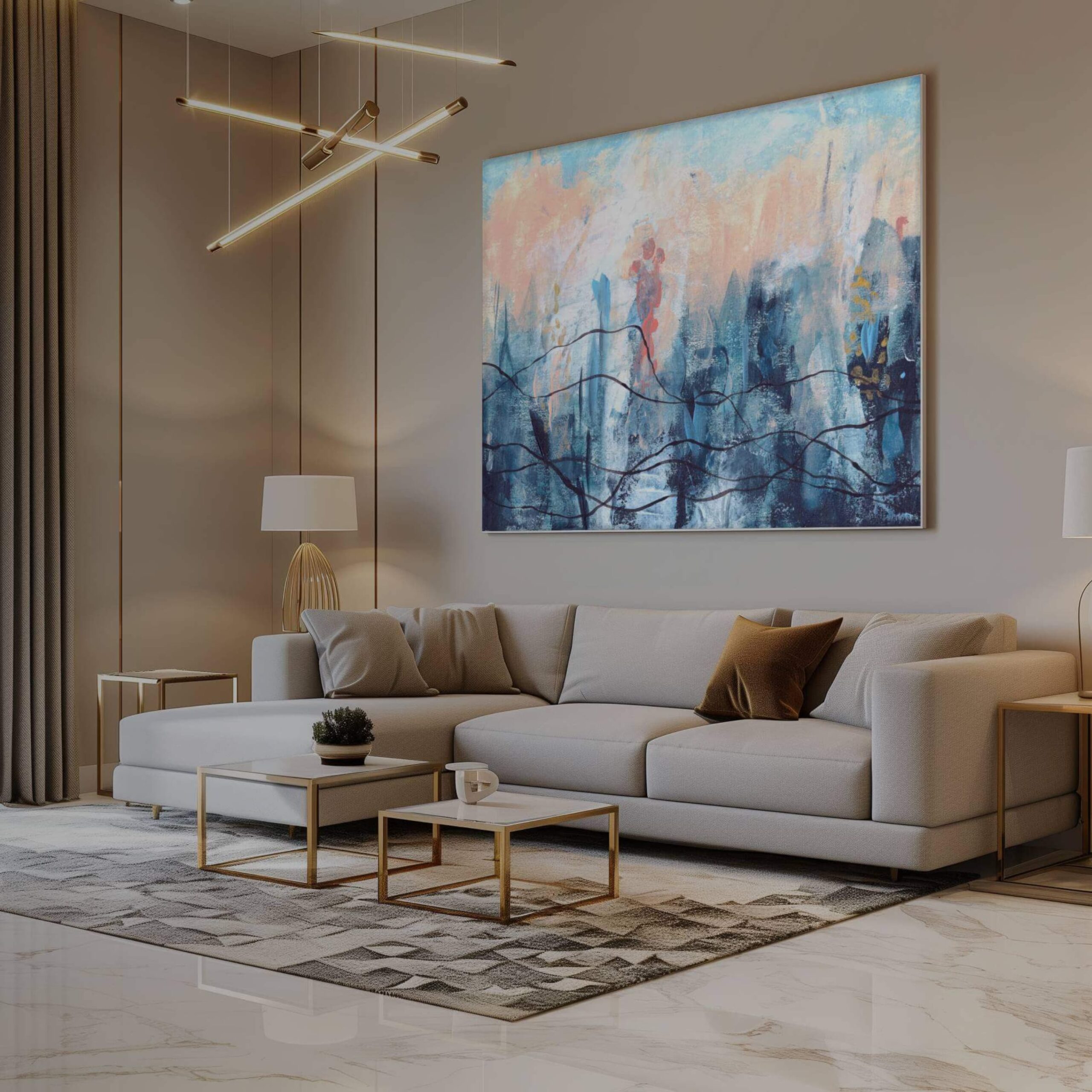
This becomes especially noticeable in modern interiors where architecture already contains clean lines, open space and restrained styling. A large abstract canvas can soften the environment by introducing flow, texture and atmosphere without requiring excessive decoration around it.
Large artwork also allows for more breathing space compositionally.
A strong abstract piece may contain areas of softness, openness and negative space that help the room feel visually balanced. Smaller decorative art often relies on busier detail to create impact quickly, which can actually increase visual noise over time.
This is explored further in How Colour in Abstract Art Changes the Feeling of a Room, where colour is discussed as atmosphere rather than decoration alone.
Calm interiors are rarely built through emptiness alone. They are built through visual confidence. Large abstract art often provides exactly that.
If you’re nervous about scale, Why Large Canvas Prints Work So Well in Modern Interiors explores why oversized pieces often work better than people initially expect.
The real reason rooms feel overwhelmed
Rooms rarely feel overwhelmed because of one artwork. They feel overwhelmed because too many elements are competing simultaneously.
Oversized art only becomes overpowering when the rest of the room is already visually chaotic. Heavy furniture, excessive styling, aggressive contrast, too many decorative accessories, multiple focal points and highly saturated colours can all create visual overload long before artwork enters the conversation.
A strong large-scale abstract piece actually works best when the room gives it enough breathing space. That does not mean minimalist emptiness. It simply means intentional balance.
A room with calmer styling often supports large art beautifully because the artwork becomes the emotional centre of the space rather than another competing object. The architecture, furniture and artwork begin working together instead of fighting for dominance like contestants in an interior-design reality show fuelled entirely by beige panic and scented candles.
Large art should feel integrated. Not isolated.
Why abstract art works better large than many other styles
Abstract art scales beautifully because it relies more on atmosphere, movement, colour and texture than literal subject matter.
This gives it more flexibility within interiors.
Large figurative or highly detailed artworks can sometimes dominate a room because the eye becomes pulled constantly towards recognisable imagery. Oversized abstract art tends to feel more spatial because the composition interacts with the room architecturally rather than functioning purely as narrative imagery.
That is one reason collector-grade abstract canvas prints often feel softer and more sophisticated at large scale than mass-produced decorative prints enlarged beyond what they were emotionally designed to handle.
Texture matters enormously here too.
Large abstract canvases reveal layers gradually. Colour relationships shift throughout the day. Surface depth catches light differently depending on angle and time. The artwork becomes part of the room’s atmosphere rather than simply sitting on top of it.
This is discussed further in What Makes Collector-Grade Canvas Art Different from Decorative Wall Art and Why Abstract Canvas Prints Work Better Than Mass-Produced Wall Art.
Because scale amplifies quality, and unfortunately, it amplifies cheapness too.
Decision box: should you choose abstract canvas prints or mass-produced wall art?
| If you want your room to feel… | Large abstract art usually works well | Avoid |
|---|---|---|
|
Calm and grounded |
Yes |
Multiple competing focal points |
|
Spacious and cohesive |
Yes |
Tiny undersized prints |
|
Architecturally balanced |
Yes |
Cluttered styling overload |
|
Modern but warm |
Yes |
Overly busy compositions |
|
Emotionally layered |
Yes |
Trend-driven decorative filler |
|
Softer visually |
Yes |
Harsh colour clashes |
|
More luxurious |
Yes |
Cheap glossy finishes |
|
Intentional and mature |
Yes |
Random disconnected artwork |
|
Visually calmer |
Yes |
Gallery walls with no breathing room |
|
Quietly impactful |
Yes |
Art chosen purely to match cushions |
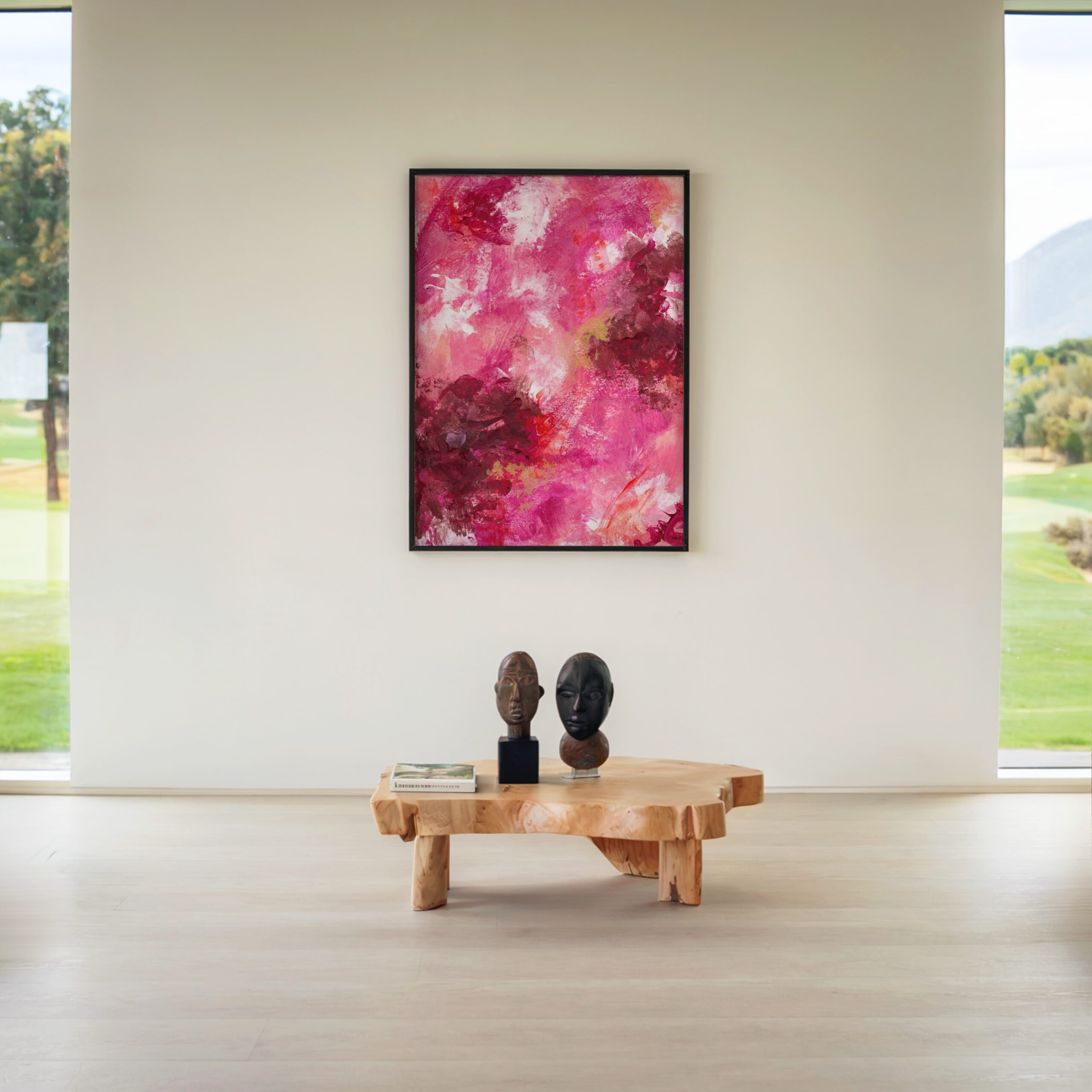
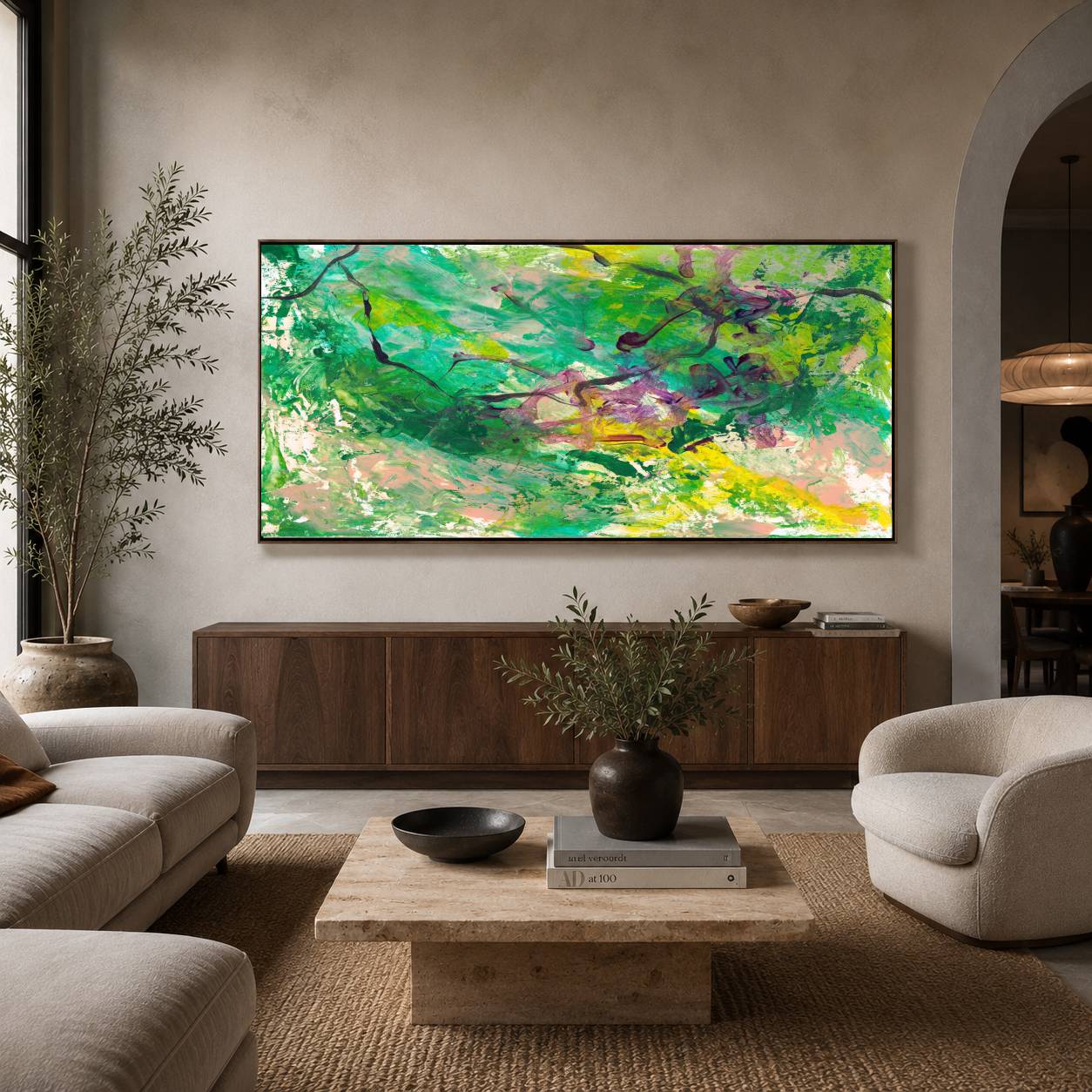
Why scale should relate to the architecture, not your fear
One of the most common mistakes people make is choosing artwork based on nervousness instead of spatial proportion.
They buy smaller art because large art feels risky. Then the room still feels unfinished because the wall proportion was never addressed properly. Large walls need confidence.
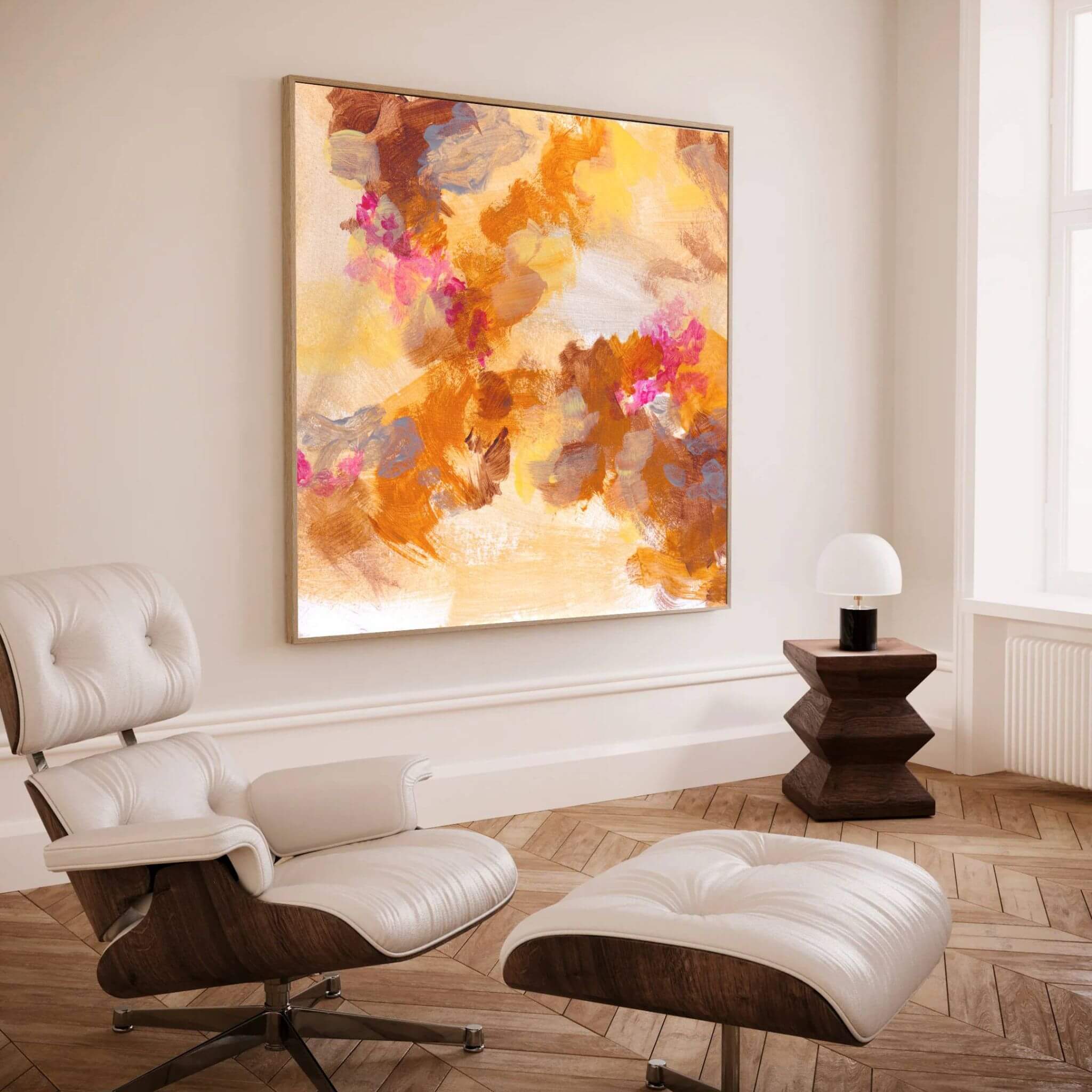
A substantial sofa, high ceilings, open-plan layout or wide hallway usually requires artwork with enough scale to visually hold the architecture together. Tiny artwork floating in oversized spaces often creates awkwardness because the eye senses imbalance immediately, even if the viewer cannot consciously explain why.
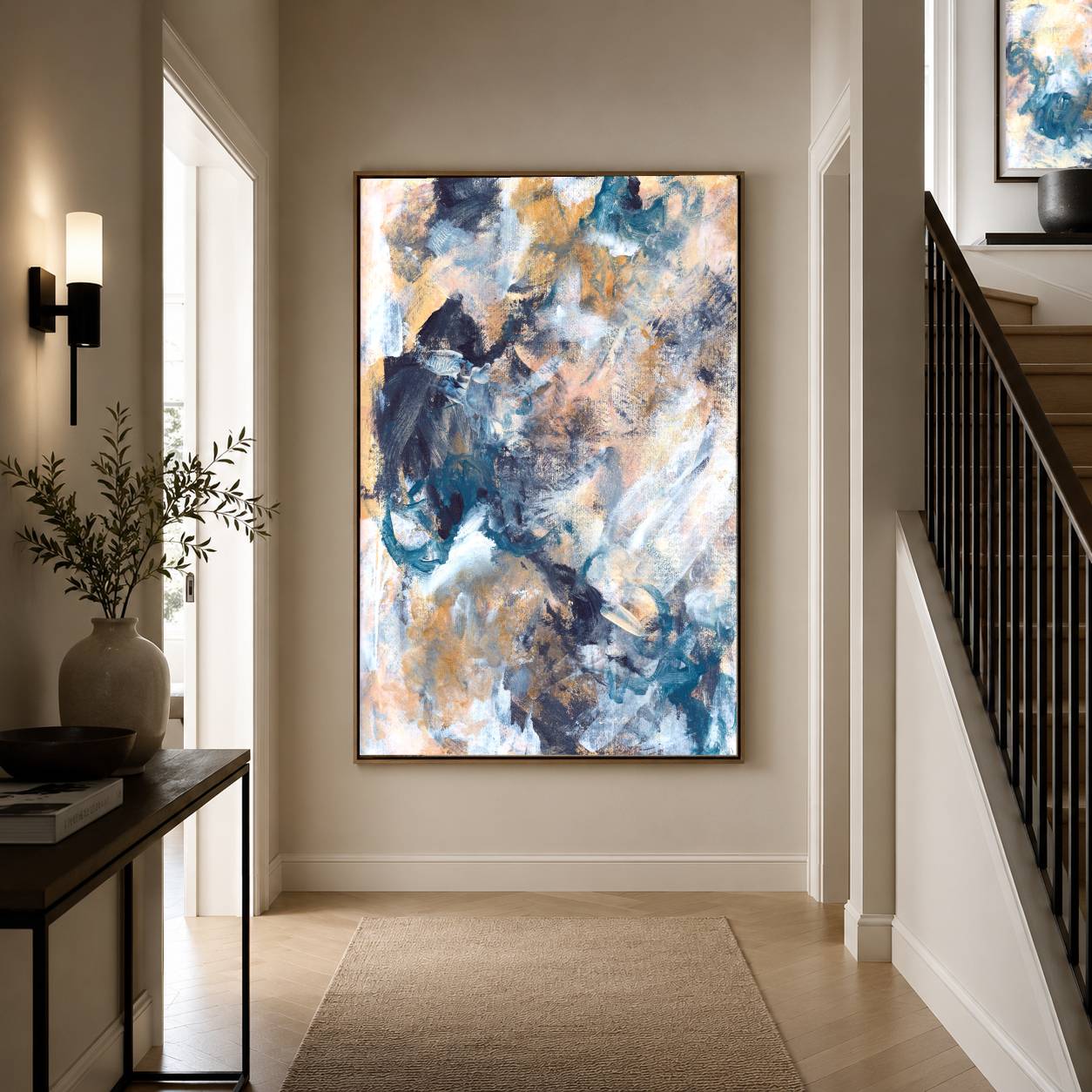
This becomes particularly important in hallways, stairwells and transitional spaces. In How to Choose Abstract Art for a Hallway, Landing or Transitional Space, scale is discussed not as decoration but as rhythm. Large artwork can guide movement through a space beautifully when proportion is handled properly.
Architecture should lead the sizing decision more than fear does. Because honestly, most interiors suffer more from hesitation than ambition.
Why colour matters more than size
A large artwork in soft, grounded colours will usually feel calmer than a small artwork using highly aggressive contrast. People often blame scale when the real issue is colour intensity.
A muted oversized canvas in layered earth tones, softened neutrals, or atmospheric blues can feel incredibly peaceful even at a substantial scale because the nervous system responds to colour emotionally. Conversely, small artworks with harsh contrast or hyper-saturated palettes can create tension immediately regardless of their physical size.
This does not mean large abstract art needs to be pale or neutral to work well. It simply means the emotional tone of the colour palette matters.
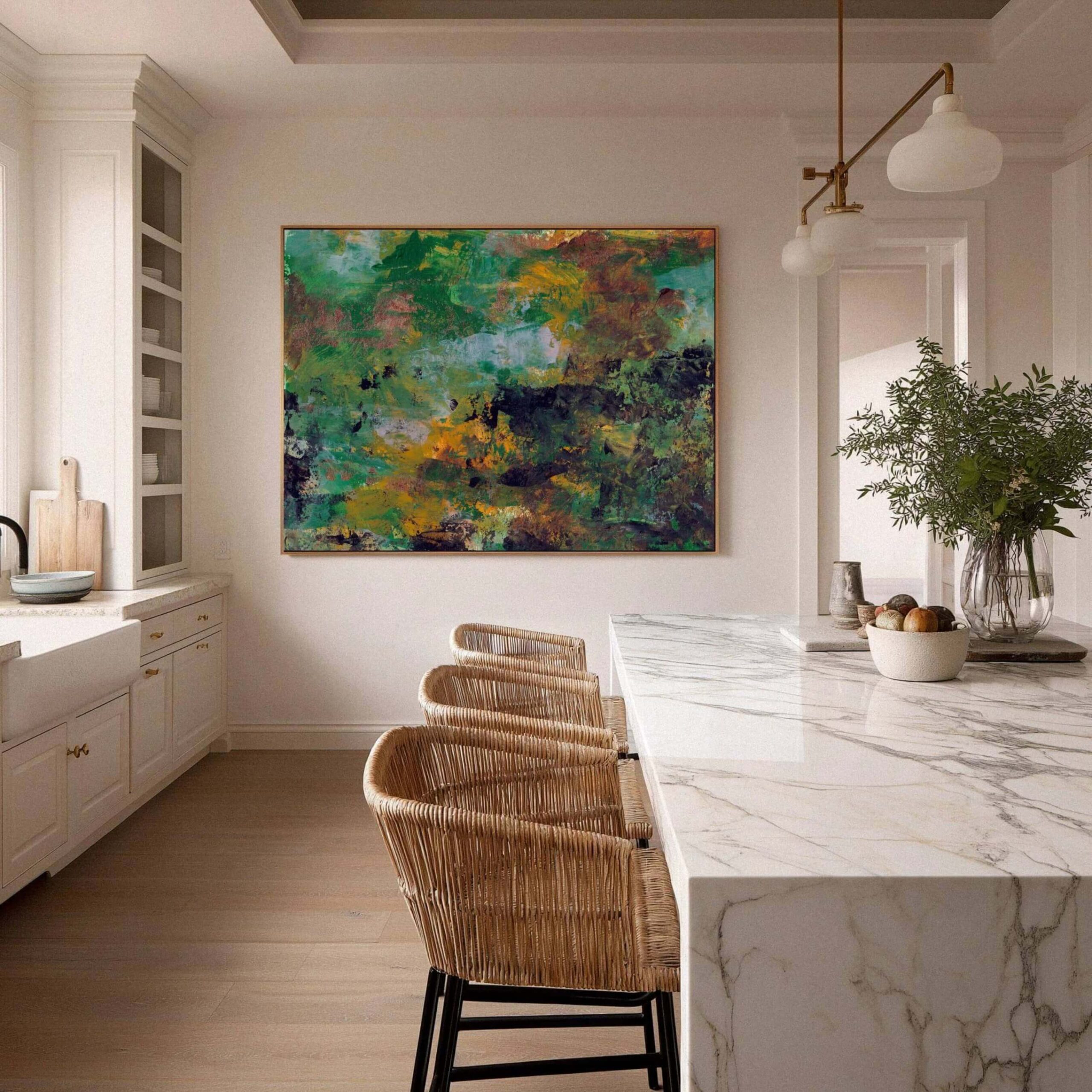
Strong colours can still feel balanced when the composition contains breathing space and restraint. Rich charcoals, deep greens, rusts, indigos and layered warm tones often feel grounded at large scale because they create depth rather than visual chaos.
This is why choosing abstract art based purely on “matching the room” rarely creates the strongest result. Emotional atmosphere matters far more than exact colour coordination.
The artwork should support the feeling of the space, not just its palette.
Why placement changes everything
Placement determines whether large art feels intentional or oppressive. A properly placed oversized canvas often feels elegant and architectural. Poorly placed large artwork feels like the wall is being physically attacked by visual enthusiasm.
-
- The centre height matters.
- The breathing space around the piece matters.
- The relationship to furniture matters.
- The lighting matters.
Large art generally works best when allowed enough surrounding space to settle visually. If oversized artwork is squeezed into cramped layouts or surrounded by too many competing decorative objects, the room can start feeling heavy.
This is one reason modern interiors often support large art beautifully. Cleaner layouts naturally give the artwork room to breathe.
Placement should also respond to how people move through the space. A hallway piece feels different from a bedroom piece. A dining-room canvas behaves differently from artwork above a sofa. Transitional spaces often benefit from softer compositions that guide movement gently, while living spaces may support stronger focal-point energy.
Good placement makes a large artwork feel inevitable. Not accidental.
Why texture softens oversized artwork
Texture is incredibly important at large scale because it introduces softness into visual presence.
Flat glossy prints often feel more overwhelming because the surface reflects light harshly and delivers all visual information instantly. Textured abstract canvas prints behave differently. Layers reveal themselves slowly. Light changes the surface subtly throughout the day. Depth softens the visual impact.
This is one reason collector-grade canvas works tend to feel far more sophisticated than mass-produced oversized prints. Texture humanises scale.
Without texture, oversized artwork can sometimes feel commercially sterile or visually aggressive, especially in minimalist interiors where every surface already feels polished within an inch of its life.
Textural abstract canvases add warmth and atmosphere instead.
They help the artwork feel lived with rather than merely installed. Why negative space matters in large abstract art. The best large abstract works often contain restraint. Not every inch of the canvas needs to scream for attention simultaneously.
Negative space allows the eye to rest. It creates rhythm and softness inside the composition itself. Large artworks with strong breathing space often feel significantly calmer than smaller, overcrowded pieces because the composition already contains visual balance internally.
This is particularly important in emotionally intelligent interiors where calm matters more than spectacle.
Large art should not feel like visual shouting. It should feel like presence. Quiet confidence usually ages better than decorative desperation.
Why collector-grade large art feels different
Large-scale artwork amplifies everything.
-
- Quality.
- Texture.
- Colour depth.
- Composition.
- Material choice.
- Presence.
This is why collector-grade abstract canvas works tend to feel dramatically different from oversized mass-produced prints. At a large scale, poor printing, cheap materials and generic compositions become painfully obvious very quickly.
A collector-grade piece usually carries more subtlety.
The colour relationships feel richer. The texture behaves more naturally in light. The composition holds attention longer. The emotional tone feels deeper and less manufactured.
That difference matters because large art becomes part of the architecture emotionally. It influences the entire room experience every single day.
People often think they are paying for “luxury” when buying higher-end, large-scale artwork.
Really, they are often paying for longevity of experience. The piece continues giving something back over time instead of becoming visually empty after three weeks.
Why emotionally intelligent interiors often use fewer, larger pieces
Calm interiors rarely rely on excessive visual fragmentation.
This is why many emotionally intelligent spaces use fewer artworks at larger scale rather than filling every wall with smaller decorative objects. Larger pieces create stronger emotional anchors while allowing more breathing room throughout the home.
The room feels more intentional. More grounded. Less visually anxious.
This is especially important in modern homes where open layouts can otherwise feel slightly emotionally disconnected. Large abstract art helps create warmth, softness and psychological focus without needing excessive decoration.
The artwork becomes part of the emotional architecture of the space itself.
Not just something hanging on it.
Comparison table: large abstract art vs undersized wall art
| Large abstract art | Undersized wall art |
|---|---|
|
Creates visual cohesion |
Often feels fragmented |
|
Anchors the room |
Can leave walls feeling unfinished |
|
Supports architecture |
Often disconnected from scale |
|
Feels intentional |
Can feel hesitant |
|
Adds atmosphere |
Often decorative only |
|
Works beautifully in modern interiors |
Can disappear visually |
|
Reduces visual clutter |
Often requires multiple pieces |
|
Feels calmer when chosen well |
Can create visual noise |
|
Adds emotional depth |
Often trend-driven |
|
Creates stronger focal points |
Weakens room balance |
Final thoughts: large art should create presence, not pressure
Large abstract art does not automatically overwhelm a room.
-
- Poor relationships overwhelm rooms.
- Poor proportion.
- Poor colour balance.
- Poor placement.
- Too much visual competition.
- Too little breathing space.
A well-chosen oversized abstract canvas often creates more calm than smaller decorative pieces because it simplifies the visual experience of the space while adding emotional depth and architectural confidence.
The best large artworks do not shout. They settle the room. They soften it. They hold it together emotionally.
And honestly, most interiors do not need more decorative filler. They need one thing with enough presence to finally let everything else relax.
If you are looking for large abstract art designed for calm, considered interiors, explore Selected Works or request access to the private Collector’s Vault.
The Vault includes collector-grade canvas works created for modern interiors that need emotional presence without visual overwhelm.
Key Takeaway
Large abstract art usually works best when it creates visual calm rather than visual noise. Oversized artwork can actually make interiors feel more spacious and emotionally balanced when the colour palette, composition and placement support the architecture instead of competing with it.
Frequently Asked Questions
Not necessarily. Large abstract art can actually make smaller rooms feel calmer and more cohesive when the composition and colour palette support the space properly.
Oversized wall art usually refers to artwork significantly larger than standard decorative prints, often used as a dominant focal point within a room.
Small artwork often feels disconnected when it lacks enough visual weight for the surrounding wall or furniture. Undersized art can make a room feel fragmented rather than balanced.
Abstract art often scales beautifully because it focuses on atmosphere, colour, texture and composition rather than detailed literal imagery.
Choose artwork with balanced colour, breathing space and appropriate placement. Large art works best when the room itself is not overly cluttered.
Not exactly. The artwork should support the emotional tone of the room rather than perfectly matching every colour already present.
Large canvas prints help soften clean architecture, create visual cohesion and introduce emotional warmth into minimalist spaces.
Texture softens visual impact, adds depth and allows the artwork to interact more naturally with light throughout the day.
Collector-grade large abstract art refers to high-quality works created with stronger materials, richer colour depth, more intentional composition and greater emotional and architectural presence than mass-produced decorative prints.