
Corporate Movement Programmes in Nottingham: How to Choose the Right Provider
TL;DR
Not all corporate movement programmes are designed around how modern employees actually work or how desk-based stress physically affects the body throughout the day.
Some programmes focus too heavily on fitness culture. Others rely almost entirely on motivational wellbeing language while ignoring nervous system regulation, posture, cognitive fatigue and the physical reality of prolonged sitting and screen exposure.
The best workplace movement providers understand that employees do not need more pressure disguised as wellness. They need practical, emotionally intelligent movement support that improves physical comfort, concentration, energy and regulation within real working environments.
When choosing a corporate movement programme in Nottingham, organisations should look beyond branding and ask whether the provider genuinely understands desk-based wellbeing, accessibility, psychological safety and sustainable workplace integration.
For practical workplace movement support designed specifically for desk-based teams, explore Sit Happens or read Office Movement Training for HR Teams: Questions to Ask Before Booking.
Definition: what is a corporate movement programme?
A corporate movement programme is structured workplace wellbeing support designed to help employees improve physical comfort, posture, movement variety, nervous system regulation, focus and energy throughout the workday through guided movement, mobility, breathing and physical awareness sessions adapted specifically for working environments.
If you’re unfamiliar with the concept altogether, What Is Workplace Movement Training and Why Are Companies Booking It? is a good place to start.
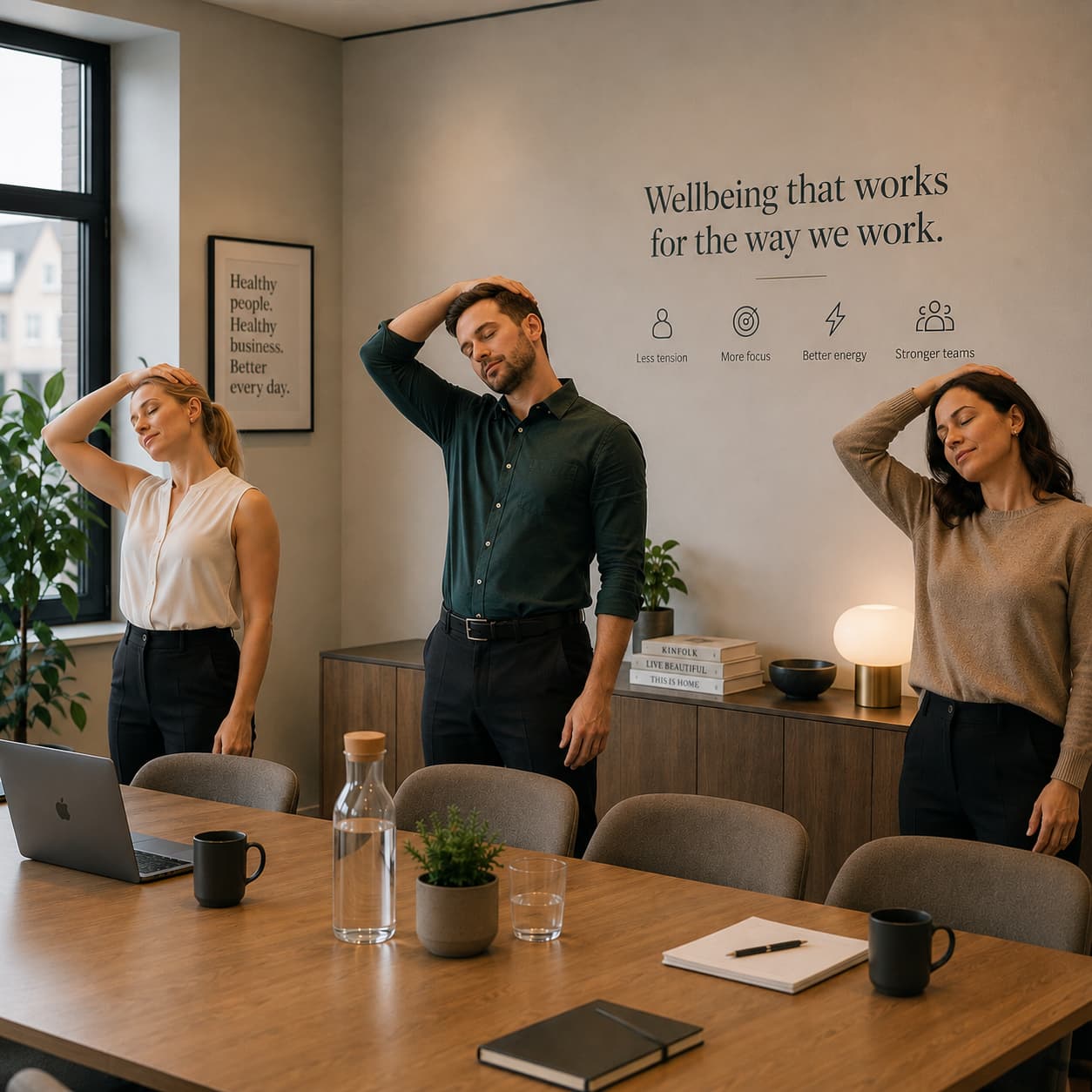
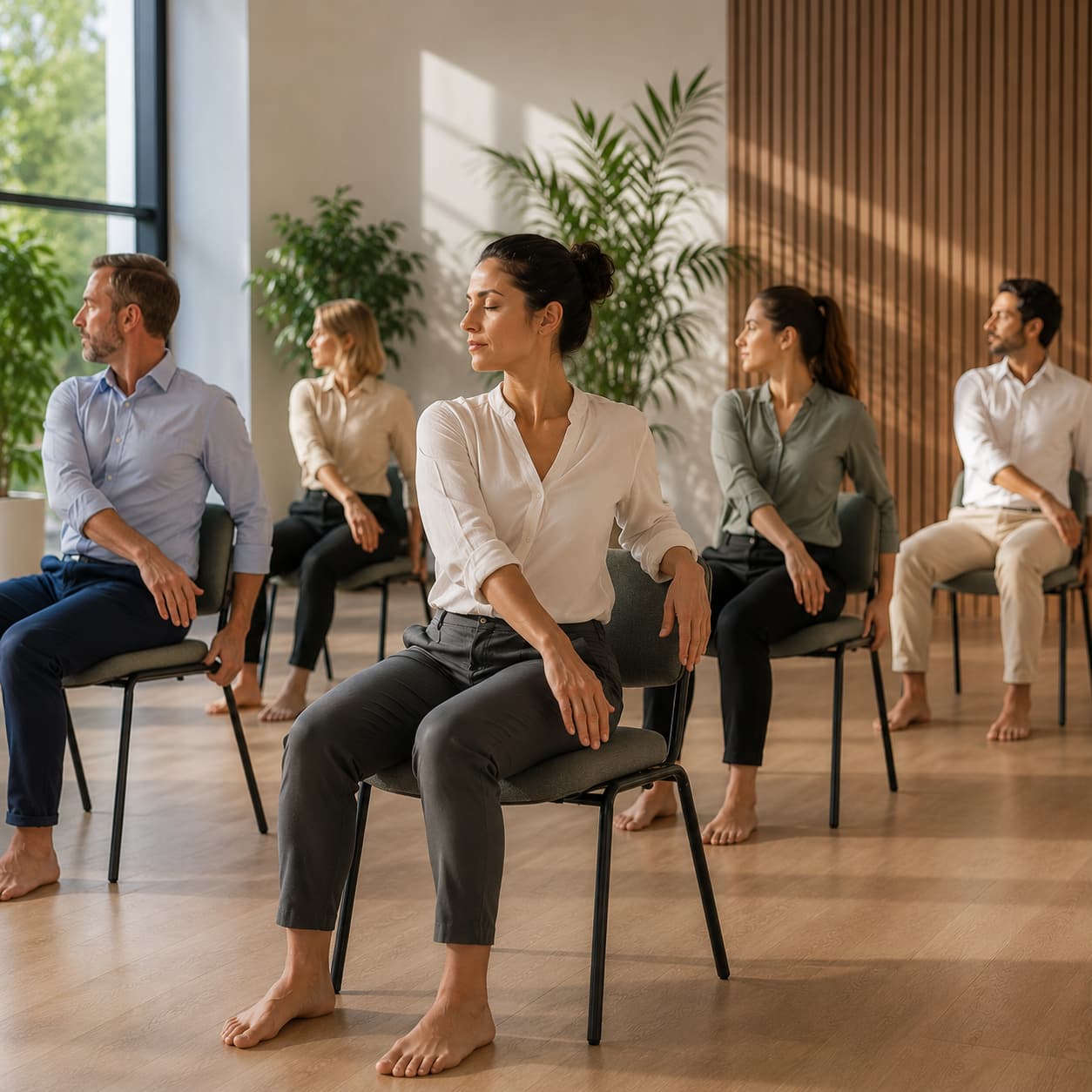
Why workplace movement support matters more now than ever
Modern workplaces place enormous demands on the nervous system while simultaneously reducing natural movement throughout the day.
Employees spend long periods sitting, concentrating intensely, responding constantly to communication platforms and remaining cognitively active for hours without enough physical transition to help the body regulate effectively. The result is a strange combination of physical stillness and neurological overload that leaves many people exhausted despite technically spending most of the day at a desk.
This is one reason workplace wellbeing programmes have become such a major focus for organisations globally. Research increasingly shows that companies investing in wellbeing support see benefits around engagement, retention and absenteeism reduction when programmes are implemented thoughtfully.
However, one of the biggest problems within corporate wellbeing is that many programmes still focus heavily on awareness while failing to address physical regulation properly.
Employees are told to manage stress while their breathing remains restricted for eight hours.
They are encouraged to prioritise wellbeing while moving from one screen-based demand directly into another without pause.
They are offered mindfulness webinars while their shoulders are practically attempting to merge permanently with their ears by 3pm every afternoon.
This is why movement-based support has become increasingly valuable. Not because employees need more workplace fitness culture. Because they need more physical regulation.
As explored in Why Workplace Wellbeing Needs Physical Practice, Not Just Advice, wellbeing becomes significantly more effective when employees physically experience regulation rather than simply hearing about it conceptually.
Why choosing the right provider matters so much
A poorly designed workplace movement programme can actually make employees less comfortable rather than more supported.
That sounds dramatic until you have watched an exhausted finance team being aggressively encouraged to “boost energy levels” through forced workplace fitness activities nobody emotionally consented to before opening Outlook that morning.
The wrong provider often misunderstands the difference between fitness and workplace wellbeing.
Desk-based employees are not necessarily lacking motivation.
They are often physically overloaded, mentally fatigued and chronically under-moved in very specific ways. Good workplace movement providers understand how posture, stress, cognitive demand and nervous system overload interact throughout the working day. Poor providers simply transplant gym culture into offices and hope nobody notices the emotional mismatch.
That distinction becomes extremely obvious once sessions begin.
The best corporate movement programmes feel calming, practical and emotionally intelligent. Employees leave feeling physically clearer and more regulated rather than overstimulated, embarrassed or socially uncomfortable.
This is why organisations should evaluate providers carefully rather than booking purely based on trendy wellbeing language or generic corporate wellness branding.
Because employees can usually tell very quickly whether a programme genuinely supports them or simply exists to make the company feel temporarily progressive during internal HR meetings.
Why movement support should feel grounded rather than performative
Many organisations unintentionally create resistance toward workplace wellbeing by choosing programmes that feel disconnected from real working life.
Employees do not want forced positivity. They do not want workplace wellness to become another area where they must perform enthusiasm publicly. They do not want corporate wellbeing experiences that feel emotionally artificial, physically intimidating or socially awkward. The strongest movement programmes tend to feel surprisingly ordinary in the best possible way.
- Employees breathe more naturally.
- Move more comfortably.
- Reduce tension.
- Improve posture variation.
- Regulate more effectively.
- Concentrate more clearly afterwards.
- The sessions integrate into working life rather than interrupting it dramatically.
This grounded approach matters because sustainable workplace wellbeing usually comes from consistency and nervous system safety rather than temporary motivational excitement. Research consistently shows that employee wellbeing programmes work best when organisations address real workplace conditions rather than relying only on surface-level interventions.
This is explored further in How Sit Happens Helps Teams Reduce Stiffness, Fatigue and Brain Fog, where the emphasis sits firmly on practical regulation and sustainable movement rather than high-intensity workplace fitness culture.
The first thing companies should ask: does the provider understand desk-based work?
This sounds obvious. It often is not. A surprising number of workplace movement providers still approach office environments as though employees are simply inactive fitness clients rather than cognitively overloaded professionals dealing with prolonged sitting, screen fatigue, posture restriction and nervous system stress.
Desk-based exhaustion behaves differently from general inactivity.
Employees may feel physically stiff despite limited physical exertion. They may feel mentally overwhelmed while simultaneously restless. Breathing often becomes shallow. Movement variety decreases dramatically. Posture becomes increasingly compressed over time.
Good workplace movement providers understand these patterns deeply.
They design sessions around regulation, posture variation, mobility, breathing and physical decompression rather than purely around calorie burn or fitness progression. The goal is helping employees function and feel better within real working environments.
That distinction matters enormously.
As discussed in Why Desk-Based Teams Need Movement Before More Wellbeing Advice, modern office fatigue is often less about laziness and far more about prolonged cognitive demand combined with physical stagnation.
Employees do not necessarily need workplace athletic performance. They need nervous systems that stop behaving like permanently open browser tabs.
Why accessibility matters more than intensity
One of the fastest ways to destroy engagement in workplace wellbeing is choosing programmes that quietly intimidate employees.
If staff feel physically judged, socially exposed or worried about not being “fit enough,” participation drops rapidly no matter how enthusiastic the initial launch sounded in the company newsletter.
Good corporate movement programmes feel accessible from the beginning.
Employees should not need previous movement experience.
Sessions should feel adaptable for different body types, confidence levels, injury histories and movement abilities. Participation should feel psychologically safe rather than performative.
This becomes especially important in workplaces where many employees already feel exhausted or physically disconnected from their body after years of sedentary work patterns. The provider should understand how to support regulation gradually rather than overwhelming employees immediately with intensity.
Because honestly, most people are not secretly desperate to perform office burpees in front of procurement while pretending this represents their deepest wellness aspirations.
Why nervous system regulation should be part of the conversation
The best workplace movement providers understand that stress is physical. That sounds simple, but it changes the entire approach to workplace wellbeing delivery.
- Stress affects breathing.
- Posture.
- Muscular tension.
- Concentration.
- Movement quality.
- Energy regulation.
- Emotional resilience.
When employees remain cognitively overloaded for long periods without enough movement or a nervous system reset, the body starts carrying stress physically throughout the day. This is why movement support often improves far more than stiffness alone. Employees frequently report:
- Improved concentration
- Better energy regulation
- Reduced mental fatigue
- Improved emotional steadiness
- Better posture awareness
- Reduced physical tension
- Clearer thinking after sessions
Movement changes physiology directly rather than simply discussing wellbeing intellectually.
Research into workplace wellbeing consistently highlights the growing importance of physical, emotional and mental wellbeing integration rather than isolated wellness initiatives.
This is why movement support should never feel disconnected from real workplace psychology. The nervous system is already part of the workday, whether organisations acknowledge it or not.
Decision box: what should organisations look for in a corporate movement
| Effective workplace movement | Generic corporate wellness |
|---|---|
|
Supports physical regulation |
Often focuses on awareness only |
|
Designed for desk-based reality |
Often disconnected from real work patterns |
|
Emotionally intelligent delivery |
Performative wellness culture |
|
Accessible and adaptable |
Can feel intimidating |
|
Sustainable integration |
One-off enthusiasm spikes |
|
Focuses on nervous system support |
Focuses mainly on motivation |
|
Helps posture and concentration |
Often lacks physical support |
|
Employee-centred |
Presentation-centred |
|
Practical and grounded |
Trend-heavy |
|
Improves daily working experience |
Often feels temporary |
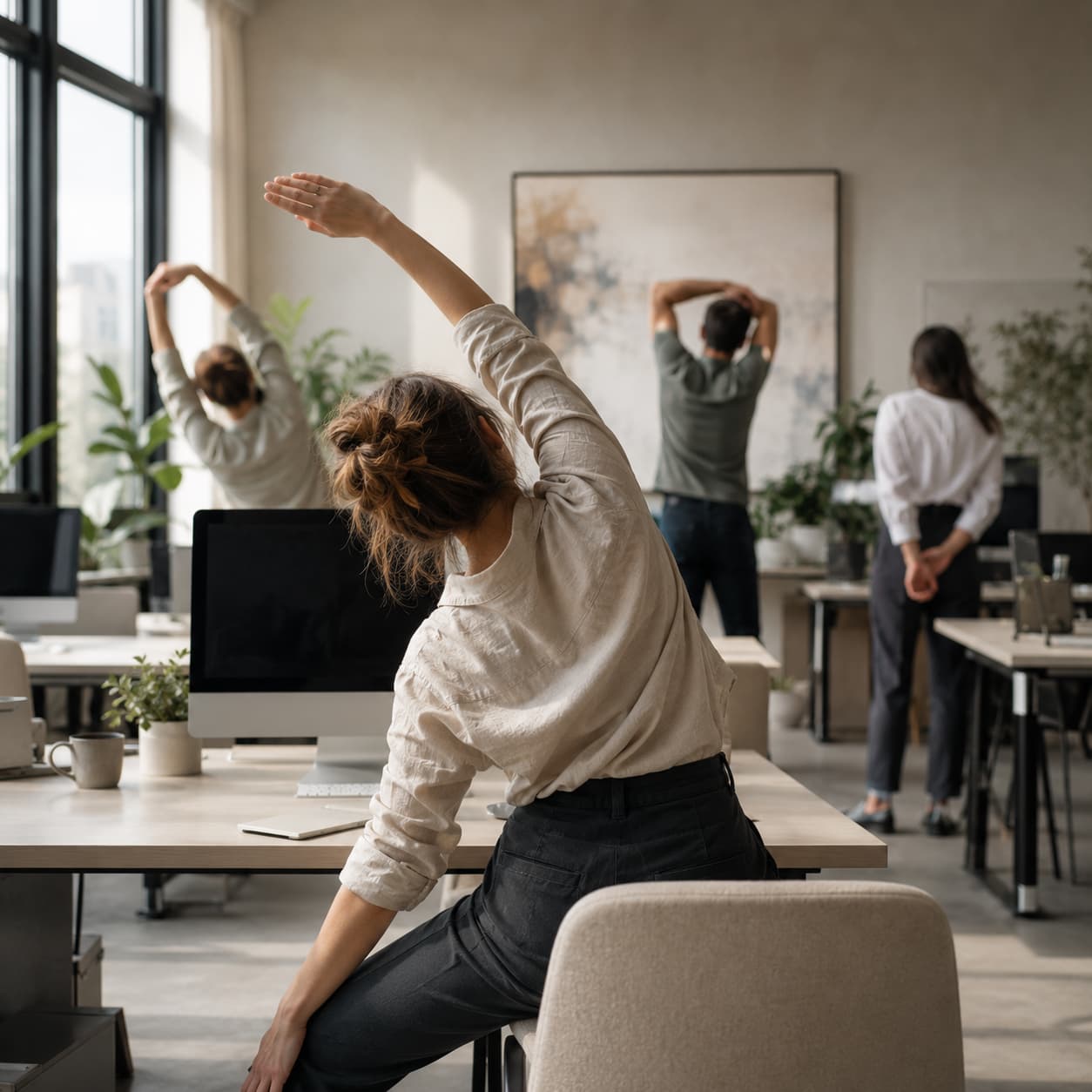
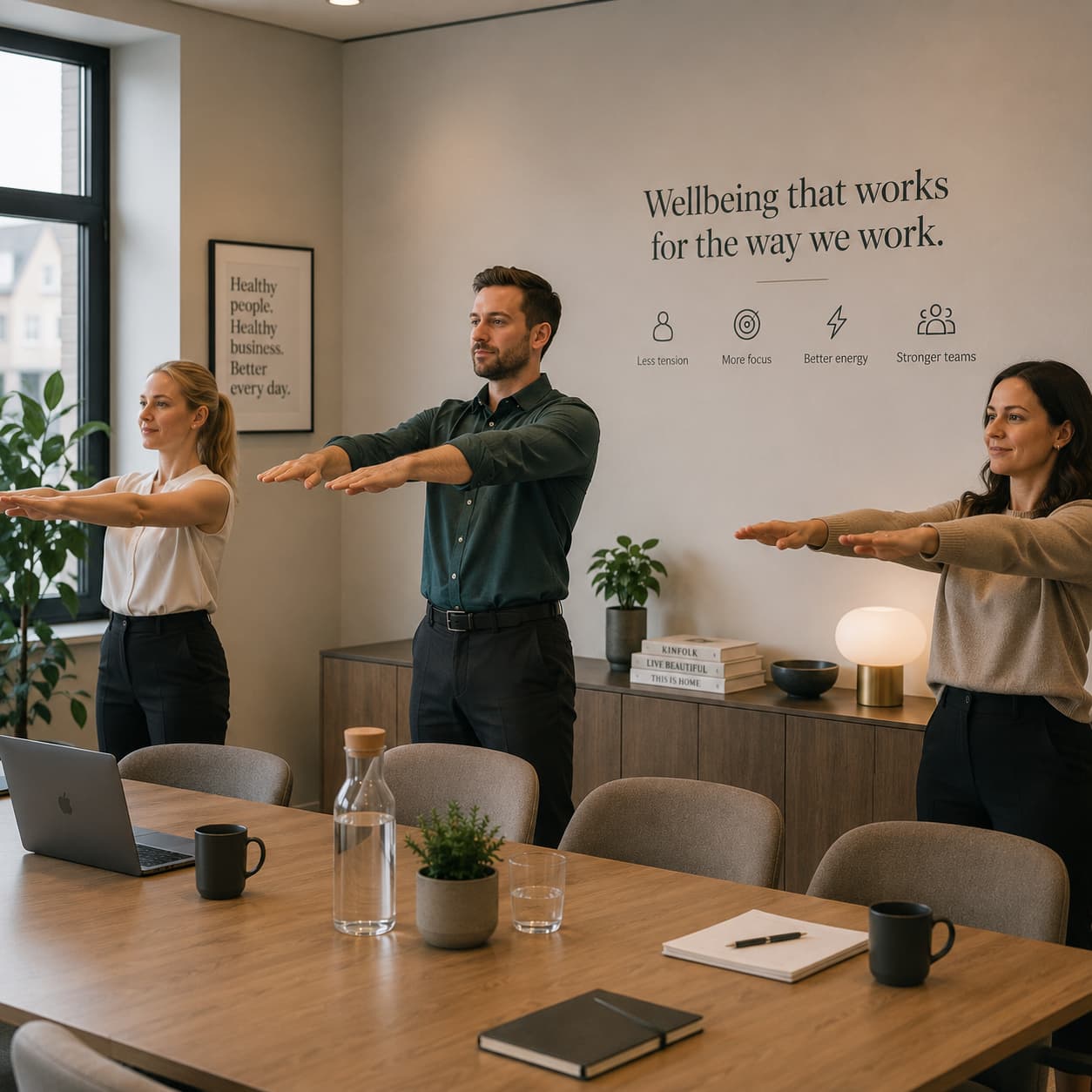
Why local understanding matters too
There are practical advantages to working with providers who understand local workplaces and real organisational culture within Nottingham and the surrounding areas. Local providers often understand:
- Typical workplace structures
- Regional industries
- Local business culture
- Realistic scheduling needs
- In-person delivery logistics
- Long-term relationship building
This matters because workplace wellbeing should not feel generic or imported from a completely different organisational reality. The strongest programmes usually evolve through understanding the actual people, pressures and physical patterns existing inside the company itself.
A good provider should therefore feel collaborative rather than prescriptive. They should ask questions. Understand employee demographics. Adapt delivery style.
Respond to organisational culture realistically instead of forcing every company into the same overly branded wellbeing template. Because different workplaces regulate differently.
A creative studio, law office, finance team and hybrid tech company all carry stress differently inside the body even when the physical consequences of desk work overlap significantly.
Why employee comfort matters more than novelty
Many workplace wellbeing initiatives focus heavily on novelty because novelty sounds exciting during planning meetings.
But novelty is not the same thing as effectiveness. Employees rarely need more stimulation. Most already feel overstimulated enough.
Good movement support often looks relatively simple from the outside because it focuses on physical regulation rather than spectacle. Breathing improves. Mobility improves. Tension reduces. Employees move more naturally and feel physically clearer afterwards.
Those outcomes matter more than whether the session generated enough “fun wellbeing content” for LinkedIn.
This is one reason How to Reduce Desk Stiffness Without Turning Work Into a Fitness Class resonates with so many organisations. Employees generally want support that feels usable and sustainable rather than socially exhausting.
Workplace wellbeing should reduce friction. Not create another category of it.
Why long-term integration matters more than one-off events
One-off workplace wellbeing sessions can absolutely be useful. But sustainable change usually comes through repetition and integration rather than isolated motivational experiences.
The nervous system adapts through consistent physical experience. Posture habits change gradually. Movement awareness develops over time. Employees regulate more effectively when movement becomes normal rather than occasional.
This is why organisations should think carefully about whether a provider offers sustainable approaches rather than relying entirely on temporary enthusiasm or corporate wellness trends.
The strongest workplace movement programmes usually support:
- Ongoing movement awareness
- Practical workplace habits
- Nervous system regulation
- Realistic integration into workdays
- Long-term physical comfort
- Sustainable behavioural change
Because ultimately, employees do not become physically healthier through one inspirational wellbeing afternoon followed immediately by returning to identical working patterns indefinitely afterwards.
The body responds to repetition. Not a corporate ceremony.
Comparison table: effective workplace movement vs generic corporate wellness
| Effective workplace movement | Generic corporate wellness |
|---|---|
|
Supports physical regulation |
Often focuses on awareness only |
|
Designed for desk-based reality |
Often disconnected from real work patterns |
|
Emotionally intelligent delivery |
Performative wellness culture |
|
Accessible and adaptable |
Can feel intimidating |
|
Sustainable integration |
One-off enthusiasm spikes |
|
Focuses on nervous system support |
Focuses mainly on motivation |
|
Helps posture and concentration |
Often lacks physical support |
|
Employee-centred |
Presentation-centred |
|
Practical and grounded |
Trend-heavy |
|
Improves daily working experience |
Often feels temporary |
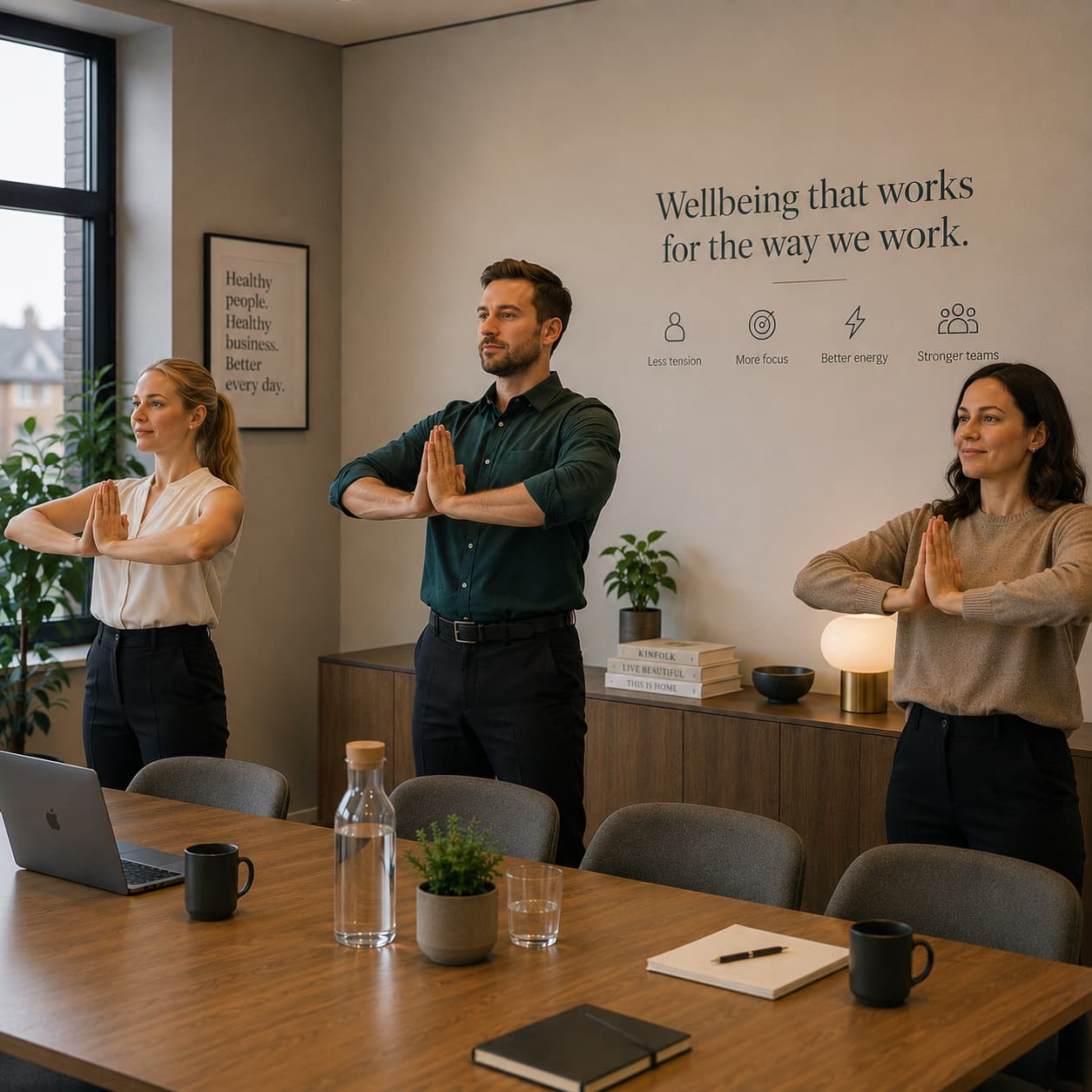

Why emotionally intelligent delivery matters
Employees are increasingly sensitive to whether workplace wellbeing feels genuine or performative. That sensitivity is understandable.
People spend a large portion of their lives working. If wellbeing support feels superficial, overly corporate or emotionally disconnected from actual employee experience, engagement usually collapses quickly underneath polite participation.
Emotionally intelligent movement delivery therefore, matters enormously. The best providers understand:
- Employee vulnerability around movement
- Workplace social dynamics
- Nervous system regulation
- Psychological safety
- Cognitive fatigue
- Physical tension patterns
- Sustainable pacing
Sessions should feel supportive without becoming patronising, structured without becoming rigid and calming without becoming emotionally theatrical.
Employees generally know when something genuinely helps them physically. That feeling matters far more than wellness buzzwords.
Practical checklist before choosing a workplace movement provider
| Questions to ask | Why it matters |
|---|---|
|
Does the provider understand desk-based fatigue? |
Workplace stress is physical too |
|
Are sessions adaptable for all abilities? |
Accessibility improves engagement |
|
Does the programme support nervous system regulation? |
Employees need regulation, not overstimulation |
|
Will employees feel psychologically safe participating? |
Comfort affects long-term uptake |
|
Is the delivery grounded and practical? |
Employees disengage from performative wellness |
|
Can the programme integrate realistically into workdays? |
Sustainability matters |
|
Does the provider understand workplace culture? |
Context affects effectiveness |
|
Is the focus on physical support rather than fitness performance? |
Workplace wellbeing differs from gym culture |
|
Will employees leave feeling physically better? |
That is the actual goal |
|
Does the provider support long-term habits? |
Sustainable change requires repetition |
Final thoughts: the best workplace movement programmes feel human, not corporate
The strongest corporate movement programmes are rarely the loudest.
They do not rely on exaggerated motivation, forced positivity or workplace wellness gimmicks designed mainly to photograph well beside branded water bottles and suspiciously enthusiastic team selfies.
They simply help employees feel physically better inside modern working life.
That means less stiffness. Less tension. Better breathing. Improved focus. More physical comfort. Greater nervous system steadiness.
The programme supports employees as actual human beings rather than productivity machines temporarily disguised inside wellbeing branding.
And honestly, most people can feel the difference immediately between movement support that genuinely understands workplace stress and programmes that were clearly designed by somebody who thinks exhausted accountants secretly dream of office bootcamp circuits during lunch.
The best providers create calm. Not performance.
You can also read:
Office Movement Training for HR Teams: Questions to Ask Before Booking
Why Workplace Wellbeing Needs Physical Practice, Not Just Advice
How Sit Happens Helps Teams Reduce Stiffness, Fatigue and Brain Fog
How to Reduce Desk Stiffness Without Turning Work Into a Fitness Class
Why Desk-Based Teams Need Movement Before More Wellbeing Advice
Key takeaway
A good corporate movement programme should help employees feel physically better, mentally clearer and more regulated during the working day without turning workplace wellbeing into awkward corporate performance theatre involving forced enthusiasm and suspiciously energetic lunges beside the printer.
Frequently Asked Questions
A corporate movement programme provides workplace movement support designed to improve posture, mobility, physical comfort, nervous system regulation and employee wellbeing.
Many organisations recognise that prolonged desk work contributes to fatigue, stiffness, concentration issues and nervous system overload.
Workplace movement focuses more on regulation, posture, mobility and sustainable physical wellbeing rather than athletic performance or calorie burn.
Companies should look for providers who understand desk-based work, accessibility, nervous system regulation and psychologically safe delivery.
No. Good workplace movement programmes should feel accessible and adaptable for varied confidence levels and movement abilities.
Yes. Movement influences posture, breathing, circulation and nervous system state, all of which affect concentration and mental clarity.
Stress and prolonged cognitive demand affect the body physically, influencing posture, energy, concentration and emotional resilience.
Yes. Many programmes can be adapted for in-person, hybrid or remote workplace environments.
Many fail because they focus too heavily on motivation or surface-level wellness branding without addressing real workplace stressors and physical regulation.
Sit Happens is a movement-based workplace wellbeing programme designed specifically for desk-based teams to support posture, movement, nervous system regulation and physical wellbeing.