
Office Posture and Movement Training: What HR Teams Should Look For Before Booking
Most HR teams do not start looking for office posture and movement training because it sounds exciting. They start looking because something is already happening. Complaints are increasing. People are tired by mid-afternoon. There is a steady background noise of neck stiffness, shoulder tension, and lower back discomfort that never quite becomes dramatic enough to justify a formal intervention, but never goes away either.
In hybrid and desk-based environments, that background strain accumulates quietly. It does not usually show up as a single dramatic injury. It shows up as low-level fatigue, irritability, reduced concentration, and occasional short-term absence that feels unrelated but rarely is.
Booking workplace posture and movement training is often framed as a wellbeing gesture. In reality, it is closer to risk management. The question is not whether movement matters. The question is whether the programme being offered will genuinely change anything once the session ends.
This is where HR teams need to be careful.

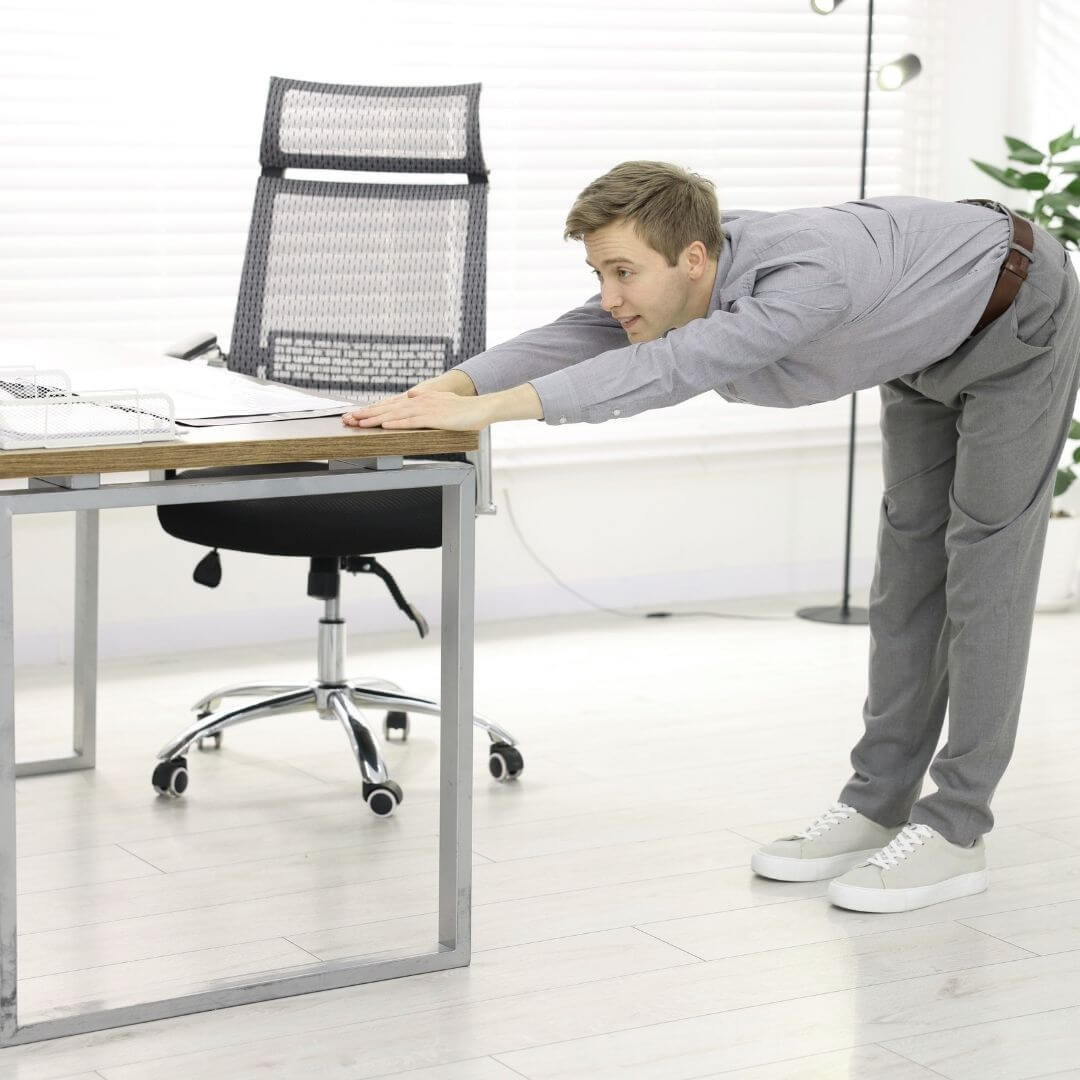
What Office Posture and Movement Training Actually Means
Office posture and movement training is supposed to address how people use their bodies during the workday. That sounds obvious, but it is often reduced to surface-level advice such as “sit up straight” or “remember to take breaks.” Employees already know those things. Knowing does not automatically change behaviour.
As explored in Why Information Alone Doesn’t Change Workplace Wellbeing, awareness without structure rarely produces sustained change in organisational settings.
A properly designed programme looks at daily patterns rather than single positions. It recognises that people do not sit badly because they are careless. They sit badly because they are absorbed in work, under pressure, or trying to meet deadlines. The posture that causes strain is usually the posture that allows them to focus.
Workplace posture and movement training that ignores that reality will feel disconnected from how work is actually done.
The difference between equipment advice and movement training is also important. Office ergonomics training for employees adjusts chairs, screens, and desks. That matters. But even with perfect ergonomics, a static body under sustained cognitive load will stiffen and fatigue. Movement training addresses variability,micro-adjustments that can be made without interrupting workflow or drawing attention to oneself in the middle of a meeting.
The most effective office posture and movement training does not try to turn employees into fitness enthusiasts. It does not ask them to suddenly adopt a new identity around movement. Instead, it works with the patterns that already exist in the workplace and introduces small, repeatable shifts that are realistic under pressure. That distinction is subtle but important, because HR teams are not purchasing inspiration. They are purchasing sustainable behavioural change.
Why One-Off Sessions Rarely Solve the Underlying Problem
There is nothing inherently wrong with a single workshop. A well-delivered 60 or 90 minute session can increase awareness and create a short burst of engagement. Employees often leave feeling looser, more alert, and temporarily motivated to move more during the day.
The difficulty is what happens after that initial lift fades.
Without reinforcement, most people return to familiar patterns within days. Work takes priority. Meetings stack up. The small intentions formed during the session dissolve under routine pressure. From an HR perspective, this creates a frustrating cycle where investment generates positive feedback in the moment but little measurable long-term change.
This drop-off pattern is one of the core reasons Why Most Corporate Wellness Programs Fail After the First Quarter, even when initial engagement is high.
If the aim of workplace posture and movement training is simply to demonstrate that the company values wellbeing, a workshop may be sufficient. If the aim is to reduce recurring discomfort reports and build physical resilience over time, a more structured format is usually required.
This is where HR teams should pause and ask what they are actually trying to achieve.
Clarifying the Objective Before Booking
Before contacting providers, it is worth defining the internal goal with precision. Is the organisation responding to specific complaints about back pain or neck strain, or is the concern broader, such as low energy levels and reduced afternoon focus? Is the training intended to support a larger corporate wellbeing programme, or is it a standalone intervention?
If the wider strategy is unclear, it may be worth revisiting What Is a Corporate Wellness Program? (And What It Usually Misses) before committing to a specific format.
Corporate posture training in the UK is often marketed under broad language such as “boost productivity” or “improve wellbeing.” Those phrases are attractive but vague. HR teams should ask for a clear explanation of how the programme links posture and movement to measurable workplace outcomes.
For a deeper look at how companies approach measurement, see ROI of Workplace Movement Programs: What Companies Actually Measure.
For example, does the training include simple tools for tracking daily movement habits? Does it provide guidance for managers so that micro-movement is culturally acceptable rather than awkward? Are there follow-up materials to reinforce learning beyond the live session?
If those elements are absent, the training may feel informative, but struggle to shift behaviour at scale.
This is often the dividing line between surface-level sessions and genuinely effective delivery, which is examined in detail in What Makes a Workplace Movement Programme Effective (and Why Most Fail).

Practicality Within a Real Office Environment
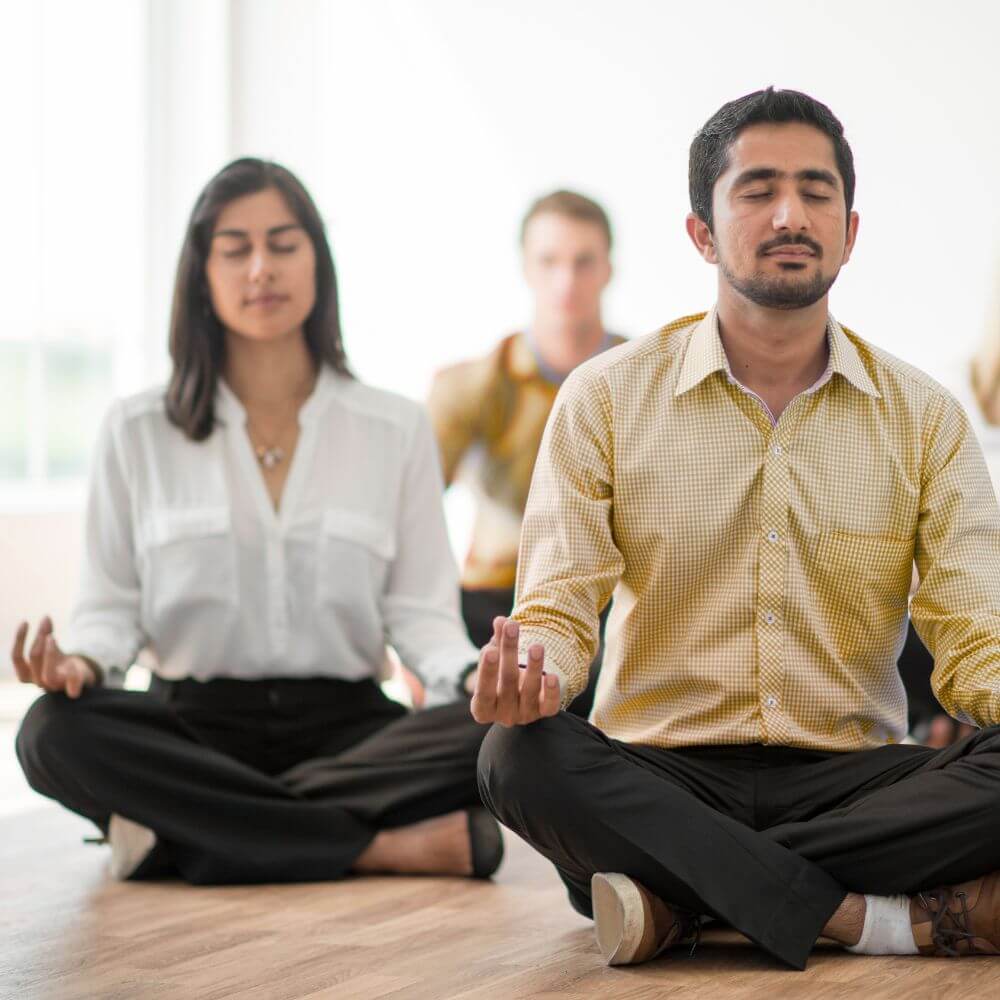
Another factor that deserves attention is practicality. Movement training for office staff must function within the constraints of the working day. Employees are unlikely to change into sports clothing, lie on the floor in a shared space, or engage in high-intensity sequences between meetings. If a programme requires conditions that do not exist in the office, adoption will be low regardless of how well it is delivered.
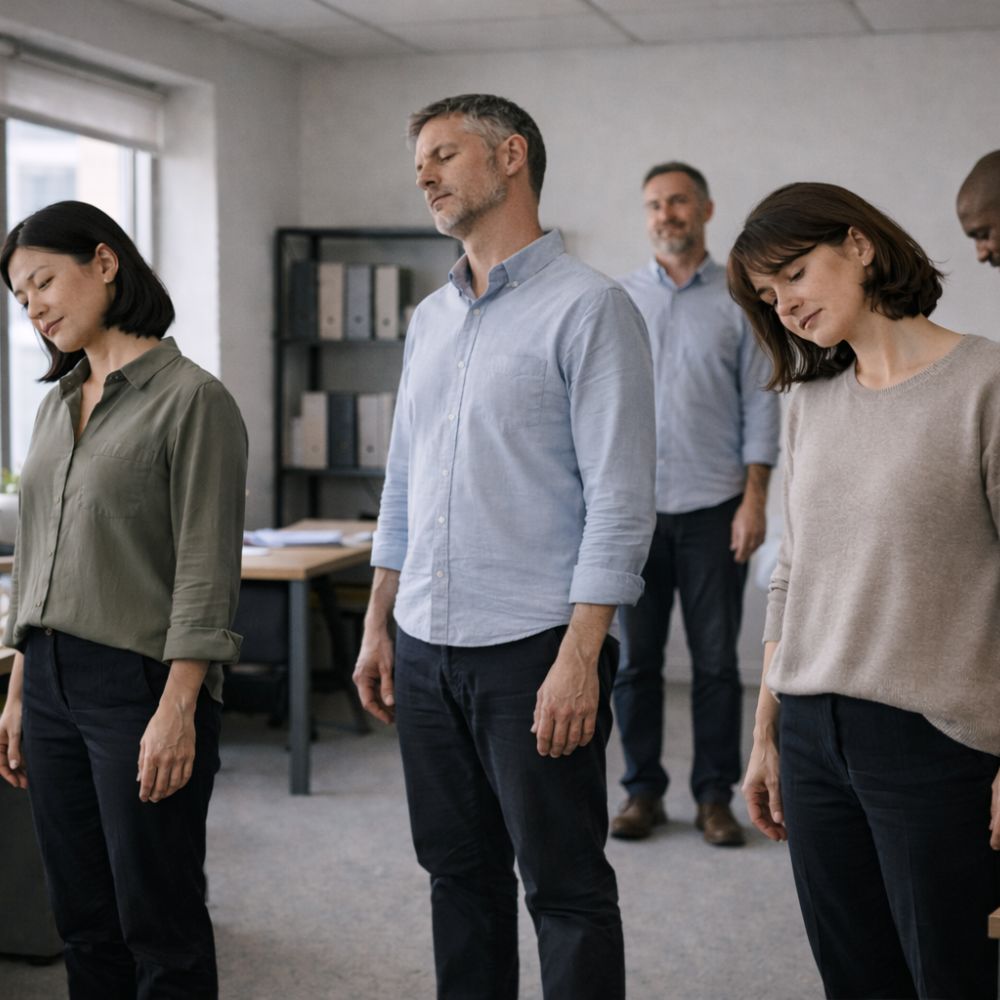
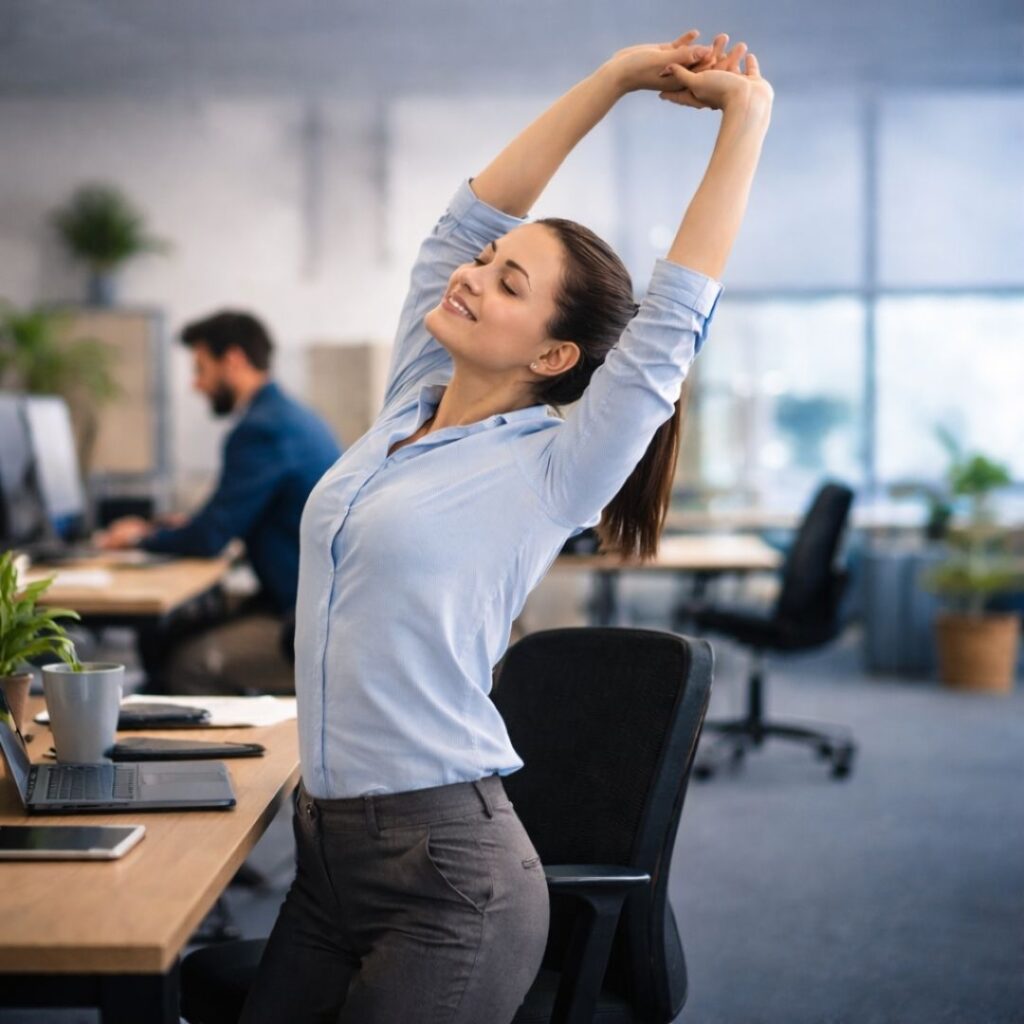
Effective office posture and movement training respects the fact that employees are in work attire, operating under time pressure, and sharing space with colleagues. It focuses on small, efficient adjustments that can be integrated discreetly and consistently. This might include structured standing transitions, breath-led resets that reduce upper body tension, or short mobility sequences that can be performed beside a desk without equipment.
HR teams should ask providers to describe a typical session in concrete terms. What does an employee actually do? How long does it take? How does it fit between two calendar blocks? If the answer sounds like a fitness class transplanted into an office, it may not be the right fit.
The Importance of Behaviour Design
Perhaps the most overlooked aspect of workplace posture and movement training is behaviour design. Employees rarely ignore posture advice out of laziness. They ignore it because it competes with more urgent tasks. Sustainable change requires cues, repetition, and social reinforcement.
A programme that addresses behaviour might include structured prompts tied to natural workday events, such as standing transitions after video calls or short mobility resets before long planning sessions. It may involve briefing managers so that they model participation, reducing any perception that movement during the workday is unprofessional.
HR teams evaluating office posture and movement training should look beyond the content of the exercises and examine how the provider approaches habit formation. Are there clear mechanisms for repetition and reinforcement, or is the expectation that motivation alone will carry the change forward?
Programmes built on motivation alone tend to fade. Programmes built on structure tend to embed.
Qualifications, Safety, and Professional Boundaries
Because posture and movement intersect with physical health, it is also important to clarify professional boundaries. A credible provider should be transparent about qualifications, insurance, and the scope of what the training can and cannot do. Office posture and movement training can reduce strain patterns and increase awareness, but it is not a substitute for medical assessment where injury is present.
HR teams should confirm that the provider is comfortable adapting movements for mixed-ability groups and is able to communicate clearly about safety. Corporate environments include employees with previous injuries, varying levels of fitness, and differing comfort with physical activity. Sensitivity and adaptability are essential.
Workshop or Programme: What Are You Actually Buying?
This is usually where things get fuzzy.
On paper, a one-off workshop and a structured multi-week programme can look similar. Both involve movement. Both promise improved posture. Both talk about energy and focus. The difference only becomes obvious once you think about what happens after the session ends.
A workshop is an intervention. It disrupts the day, delivers information, gets people moving, and creates a temporary shift in awareness. For some organisations, that is enough. It signals commitment. It starts conversations. It may even prompt a few individuals to change habits on their own.
A programme is something else entirely. It assumes that behaviour does not change because someone explained it well once. It builds repetition into the structure. It expects resistance, inconsistency, and competing priorities, and designs around them. It revisits key principles, tracks participation, and gradually makes movement feel normal rather than optional.
If you are comparing proposals, ask yourself a simple question: do we want a moment, or do we want a shift?
That question will usually clarify the format more honestly than any pricing sheet.
Workshop vs Programme: Side-by-Side Reality Check
If you are reviewing proposals, it helps to look at them practically rather than emotionally.
Here is what you are usually comparing:
| Evaluation Area | One-Off Workshop | Structured Programme |
|---|---|---|
|
Time Commitment |
60-90 minutes |
6-12 weeks |
|
Behaviour Reinforcement |
Minimal |
Built into delivery |
|
Follow-Up Material |
Sometimes |
Expected |
|
Cultural Integration |
Limited |
Planned |
|
Measurable Impact |
Hard to track |
Easier to measure |
|
Habit Formation |
Unlikely alone |
More realistic |
This is not about prestige. It is about expectations. If you want to introduce the topic, a workshop works. If you want to shift daily behaviour patterns, you need repetition. There is no magic in format. There is only structure.
Pre-Booking Checklist for HR Teams
Before confirming office posture and movement training, run through this internally:
- Do we know exactly why we are booking this?
- Are we expecting awareness or behaviour change?
- Does the format realistically fit within our working day?
- Are we comfortable with how success will be measured?
- Have we verified qualifications and insurance?
- Is leadership aligned and supportive?
- Is there reinforcement beyond the live session?
If you cannot answer two or three of those confidently, the issue is not the provider. It is clarity.
That clarity protects your budget and your credibility.
Deciding Without Overcomplicating It
There is no prestige in choosing the longer format if your objective is modest. Equally, there is little point in booking a single session if the underlying issue has been present for years.
If the company simply wants to introduce the topic of posture and movement and see how employees respond, a well-designed workshop can be a sensible first step. It is contained, visible, and relatively easy to schedule.
If the company is dealing with recurring complaints, low afternoon energy, or a culture where sitting for hours without pause is the norm, then expecting a single session to change that pattern is unrealistic. In those cases, structure matters more than novelty.
The decision becomes clearer when you remove the language of wellbeing and ask instead: what problem are we trying to reduce, and over what time frame?
Once that is clear internally, conversations with providers tend to become more direct. Instead of asking what they offer, you can describe what you need and assess whether their structure supports it.
What Happens Next?
Once you have defined your objective and chosen the right format, the next step is simple. Request a clear outline of the programme structure before booking.
You should be able to see:
- Session themes
- Progression across weeks (if applicable)
- Expected outcomes
- Measurement approach
- Practical requirements for your team
If that outline is vague, the delivery usually will be too.
If you are considering office posture and movement training for a desk-based team in Nottingham or the surrounding area, you can request a detailed breakdown of the Sit Happens 12-week structure, including session themes and integration model.
That allows you to assess fit before committing budget.
The Hidden Cost of Doing Nothing
One reason office posture and movement training gets delayed is that the problem rarely looks urgent. There is no single dramatic event that forces action. Instead, there is a slow accumulation of small issues: low-level discomfort, energy dips, slightly shorter attention spans in the afternoon, more frequent short-term absences that never quite connect back to physical strain.
From a budgeting perspective, this can make the issue easy to deprioritise. However, the cost of doing nothing is not zero. It shows up in reduced consistency, lower cognitive endurance, and subtle declines in morale. Employees who feel physically depleted by midweek are less likely to sustain high-quality output over time.
HR teams should therefore evaluate posture and movement training not only as a wellbeing initiative but as a preventative measure. The absence of crisis does not mean the absence of cost.


Leadership Visibility and Cultural Permission
Movement inside office environments is still culturally sensitive. In some organisations, standing up during a meeting or performing a brief mobility reset between calls feels normal. In others, it feels awkward or even unprofessional.
For office posture and movement training to have lasting impact, leadership visibility matters. If managers and senior staff model participation, even in small ways, it signals that movement is not a distraction from work but a support for it. Without that signal, employees may quietly avoid implementing what they have learned.
HR teams should therefore consider how leadership will be involved. A short internal briefing or visible participation during sessions can shift adoption rates significantly. Cultural permission often determines whether the training remains theoretical or becomes practical.
Adapting for Hybrid and Remote Teams
Hybrid working has complicated posture and movement patterns. Some employees split time between well-equipped office workstations and improvised home setups. Others work almost entirely remotely, often at kitchen tables or shared spaces not designed for prolonged sitting.
Effective workplace posture and movement training should acknowledge these realities rather than assume a uniform environment. The content should be adaptable across locations and not rely on specific office furniture or equipment.
When evaluating providers, HR teams should ask how the training translates to remote contexts. Are the strategies applicable in a small home workspace? Can sessions be delivered virtually without losing engagement? A programme that cannot flex across environments may struggle in hybrid organisations.
Aligning Movement Training With Broader Wellbeing Strategy
Office posture and movement training should not sit in isolation. It works best when aligned with broader corporate wellbeing efforts, such as mental health support, flexible working policies, and ergonomic improvements.
Physical strain and mental fatigue often interact. An employee under sustained cognitive stress is more likely to adopt rigid postures and forget to move. Similarly, chronic discomfort can reduce patience and emotional resilience. Integrating posture and movement training into an existing wellbeing framework strengthens its credibility and impact.
HR teams should consider how the programme connects to current initiatives. Does it complement ergonomic assessments? Does it support mental wellbeing campaigns by addressing physical energy regulation? When positioned as part of a coherent strategy rather than a standalone event, the training is more likely to be taken seriously across the organisation.
Final Thoughts
Office posture and movement training can contribute meaningfully to corporate wellbeing, but only when it is approached with the same clarity applied to other operational decisions. When objectives are defined, formats are matched to intention, and expectations are realistic, the programme has a far greater chance of producing steady improvement rather than a short burst of enthusiasm.
Frequently Asked Questions
Ergonomics focuses on how the workstation is set up. Posture and movement training focuses on how the employee uses their body throughout the day, regardless of how well the workstation is configured.
That depends on the goal. Awareness can be raised in a single session. Habit change typically requires repeated exposure over several weeks.
It can reduce common strain patterns and increase body awareness, but it is not a medical intervention and should not be presented as a cure.
Yes, provided it is adaptable and does not rely on specialist equipment or large physical spaces.
In most corporate environments, effective sessions are designed to work within standard professional attire.
Through feedback trends, participation levels, reported discomfort patterns, and alignment with broader wellbeing metrics already used within the organisation.
It is particularly relevant for desk-based roles, but principles can be adapted to other work settings.
Consistency tends to support behavioural change more reliably than intensity. Regular exposure, even if brief, usually embeds habits more effectively than isolated events.