
What Is Workplace Movement Training and Why Are Companies Booking It?
TL;DR
Workplace movement training is a practical form of employee wellbeing support that helps people move better during the working day. It usually includes simple mobility work, posture awareness, strength-based movement, breathing, nervous system regulation, and practical resets employees can use at their desks or in the workplace.
Companies are booking workplace movement training because sitting for long hours, screen fatigue, stress, poor posture, low energy, and reduced focus are becoming everyday problems in office-based teams. Unlike generic wellness talks or one-off wellbeing gestures, workplace movement training gives employees something physical, useful, and repeatable.
Done well, it is not a fitness class awkwardly dropped into the office like a confused burpee. It is structured, accessible movement training designed to help people feel better, work better, and recover from the physical load of modern work.
Definition: What is workplace movement training?
Workplace movement training is structured movement education delivered in a work setting to help employees reduce physical tension, improve posture, build mobility, support focus, and manage the effects of long periods of sitting or screen-based work. It may include desk-based resets, guided mobility, breathing, body awareness, simple strengthening, and practical tools employees can use during the working day.
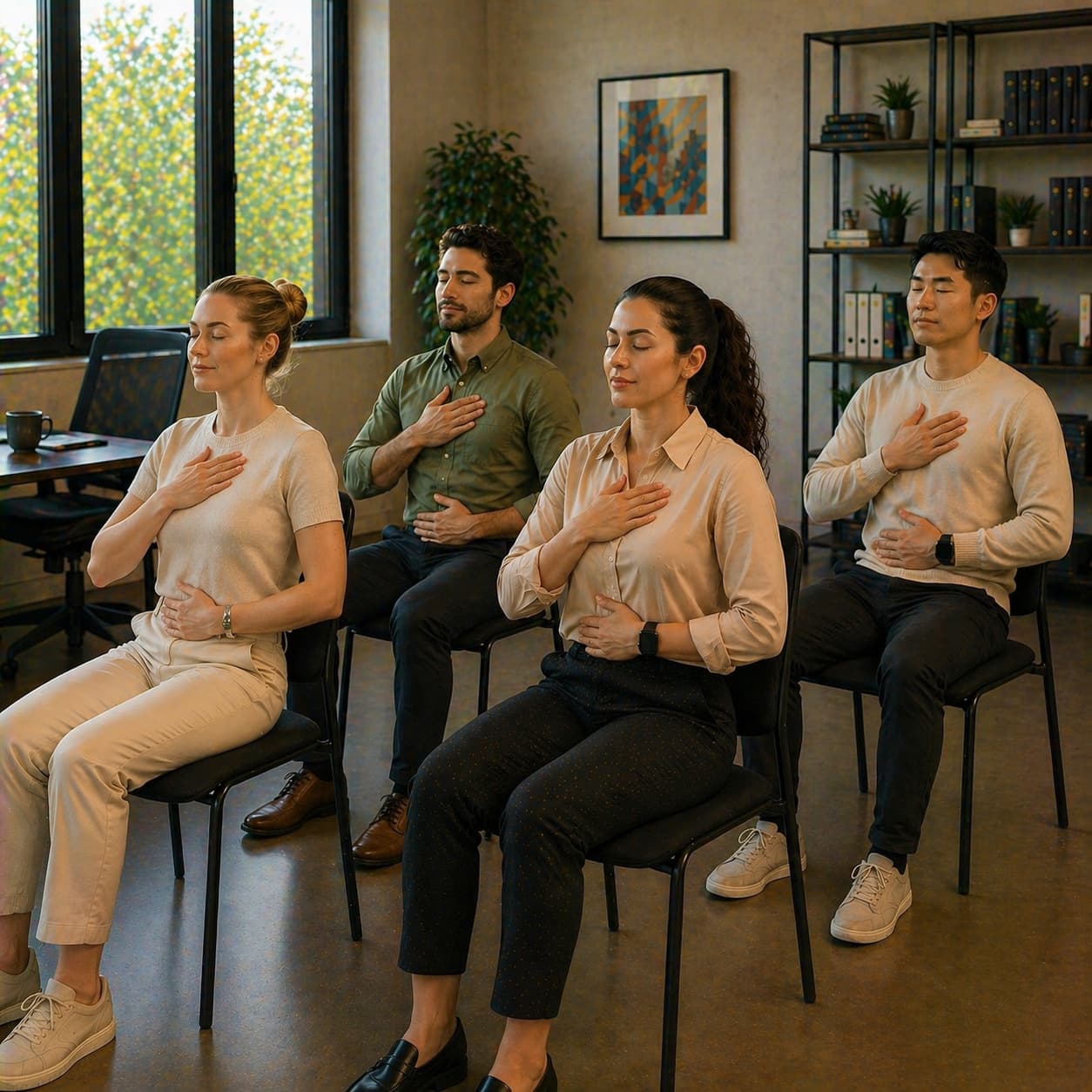
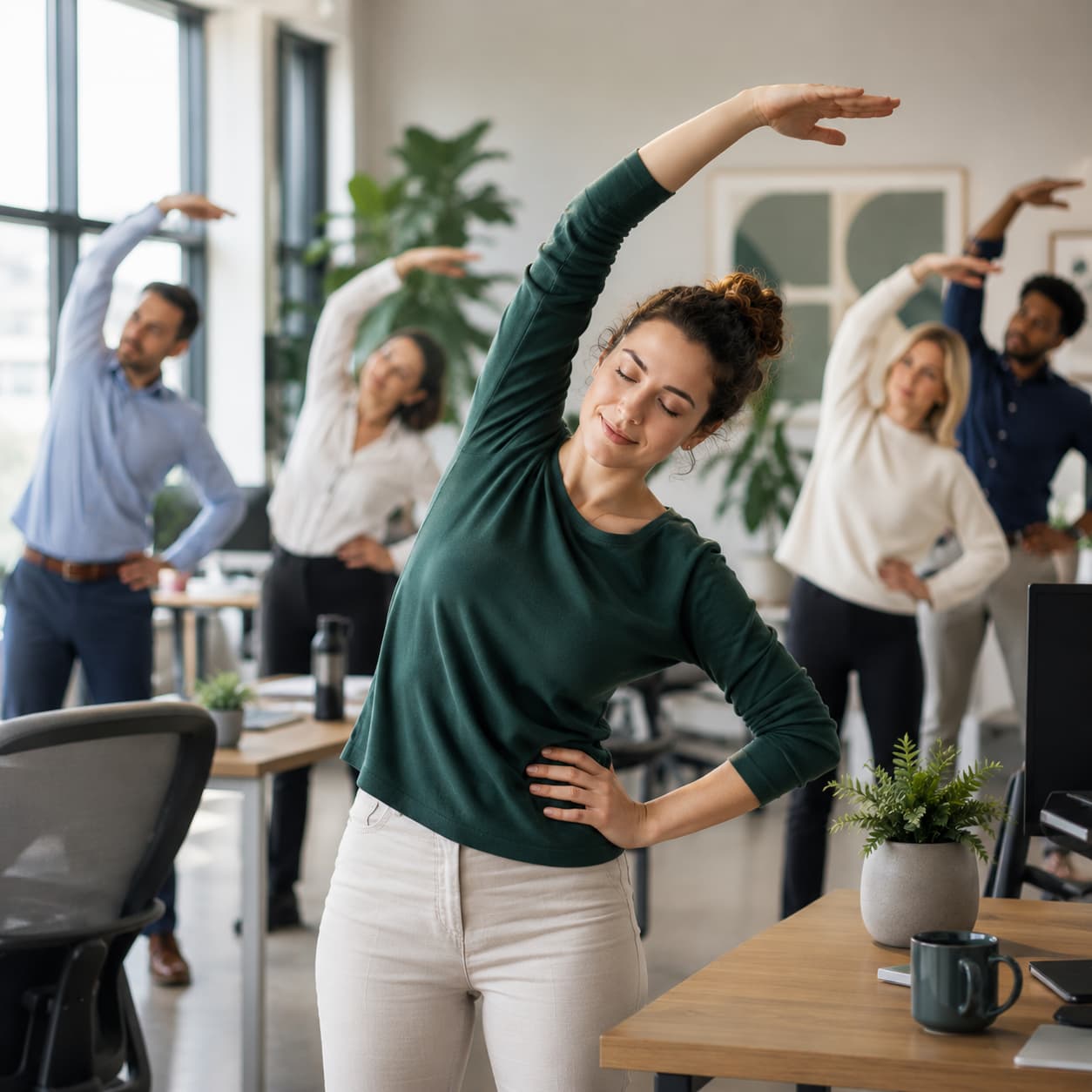
Why workplace movement training is becoming more relevant
Work has changed, but the human body has not magically upgraded itself to cope with eight hours of sitting, screen glare, shallow breathing, shoulder tension, calendar chaos, back-to-back calls, and the deeply glamorous posture of someone trying to answer emails while eating lunch over a keyboard.
Most modern work asks people to be still for too long.
Not still in the useful sense. Not grounded, calm, present stillness. More like collapsed stillness. Frozen stillness. The kind where the shoulders creep towards the ears, the spine folds into a question mark, the hips forget they exist, and the brain keeps trying to focus while the body quietly stages a protest.
This is one of the reasons workplace movement training is becoming more relevant.
Companies are beginning to understand that employee wellbeing is not only about mental health support, flexible working, fruit bowls, or occasional motivational talks from someone with a headset and a slide deck. Those things may have their place, but they do not fully address the physical reality of office work.
People are tired. They are stiff. They are distracted. They are carrying stress in their bodies.
They are sitting for long periods, moving less than they think, breathing shallowly, and using screens in positions the human skeleton did not exactly vote for.
Workplace movement training responds to that reality in a practical way. It gives employees simple, structured ways to move, reset, and understand their bodies during the working day. It does not require them to become gym people. It does not demand Lycra, spiritual enlightenment, or a sudden passion for wellness culture. It simply gives them usable tools.
That is why companies are booking it. Because the problem is not abstract. It is sitting in every meeting room, every open-plan office, every home-working setup, and every employee who says, “I’m fine,” while rotating their neck like a haunted owl.
Decision box: is workplace movement training right for your company?
| If your team is experiencing… | Workplace movement training can help by… | Best format |
|---|---|---|
|
Desk fatigue |
Teaching simple movement resets during the day |
Short workplace sessions or a 12-week programme |
|
Poor posture |
Building awareness of sitting, standing, breathing, and alignment |
Posture-focused movement training |
|
Low afternoon energy |
Using movement to support circulation, attention, and alertness |
Midday or early afternoon sessions |
|
Stress and tension |
Combining movement, breathing, and body awareness |
Practical wellbeing sessions |
|
Hybrid working strain |
Giving employees tools they can use at home or in the office |
Desk-based and office-based training |
|
Back-to-back meeting culture |
Teaching quick resets between calls and tasks |
Micro-movement training |
|
Sedentary working patterns |
Encouraging regular, accessible movement habits |
Ongoing workplace movement programme |
|
Generic wellbeing fatigue |
Offering something practical and physical |
Interactive group sessions |
Workplace movement training is not just office yoga
This is important because the phrase “workplace movement training” can easily get lumped into the same mental drawer as office yoga, lunchtime fitness, wellbeing workshops, chair stretches, or someone telling staff to breathe while everyone quietly worries about their inbox.
Workplace movement training may include elements from yoga, Pilates, mobility work, strength training, breathwork, posture education, and nervous system regulation, but it is not the same as simply running a fitness class at work.
A good workplace movement programme is built around the demands of the working day.
That means it looks at what employees are actually doing. Sitting for long periods. Working at screens. Holding tension in the neck and shoulders. Losing hip mobility. Shallow breathing. Moving from meeting to meeting without physical transition. Feeling mentally overloaded while physically underused. Experiencing low energy, poor concentration, and the strange late-afternoon sensation of being both wired and useless.
Workplace movement training works with those patterns.
It teaches people how to notice tension earlier. How to reset their posture without obsessing over perfect alignment. How to move their spine, shoulders, hips, wrists, and ankles in ways that counter the repetitive positions of desk work. How to use simple breathing and grounding tools to shift from stress into steadier attention. How to build movement into the working day without making it a whole bloody production.
That is the difference.
Office yoga can be lovely. Pilates can be excellent. Stretching can help. But workplace movement training is more specific. It is designed around work itself, not simply placed inside the workplace.
The aim is not to give employees a nice break and then send them back to the same physical patterns unchanged.
The aim is to help them understand how their body behaves during work and how to interrupt the patterns that leave them stiff, tired, tense, and mentally foggy.
Why companies are booking workplace movement training now
Companies are booking workplace movement training because the cost of sedentary, screen-based work is becoming harder to ignore.
That cost does not always show up dramatically. It is not always an injury, absence, or formal complaint. Often, it appears as low energy, reduced concentration, physical discomfort, irritability, afternoon slumps, stress accumulation, and employees who feel drained before the day is even over.
The workplace may look productive from the outside, but inside the bodies doing the work, things can be a bit of a mess.
People sit through long meetings with tight hips and rounded shoulders. They work at laptops on dining tables, sofas, kitchen counters, trains, hotel rooms, and occasionally setups that look like ergonomic crimes committed in broad daylight. They carry tension through the jaw, neck, back, wrists, and breath. They finish the day mentally tired but physically restless.
Companies are starting to realise that this matters.
Not because every employer has suddenly become a deeply enlightened guardian of spinal mobility, though wouldn’t that be charming. More realistically, because physical discomfort affects performance. Poor posture affects energy. Lack of movement affects focus. Stress held in the body affects mood, communication, resilience, and attention.
Workplace movement training is appealing because it is practical.
It does not ask employees to talk about their feelings in a circle if that is not appropriate. It does not rely on abstract wellbeing language. It gives people something they can do. A reset. A movement. A breathing pattern. A way to sit, stand, pause, stretch, mobilise, strengthen, and return to work with more physical awareness.
For companies, that makes it easier to justify.
It supports wellbeing, but it also supports focus, energy, workplace culture, and productivity. It feels less like a perk and more like maintenance for the human beings doing the work.
Which, frankly, should not be a radical concept.
The real problem: work is mentally active but physically passive
One of the strange things about modern work is that it can be mentally exhausting while physically inactive.
Employees can spend the whole day making decisions, solving problems, handling people, responding to messages, attending meetings, managing deadlines, switching tasks, absorbing information, and staying emotionally composed, while their bodies barely move beyond typing, scrolling, reaching for coffee, and occasionally walking to the printer as if it is a pilgrimage.
The brain is busy. The body is stuck. That mismatch creates problems.
The body is designed for movement, variation, load, rest, breath, and rhythm. It does not particularly thrive when held in one position for hours while the mind races through a hundred demands. Over time, that mismatch can contribute to stiffness, discomfort, fatigue, poor breathing patterns, reduced circulation, tension, and a general feeling of being disconnected from the body.
Workplace movement training helps close that gap.
It brings the body back into the working day in a structured and realistic way. Not by asking people to abandon their tasks and become wellness influencers between meetings, but by giving them practical ways to move and reset within the reality of work.
This might include:
- Short posture resets between meetings
- Shoulder and upper-back mobility
- Hip and spine movement after sitting
- Breath awareness during stressful periods
- Desk-based movement breaks
- Standing movement sequences
- Simple strengthening for postural support
- Guided relaxation or downregulation at the end of sessions
- Education around how physical habits affect energy and focus
The point is not to make the working day perfect. The point is to stop the body from being treated like an inconvenient chair accessory.
How workplace movement training supports posture
Posture is one of the most obvious reasons companies book workplace movement training, but it is often misunderstood.
Good posture is not about sitting rigidly upright like someone has threatened you with a ruler. It is not about holding one perfect position all day. In fact, trying to maintain one “correct” posture for hours can create its own problems.
The best posture is usually the next posture. In other words, the body needs variation.
Workplace movement training helps employees understand this. It teaches them that posture is not a fixed shape, but a relationship between awareness, strength, mobility, breath, environment, and habit.
A person may slump not because they are lazy, but because they are tired, unsupported, stressed, weak in certain areas, stiff in others, or simply unaware of how long they have been sitting in the same position. Workplace movement training addresses those patterns without turning posture into a moral failure.
This matters because people already carry enough shame about their bodies. They do not need someone wandering into the office to announce that their spine is a disaster and their chair is plotting against them.
Instead, workplace movement training can help employees notice:
- How they sit when concentrating
- How their shoulders respond to stress
- Whether they hold their breath during difficult tasks
- How long they stay in one position
- Where they feel stiffness after desk work
- How small movements can reduce tension
- How strength and mobility support better posture
- How to reset without needing a full workout
This kind of training is practical and kind. It does not demand perfection. It builds awareness. That is much more useful.
How movement improves focus and energy at work
Movement is not only about muscles and joints. It affects attention.
When employees sit for long periods without movement, energy can drop. The body becomes sluggish. The breath may become shallow. The mind can feel foggy. The afternoon slump arrives, takes off its coat, makes itself comfortable, and ruins everyone’s plans.
Workplace movement training uses movement to interrupt that pattern.
Even short periods of movement can help employees feel more alert, more present, and more physically awake. This does not need to be intense. In fact, workplace movement should usually be accessible and sustainable, not a surprise bootcamp in a meeting room.
Simple movement can help people shift state.
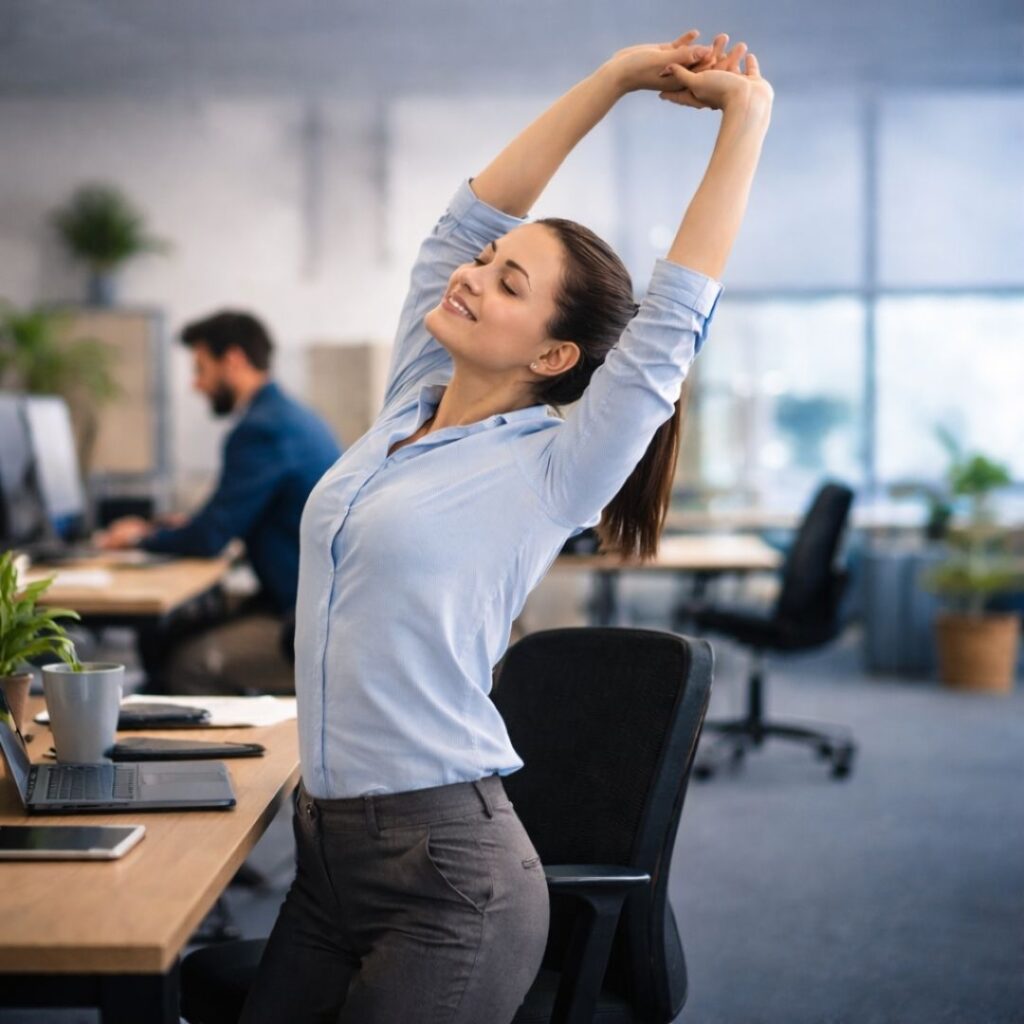
A few minutes of mobility can wake up the spine and shoulders. Standing movement can change circulation and energy. Breath-led movement can help calm an overactive nervous system. Gentle strengthening can create a sense of physical support. A short guided reset can help employees transition between tasks.
This is especially useful in offices where people move from one meeting straight into another without any physical pause. The brain may technically change topic, but the body has not been given a transition. It is still holding the last conversation, the last deadline, the last awkward Teams call where someone said, “Can everyone see my screen?” for the seventh time.
Movement creates a boundary.
It helps employees reset between tasks. It gives the nervous system a signal that something has shifted. It brings attention back into the body, which can make returning to work feel clearer.
This is why workplace movement training is not a fluffy extra. It supports the basic physical conditions needed for better focus.
Why workplace movement training supports employee wellbeing
Employee wellbeing is often discussed as though it exists mainly in the mind.
Stress, burnout, motivation, engagement, resilience, morale, mental health. These are all important, obviously. But wellbeing is also physical. The body is not just carrying the head around like an unpaid intern.
If someone is in pain, stiff, tense, exhausted, shallow-breathing, under-moving, and physically uncomfortable for most of the day, their wellbeing is affected. Their mood is affected. Their concentration is affected. Their tolerance is affected. Their ability to recover is affected.
Workplace movement training supports wellbeing by addressing the body directly.
It gives employees a way to release tension, build awareness, move more confidently, breathe more fully, and understand how physical habits influence how they feel at work. It also gives teams a shared experience that is not based on performance, competition, or forced vulnerability.
That matters.
Not everyone wants a wellbeing session that asks them to share deeply personal reflections with colleagues. Not everyone wants mindfulness delivered in a way that feels abstract or awkward. Not everyone wants high-intensity exercise. Workplace movement training can be a more accessible middle ground.
It is practical, embodied, and grounded.
People can participate at their own level. They can take away tools immediately. They can feel the difference in their own body, which is often more convincing than being told wellbeing matters via a 46-slide presentation and a branded water bottle.
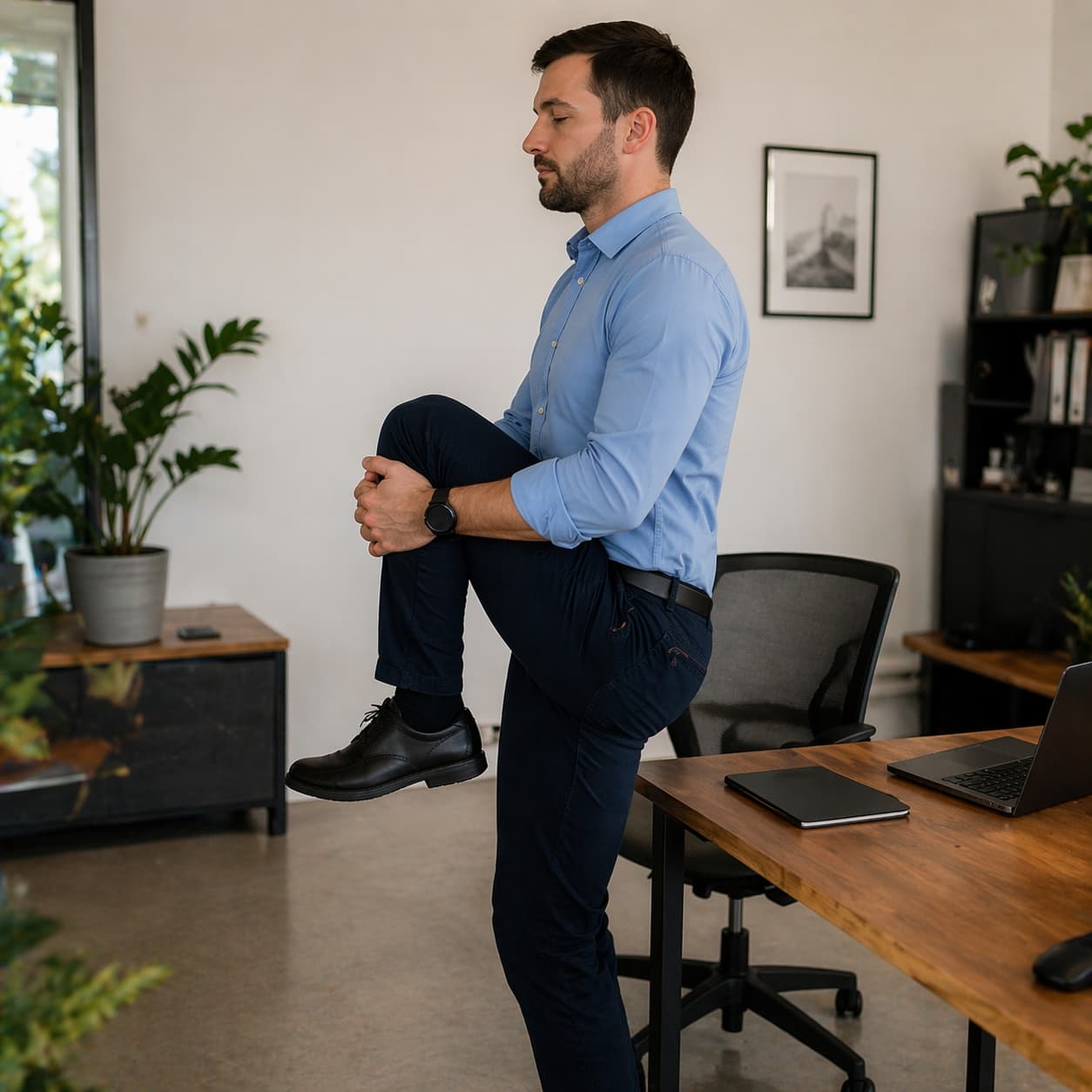
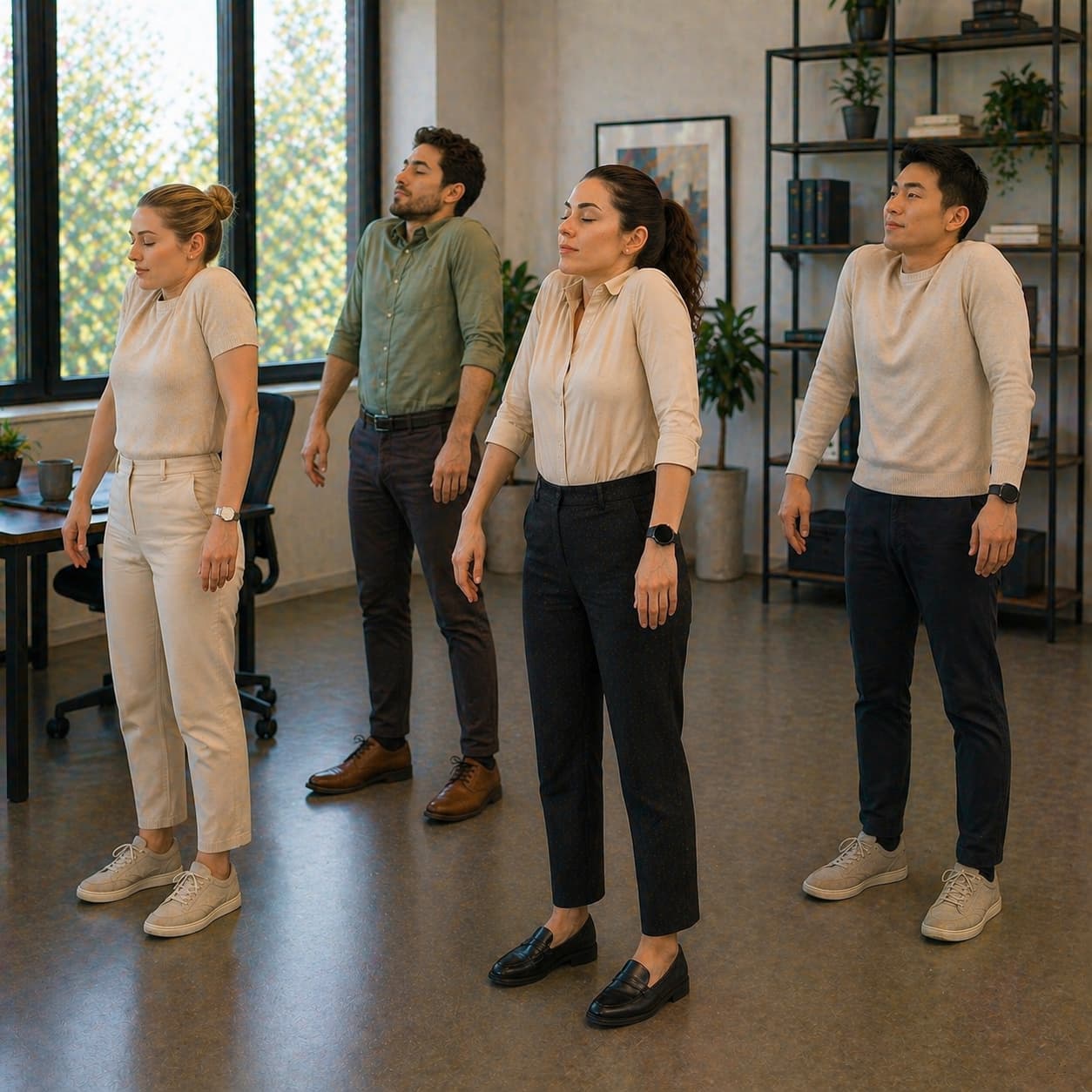
Workplace movement training is useful for hybrid teams too
Hybrid working has made workplace movement more complicated.
Some employees work from proper office setups. Some work from home offices. Some work from kitchen tables. Some work from sofas despite knowing full well that their neck will complain later. Some move between locations and never quite have a consistent ergonomic environment.
This means workplace movement training needs to be flexible.
It cannot assume everyone has the same chair, desk, screen height, commute, schedule, space, or energy level. Good workplace movement training gives employees principles they can use anywhere. For example:
- How to reset after sitting
- How to move the spine and hips in a small space
- How to reduce shoulder tension without equipment
- How to use breath to transition between tasks
- How to build short movement habits into the day
- How to notice early signs of physical fatigue
- How to adapt movement for different work environments
This is one reason companies are booking it now. Hybrid work has made the physical side of work more varied and often less visible. Employers may not see the employee hunched over a laptop at home, but the effects still show up in energy, focus, comfort, and stress.
Workplace movement training gives people tools that travel with them. That is more useful than only adjusting one desk.
What happens in a workplace movement training session?
A workplace movement training session should be practical, accessible, and relevant to the working day.
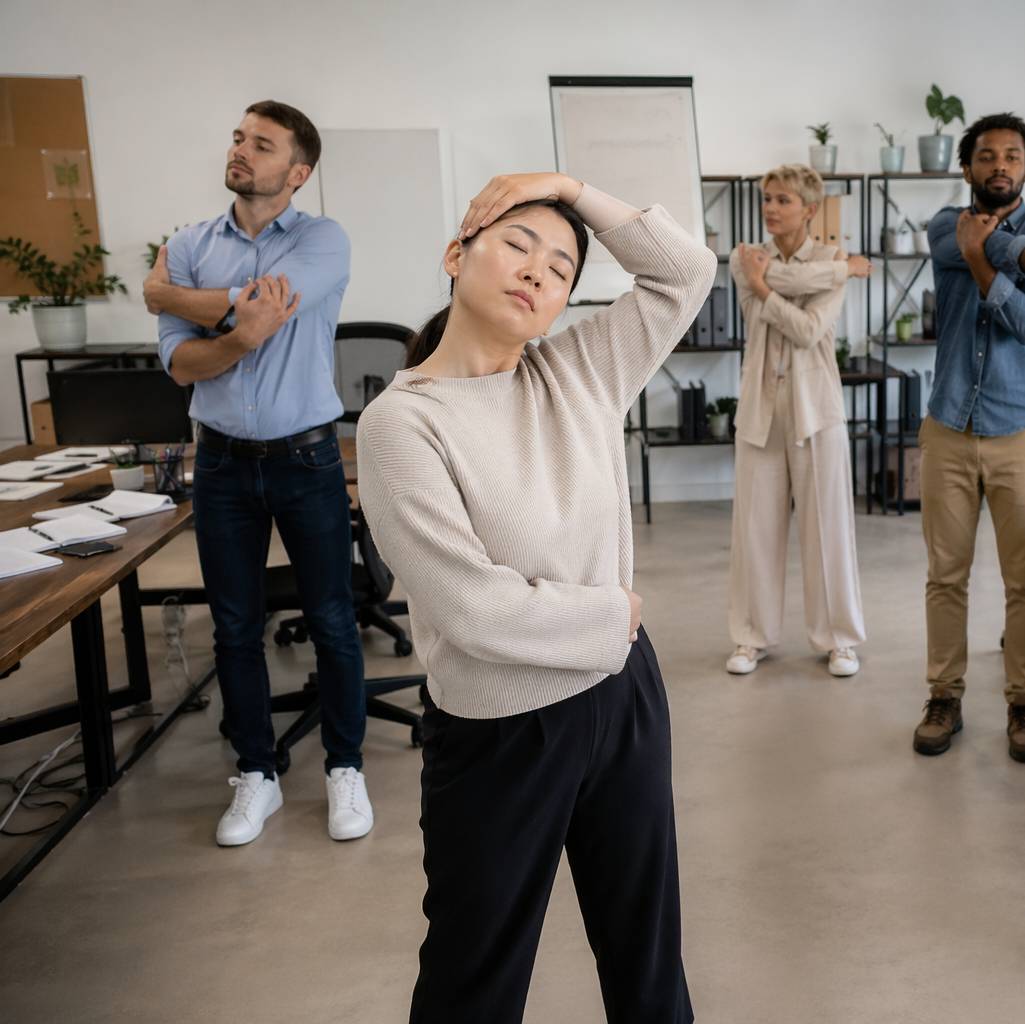
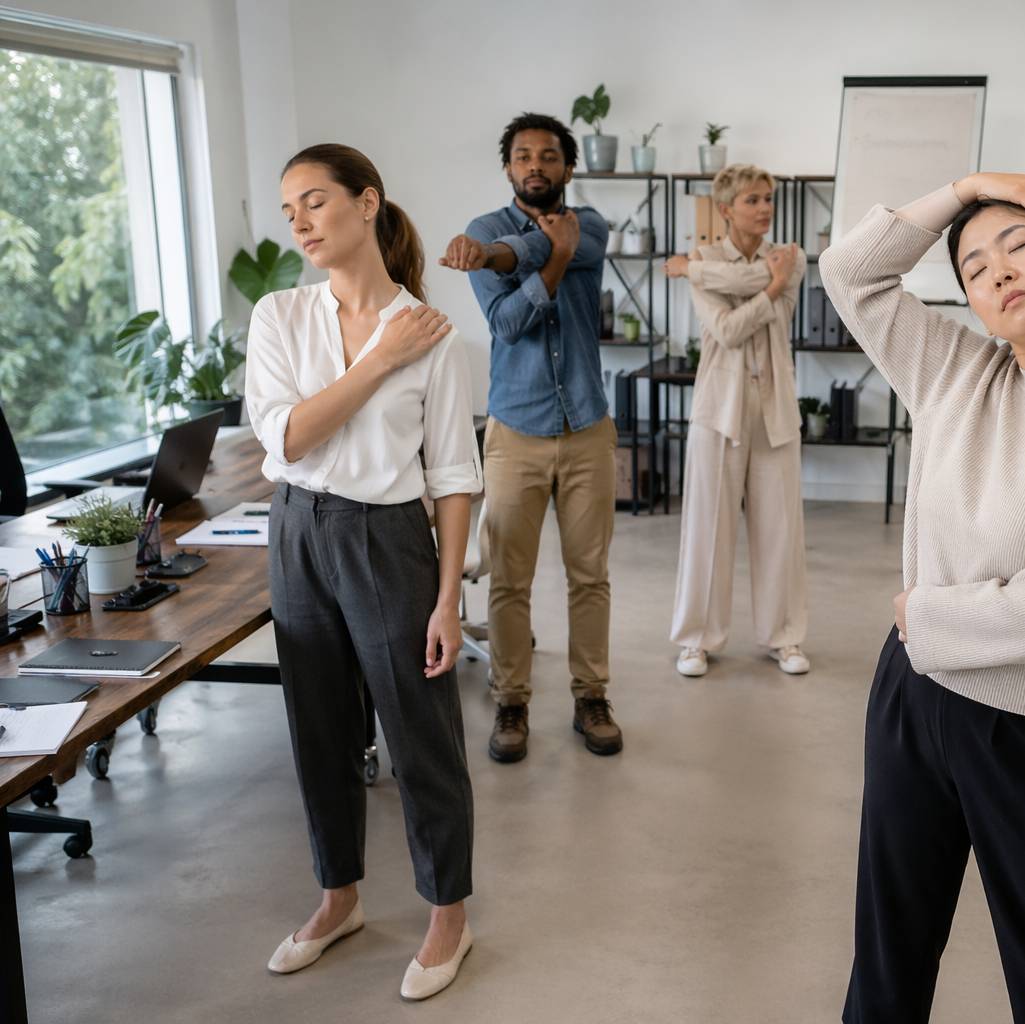
It may take place in a meeting room, office space, studio, conference room, breakout area, or workplace wellbeing setting. Employees do not need to be athletes. They do not need to be flexible. They do not need to arrive with a yoga mat unless the session has been designed that way.
A good session usually includes a combination of education and movement.
It might begin with a short explanation of the focus, such as posture, desk fatigue, shoulder tension, hip mobility, breathing, or afternoon energy. Then employees are guided through simple movements designed to address those patterns. The session may include standing work, seated resets, mobility, gentle strengthening, breathing, coordination, balance, or short relaxation.
The tone matters.
Workplace movement training should not feel intimidating, performative, or painfully earnest. People should not feel as though they have accidentally entered a fitness audition. The best sessions are structured but human. Clear, practical, inclusive, and grounded in what people actually need.
A session might include:
- A short physical awareness check-in
- Simple mobility for the neck, shoulders, spine, hips, wrists, or ankles
- Posture education without rigid correction
- Desk-based resets employees can repeat alone
- Standing movement to increase energy
- Gentle strengthening to support posture
- Breathwork to reduce stress and improve focus
- A short closing reset or relaxation
- Practical takeaways for the working day
The goal is not to exhaust people. The goal is to help them leave feeling clearer, more mobile, more aware, and better equipped.
One-off session or longer workplace movement programme?
Companies can book workplace movement training in different ways, and the right format depends on what they are actually trying to change.
A one-off session can be useful when a company wants to introduce the idea, support a wellbeing day, give staff something practical, or test whether workplace movement is a good fit for the team. It gives employees an immediate experience of moving differently during the working day, and it can be a very good starting point if the company has never offered anything like this before.
But a one-off session has limits.
It can give people useful tools, but it cannot build a habit by itself. Most employees already know they should move more, sit better, take breaks, breathe properly, stop hunching over their laptop like a Victorian clerk with Wi-Fi, and generally stop treating their body like a collapsible office accessory. Knowing is not usually the problem. Repetition is the problem. Integration is the problem. Remembering to do the useful thing when the inbox is on fire is the problem.
That is where a longer workplace movement programme becomes more valuable.
A structured programme gives employees time to learn, practise, repeat, and actually absorb the work. Instead of receiving a few useful movements once and then forgetting them by Thursday, they begin to understand their own patterns. They notice where they hold tension. They recognise how their posture changes when they concentrate. They learn how to reset before stiffness becomes discomfort, and how to use movement as part of the working day rather than as a separate wellness activity they have to squeeze in when they already feel knackered.
A longer programme also allows the work to build properly. The first session might focus on awareness, posture, and simple desk-based resets. Later sessions can introduce more mobility, breath, strength, coordination, balance, and recovery tools. Over time, employees are not just being told to move more. They are learning how to move in a way that supports their work, their energy, and their ability to stay physically present through the day.
This is why ongoing workplace movement training often creates more meaningful change than a one-off session. The one-off session opens the door. The programme helps people actually walk through it without immediately returning to their usual collapsed laptop goblin position.
A 12-week programme, for example, gives enough time to move from awareness into habit. Employees can begin with simple resets, then gradually build better mobility, stronger postural support, steadier breathing, and more confidence in using movement to manage fatigue, tension, and focus. The work becomes familiar enough to use, but not so repetitive that everyone starts silently praying for a fire drill.
One-off sessions can absolutely be useful.
But if a company wants workplace movement to become part of how employees look after themselves during the day, rather than a nice thing they did once in a meeting room, a longer programme will usually offer more value.
Because bodies do not change from one inspirational Wednesday.
Annoying, but true.
Comparison table: workplace movement training vs traditional workplace wellbeing
| Feature | Traditional wellbeing session | Workplace movement training |
|---|---|---|
|
Main focus |
Awareness, information, motivation or stress education |
Practical physical tools employees can use |
|
Employee experience |
Often passive or discussion-based |
Active, embodied and interactive |
|
Immediate benefit |
Depends on topic and delivery |
Employees usually feel physical difference quickly |
|
Relevance to desk work |
May be general |
Directly addresses sitting, posture, tension and fatigue |
|
Accessibility |
Can vary depending on format |
Can be adapted for different bodies and abilities |
|
Long-term value |
Stronger if followed up |
Stronger when repeated and built into habits |
|
Best for |
Education, policy support, awareness |
Physical wellbeing, focus, mobility and energy |
|
Risk |
Can feel abstract or tokenistic |
Needs skilled delivery to avoid feeling like random stretching |
|
Workplace fit |
Often delivered as talks or workshops |
Delivered as practical movement sessions |
|
Outcome |
Better understanding |
Better physical awareness and usable movement tools |
What companies should look for in a workplace movement provider
Not all workplace movement training is equal, and companies should be careful here.
Being able to teach yoga, Pilates, fitness, mobility, or strength work does not automatically mean someone can deliver well inside a workplace. A corporate setting is different from a studio, gym, or class environment. People may be dressed for work. They may be sceptical. They may feel awkward moving in front of colleagues. They may be tired, short on time, carrying injuries, worried about looking silly, or quietly hoping nobody asks them to do anything involving the floor.
A good workplace movement provider needs to understand all of that.
The session has to feel professional, clear, and safe without becoming stiff or patronising. It needs enough structure to reassure people, but enough humanity that the room does not feel like it has been trapped inside a HR initiative with laminated enthusiasm.
The provider should be able to explain why each part of the session matters in plain language. Employees should understand how the movement relates to sitting, posture, screen use, shoulder tension, breath, energy, or focus. If people can connect the movement to their actual working day, they are much more likely to use it again.
A strong workplace movement provider should offer clear structure, practical relevance, inclusive movement options, and confident delivery. They should understand posture and desk-based strain without turning the session into a lecture about everyone’s terrible sitting habits. They should be able to adapt for mixed abilities, offer alternatives without making anyone feel singled out, and create an atmosphere where employees can participate without feeling watched, judged, or dragged into a performance.
The best providers also understand that workplace movement is not about showing off exercises.
It is about helping people build physical awareness and usable habits. That means the teaching has to be intelligent, but not overcomplicated. Practical, but not dull. Calm, but not dead behind the eyes.
The right provider will make employees feel more capable in their own bodies, not embarrassed by them.
That balance matters.
Nobody wants to be spoken to like their shoulders are a corporate initiative.
Why companies are moving away from token wellbeing
Many companies have already tried wellbeing initiatives that looked good on paper but did not change much in practice.
A webinar here. A poster there. A wellbeing week. A mindfulness app nobody opens. A fruit bowl that somehow becomes both symbolic and depressing. These things are often well-intentioned, but employees can usually tell when wellbeing is being treated as something to announce rather than something to integrate.
This is one of the reasons workplace movement training is becoming more appealing.
It is tangible.
Employees do not have to believe in a theory before they benefit from it. They can feel the difference in their own body. They can notice that their shoulders move more easily after a few minutes of guided mobility. They can feel their breath change. They can recognise how much tension they were holding. They can learn a reset they can use before a meeting, after a long call, or when they have been sitting for too long and their spine has started quietly filing a complaint.
That immediacy matters. It makes the support feel real.
Workplace movement training does not pretend to solve every problem inside a company. It will not fix unmanageable workloads, poor leadership, unclear expectations, or the fact that some meetings should have been emails and some emails should have been quietly buried at sea. But it does give employees something practical they can use during the working day.
That is the difference between token wellbeing and useful wellbeing. Token wellbeing says, “We care,” and hopes the poster does the heavy lifting. Useful wellbeing gives people something that actually helps.
How workplace movement training supports company culture
Workplace movement training can support company culture, but not in the forced team-building way that makes everyone want to hide in the toilets until the facilitator leaves.
A good session creates a shared pause. It gives employees permission to step out of constant cognitive demand and reconnect with the body they have been dragging through meetings, deadlines, screens, and task-switching all day. That may sound simple, but in many workplaces it is quietly radical.
Most office cultures reward stillness, but not the useful kind. They reward sitting through discomfort, pushing through fatigue, ignoring tension, staying available, and treating physical needs as interruptions. Workplace movement training challenges that without making a grand dramatic speech about it. It simply makes movement normal.
That normalisation matters.
When employees are encouraged to stand up, reset, breathe, move their shoulders, change position, or take two minutes between tasks, the workplace starts to send a different message. It says that bodies are not a nuisance. They are part of how people work well.
This can be especially valuable in teams under pressure. A movement session can become a reset point in the week. It can help people transition out of stress patterns, release some physical tension, and return to work with more steadiness. It can also create a shared experience that is not based on performance, competition, forced vulnerability, or pretending to enjoy an icebreaker.
The cultural benefit is not that everyone suddenly becomes a wellness person.
The benefit is that movement becomes ordinary. And ordinary is where habits actually live.
What workplace movement training can and cannot do
It is important to be realistic about workplace movement training, because overselling wellbeing is part of the reason people stop trusting it.
Movement is useful, but it is not magic. It cannot compensate for chronic understaffing, poor management, impossible workloads, toxic culture, or a workplace where people are expected to be constantly available like emotionally exhausted vending machines.
If the wider work environment is unhealthy, movement training should not be used as a shiny distraction from that. Employees are not stupid. They know the difference between genuine support and a company handing them a breathing exercise while leaving the actual pressure untouched.
That said, workplace movement training can make a meaningful difference within its proper scope.
It can help employees feel more physically aware. It can reduce everyday tension. It can support posture, mobility, energy, focus, and breath. It can give people simple tools for managing the physical strain of long sitting hours and screen-based work. It can help teams build healthier movement habits during the working day.
It works best when companies treat it as part of a wider wellbeing approach, not as a decorative perk.
That means sessions should be scheduled at sensible times, not squeezed into the day like an apology. Leaders should support participation. Employees should not feel guilty for attending. The training should connect to the real demands of the workplace, and where possible, it should be repeated often enough for the tools to become familiar.
When those conditions are in place, workplace movement training can be genuinely valuable. Not because it fixes everything. Because it addresses something real.
Practical checklist before booking workplace movement training
| Question | Why it matters |
|---|---|
|
What physical challenges are employees experiencing? |
This helps shape the session around real needs rather than vague wellbeing language |
|
Are staff mostly office-based, hybrid, remote, or mixed? |
The format should reflect how and where people actually work |
|
Do employees need posture support, stress reduction, energy resets, or mobility? |
A clear focus makes the session more useful |
|
Is this a one-off session or part of a longer wellbeing plan? |
This determines how much depth and progression the training can offer |
|
When is the best time in the working day? |
Midday or early afternoon sessions may support energy, focus, and physical reset |
|
Is the space suitable for movement? |
Sessions can be adapted, but space affects what can be taught comfortably |
|
Will employees need mats or equipment? |
Many workplace sessions can be delivered without equipment, which makes participation easier |
|
How will the company encourage attendance? |
Participation improves when employees know the session is genuinely supported |
|
Will employees receive practical takeaways? |
Simple tools help the benefits continue after the session |
|
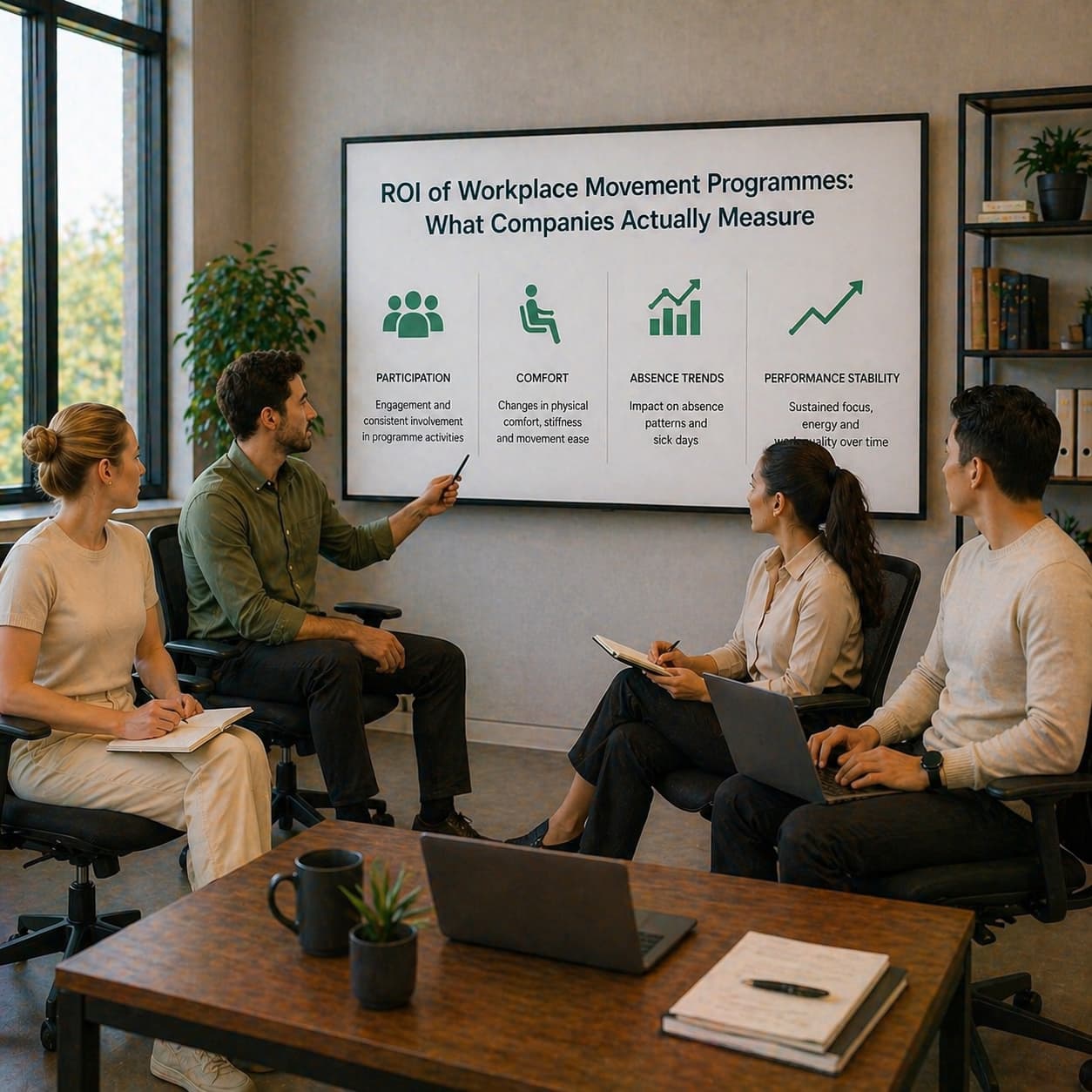
How will success be measured? |
Feedback forms, attendance, comfort, energy, focus, and posture awareness can all be tracked |
Why Sit Happens was built around this problem
Sit Happens was built because modern work does something very odd to people.
It asks them to be alert while physically collapsed. Productive while tense. Focused while under-moving. Calm while overstimulated. Present while sitting in the same position for hours and pretending that a five-minute walk to refill a water bottle counts as a complete relationship with the body.
That is not a personal failing. It is a design problem.
Most office work is built around the assumption that the body can be parked for long stretches while the brain does all the useful labour. But the body is not separate from focus, energy, communication, stress, or performance. When people are stiff, tense, shallow-breathing, tired, and physically disconnected, that affects how they work.
Sit Happens is designed to make workplace movement practical, intelligent, and accessible.
It combines structured movement, posture awareness, mobility, simple strength, breathing, and calm resets in a way that fits real working environments. It is not about turning the office into a gym. It is not about forcing employees into performative wellness. It is not about pretending one session will undo years of desk-based strain while everyone smiles politely and goes back to their laptops.
It is about giving people tools they can actually use.
The programme can be delivered as an introductory session, a workplace audit, or a structured programme. The focus is always the same: helping employees move better, feel better, and work with more physical awareness during the day.
Because if people are expected to sit, think, decide, communicate, solve, lead, write, manage, listen, respond, and produce for hours at a time, their bodies need support.
That should not be controversial. It should be basic maintenance.
Final thoughts: workplace movement training is practical wellbeing
Workplace movement training is becoming more relevant because it meets a real need.
People are not just mentally tired at work. They are physically shaped by how work is designed. Long sitting hours, screen use, poor posture habits, stress, shallow breathing, and lack of movement all influence how employees feel and function.
Companies are booking workplace movement training because it offers something practical. It helps employees understand their bodies, interrupt tension, improve mobility, reset energy, and return to work with more awareness. It gives them tools they can use during the day, not just ideas they are expected to remember when they are already overwhelmed.
That is why it works.
Not because it is trendy.
Not because it looks good on a wellbeing calendar.
Not because everyone secretly wants to do shoulder circles next to the finance team.
It works because modern work often asks human bodies to behave like office furniture.
And, unsurprisingly, bodies object.
If your team spends long hours sitting, working at screens, moving between meetings, and dealing with the physical strain of modern office life, workplace movement training can help.
Sit Happens is a structured workplace movement programme designed to support posture, mobility, energy, focus, and employee wellbeing through practical, accessible movement.
Explore Sit Happens: https://vikithorbjorn.art/sit-happens/
Enquire about workplace movement training: https://vikithorbjorn.art/movement/
Key takeaway
Workplace movement training helps employees improve posture, mobility, focus, energy, and physical awareness during the working day. Companies are booking it because office work creates real physical and mental strain, and practical movement support is becoming a more useful wellbeing investment than another PDF about stress management nobody opens.
Frequently Asked Questions
Workplace movement training is practical movement support for people who spend a lot of their working day sitting, typing, looking at screens, moving between meetings, or holding tension without realising it. It usually includes simple mobility work, posture awareness, breathing, desk-based resets, gentle strengthening, and movement tools employees can use during the day without needing gym clothes, equipment, or a personality transplant.
Companies are booking workplace movement training because office work takes a real physical toll. Long sitting hours, screen use, shallow breathing, shoulder tension, back stiffness, low energy, and poor movement habits all affect how people feel and function at work. A good session gives employees something practical they can actually use, instead of another wellbeing message that sounds lovely and then disappears into the corporate fog.
No. It can include elements of yoga, Pilates, mobility, breathwork, posture education, and simple strength work, but workplace movement training is built around the reality of the working day. The focus is not on doing a yoga class in an office. The focus is helping people move better, sit with more awareness, reset between tasks, and reduce the physical strain of desk-based work.
It is suitable for office-based teams, hybrid workers, leadership teams, school staff, desk-heavy departments, and employees who spend long periods sitting or working at screens. It is also useful for teams under pressure, because physical tension and mental load tend to travel together, usually without asking permission.
No. Workplace movement training is not about being bendy, sporty, strong, or impressively coordinated. It should be accessible for mixed groups, including people who feel nervous about movement or have not exercised for years. The aim is to help employees feel more aware, more mobile, and more supported in their own bodies, not to turn the meeting room into a fitness test.
Yes, but not by forcing everyone into one perfect sitting position. Good posture is not about sitting like a Victorian child trying to impress a piano teacher. It is about awareness, variation, strength, mobility, breathing, and changing position before the body starts complaining. Workplace movement training helps employees notice their habits and use simple resets to support better posture through the day.
It can help, yes. Movement gives the body and brain a reset, especially during long periods of screen work or back-to-back meetings. Even a few minutes of guided movement can help employees feel more awake, less stiff, and more present. It will not fix a ridiculous workload, obviously, but it can make the working day feel less physically and mentally jammed.
A session can be 45, 60, or 90 minutes depending on the company’s needs. A shorter session works well as an introduction or wellbeing-day activity. A 90-minute session allows more time for assessment, education, movement, and practical takeaways. A longer programme, such as a weekly 12-week structure, is better if the company wants the work to become a habit rather than a nice thing everyone did once and then forgot.
Yes. In fact, hybrid teams often need it because people are working from different setups, and some of those setups are frankly crimes against the spine. Workplace movement training can teach tools employees can use at home, in the office, or between locations, including desk resets, mobility breaks, breathing tools, and ways to interrupt long sitting periods.
A company should look for someone who understands movement, but also understands workplace reality. The provider needs to teach clearly, adapt for mixed abilities, avoid making people feel awkward, and explain how the movement relates to sitting, screens, posture, tension, focus, and energy. It should feel professional and practical, not like random stretching with a corporate lanyard.
The simplest way is to ask employees before and after the session about tension, energy, focus, posture awareness, and whether they feel able to use the tools again. For a longer programme, companies can track attendance, feedback, repeated use of movement resets, changes in reported discomfort, and whether employees feel more confident managing physical strain during the working day.
Yes, especially if the team spends long hours sitting, working at screens, or carrying high levels of stress. Small teams can often benefit quickly because the sessions feel more personal and easier to adapt. It does not need to be a huge corporate production with branded water bottles and someone saying “wellbeing journey” too many times. It can simply be useful, practical support for the people doing the work.