
How Large Should Artwork Be Above a Sofa? Complete Guide
TL;DR
Artwork above a sofa should usually measure around 60-75% of the sofa’s width, but good proportion is about more than numbers. The right artwork balances the room, creates atmosphere and gives the space a clear focal point. Most homeowners don’t buy artwork that’s too large. They buy artwork that’s too small.
The Wall Above Your Sofa Is Probably the Most Important Wall in Your Home
Walk into almost any living room and your eyes are drawn to one place before anything else.
The wall behind the sofa.
Whether we realise it or not, it’s usually the visual centre of the room. It’s where conversations happen, where people relax after work, where friends gather and where family photos are taken. It’s also the wall that quietly determines whether a room feels finished or as though something is missing.
That’s why choosing artwork for this space matters more than choosing artwork almost anywhere else. Yet it’s also where people hesitate the most.
I’ve lost count of the number of conversations I’ve had with people who knew they wanted a statement piece but were convinced it would be “too much”. They’d spent months renovating a room, investing in beautiful flooring, lighting and furniture, only to become nervous when it came to the artwork.
Not because they couldn’t find something they liked. Because they were worried about choosing the wrong size. Interestingly, almost nobody worries that their sofa is too big for the room. Or that their dining table makes too much of a statement.
But artwork feels different because it carries emotion as well as function. It isn’t simply another object. It’s often the final decision that gives a room its personality, and that makes people understandably cautious. Ironically, caution is usually what causes the problem.
The biggest mistake I see isn’t people choosing the wrong artwork. It’s people choosing artwork that’s far too small.
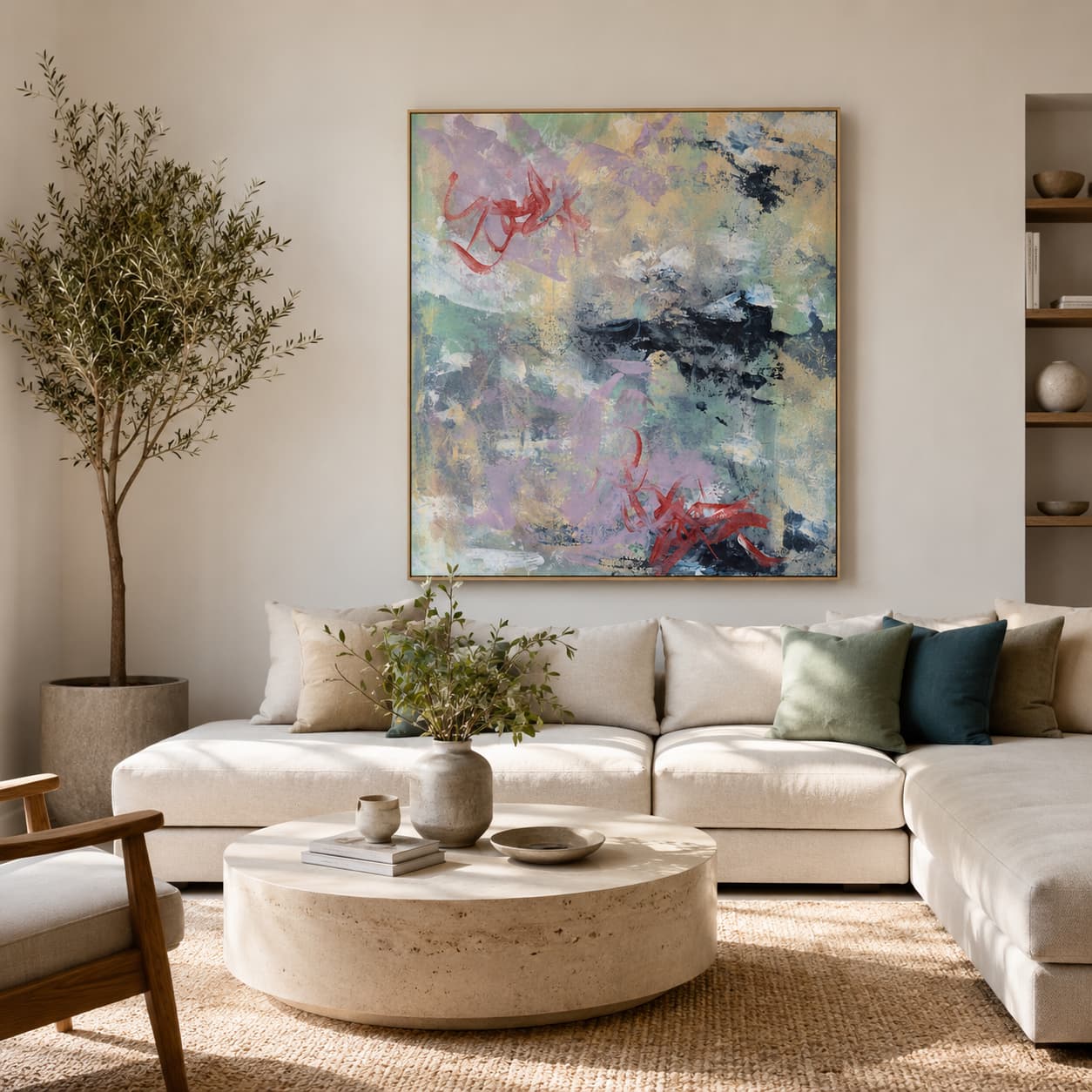
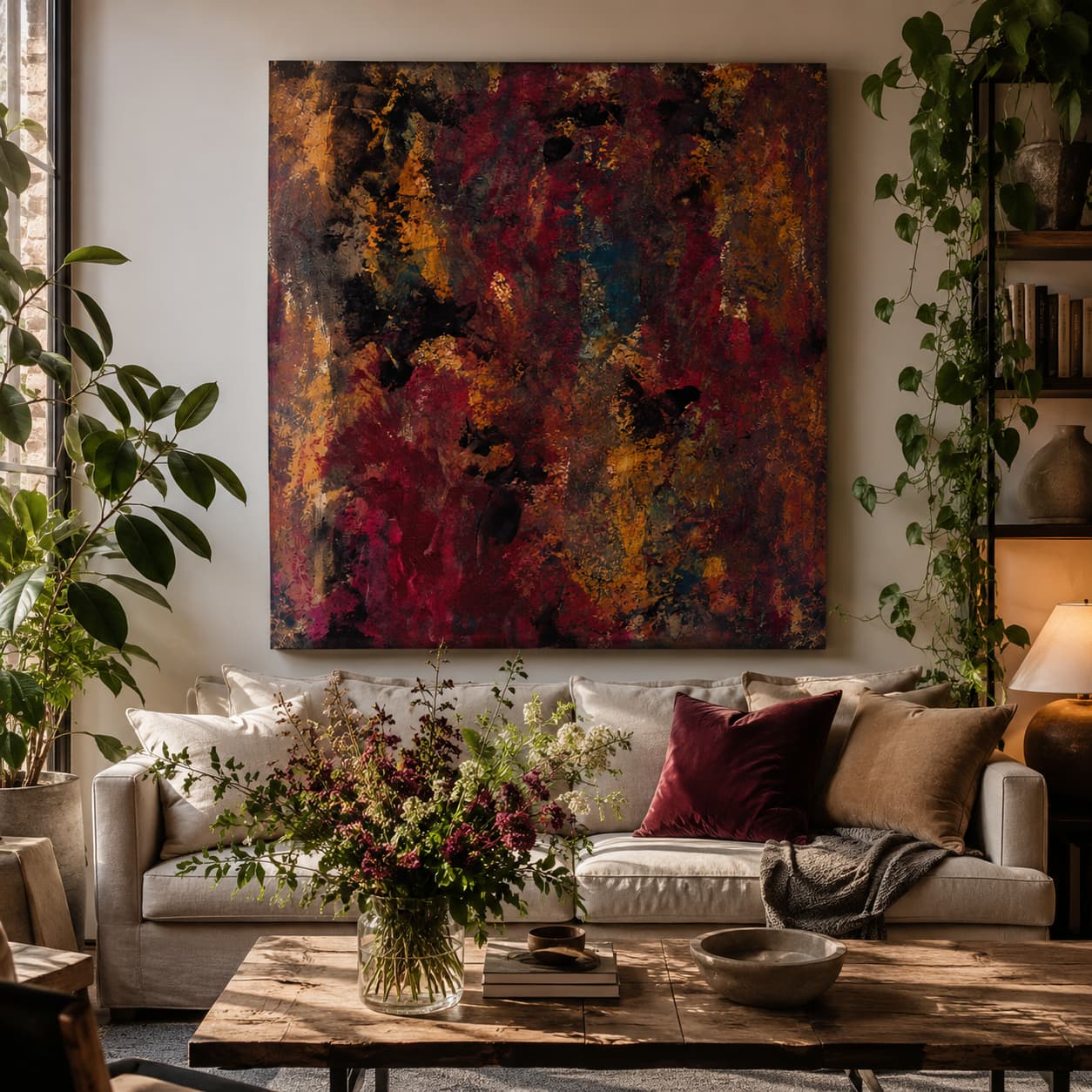
Why Most People Buy Artwork That's Too Small
I don’t think this is really about interior design. I think it’s about psychology.
Large artwork feels like a commitment. It’s more noticeable. It’s more expensive. It asks you to make a confident decision. So instead, many people compromise. They choose the smaller size because it feels safer.
The problem is that your living room doesn’t judge artwork by how expensive it was or how nervous you felt buying it. It judges it by proportion.
A beautiful painting that’s too small doesn’t suddenly become a focal point because it cost £2,000. Equally, a large canvas doesn’t dominate a room simply because it measures 150 centimetres across.
Rooms respond to balance. That’s why people often tell me the same thing after installing a large canvas from my Collector’s Vault.
“I thought it might feel overwhelming.” Then, a few weeks later… “I can’t imagine this wall with anything smaller now.”
I’ve genuinely never had someone contact me to say the artwork felt too ambitious because it was correctly proportioned to the room.
I have, however, spoken to plenty of people who wished they’d been braver. Sometimes the room had been waiting for that scale all along.
The Guideline That Interior Designers Use
There isn’t a perfect mathematical formula.
-
- Every room is different.
- Ceiling height matters.
- Natural light matters.
- The depth of your sofa matters.
- The architecture matters.
But there is one guideline that’s stood the test of time because it works surprisingly well. Choose artwork that’s approximately 60% to 75% of the width of your sofa. For example:
| Sofa Width | Recommended Artwork Width |
|---|---|
|
170 cm |
100-125 cm |
|
180 cm |
110-135 cm |
|
200 cm |
120-150 cm |
|
220 cm |
130-165 cm |
|
250 cm |
150-185 cm |
|
280 cm |
170-210 cm |
Don’t treat those numbers as rules. Treat them as a starting point.
I’ve seen slightly smaller pieces work beautifully because the room had lower ceilings and intimate proportions. I’ve also seen enormous canvases work in relatively ordinary living rooms because the scale simply made sense.
Measurements are there to guide you. Your eyes make the final decision.
An Artist Thinks About Scale Differently
One thing people often assume is that artists start with a blank canvas and simply paint whatever they feel.
Sometimes that’s true. But when I’m deciding which pieces belong in the Collector’s Vault, scale is one of the first things I think about. Not because bigger is automatically better. Because artwork doesn’t live in a studio.
It lives in someone’s home.
A painting changes the moment it leaves the easel.
Suddenly it has to sit above a sofa, opposite a dining table or at the end of a long hallway. It has to work with natural light in the morning, lamps in the evening and furniture that I will never actually see.
That’s why I don’t think of scale as a number. I think of it as a relationship. The relationship between the artwork and the room. The relationship between colour and light. The relationship between empty space and visual weight.
When those relationships feel right, people stop noticing the measurements. They simply say the room feels better. That’s always the goal.
Buying for the Wall or Buying for the Feeling?
Here’s something that’s rarely discussed.
People often believe they’re buying artwork for a wall. They’re not. They’re buying it for a feeling.
Nobody walks into their living room hoping to think, “That canvas is 140 centimetres wide.” They want to feel calm. Inspired. Grounded. Curious. Welcomed.
The dimensions simply allow the artwork to create that experience. That’s one of the reasons I rarely encourage people to begin with colour. Or price. Or even style.
I usually ask a much simpler question. How do you want this room to feel when you walk into it? Because once you know the answer to that, choosing artwork becomes infinitely easier.
Why Size and Scale Are Two Different Things
This is where many buying guides fall short. They talk about measurements, but they ignore scale. At first glance, those two words sound interchangeable, but they’re not.
Size is objective. A canvas that’s 150 cm wide is always 150 cm wide. Scale is emotional. It’s about how that artwork relates to everything around it. The same painting can feel enormous in one room and surprisingly restrained in another. Nothing about the artwork has changed. The room has.
That’s why choosing artwork isn’t simply a case of reaching for a tape measure.
Imagine two homes.
The first is a Victorian terrace with lower ceilings, darker walls and a cosy sitting room. The second is a contemporary new-build with double-height glazing, an open-plan kitchen and ceilings stretching well above three metres.
Hang the same 150 cm canvas in both rooms. In the Victorian house, it immediately becomes the focal point. In the open-plan home, it may simply feel balanced.
The dimensions haven’t changed. The relationship has. This is one of the reasons I always encourage people to think about the room as a whole rather than the wall in isolation.
Artwork doesn’t exist on a blank white rectangle. It lives alongside lighting, furniture, windows, rugs, shelves, fireplaces, books and people. When everything works together, the room feels effortless.
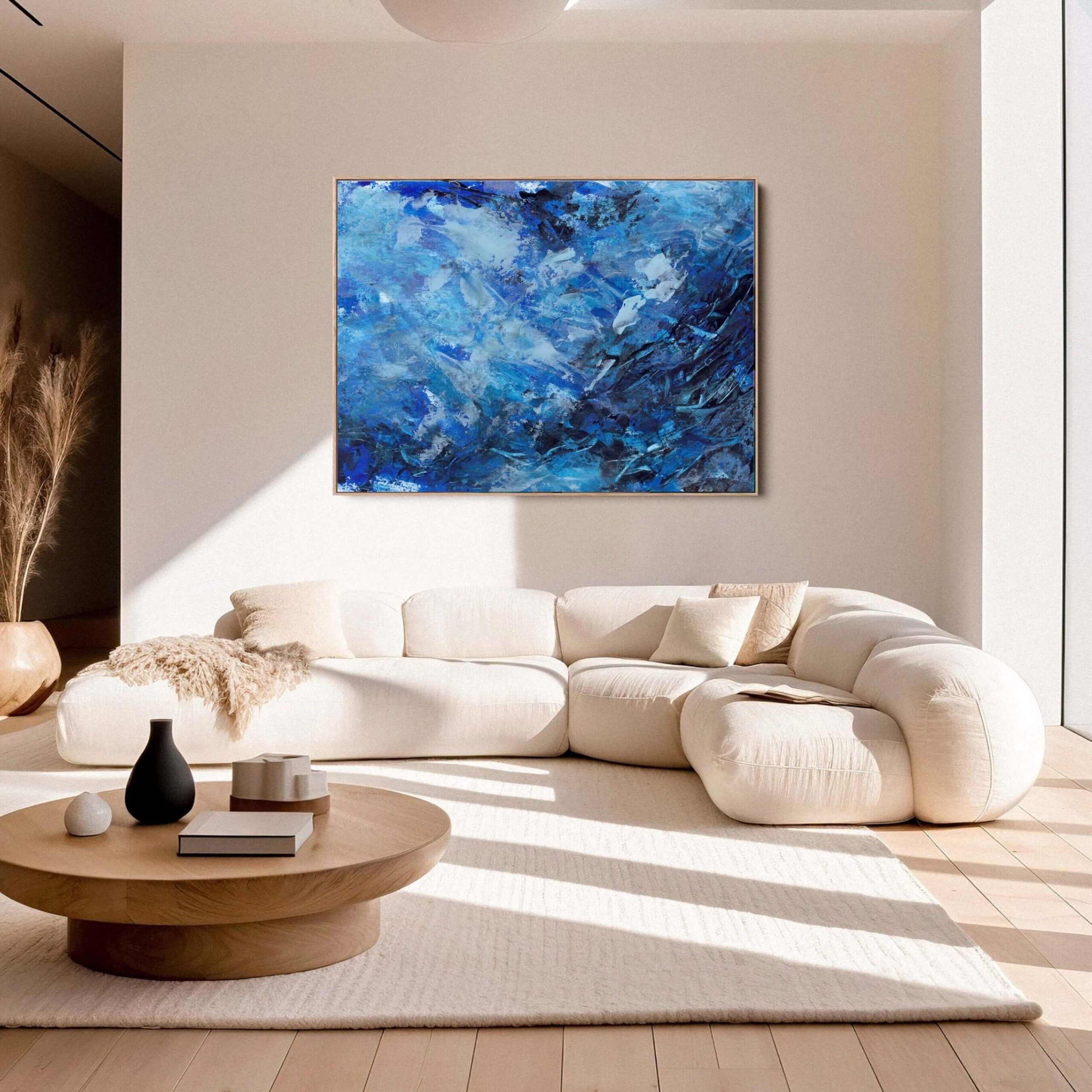
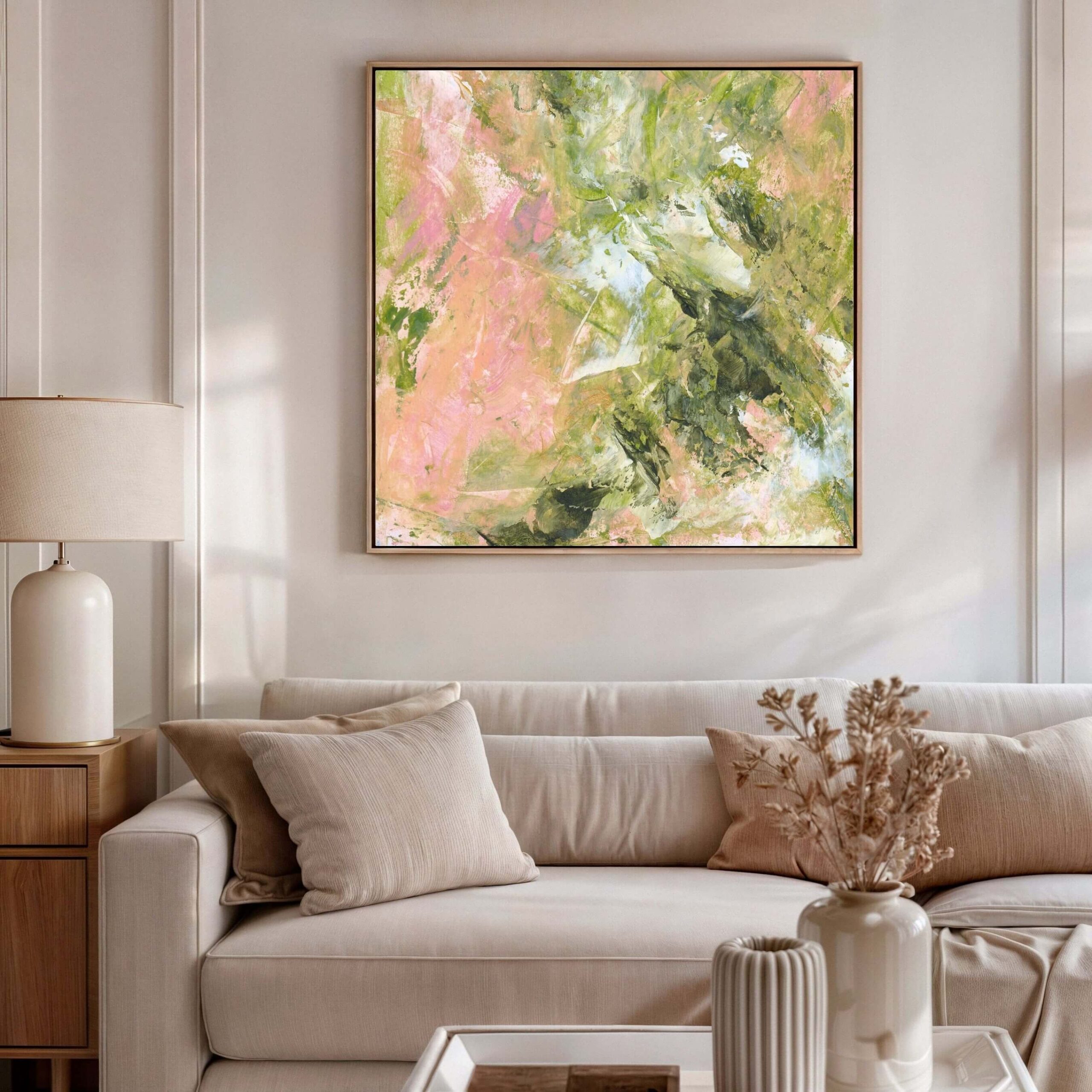
Your Sofa Isn't the Starting Point. It's the Anchor.
People often think they’re decorating a wall. In reality, they’re balancing an entire room.
The sofa acts as an anchor. It’s usually the largest piece of furniture in the living room, both physically and visually. Every other object is quietly judged against it.
If the artwork is too small, the sofa wins. Not because it’s more beautiful, but because it’s carrying all the visual weight. The room starts to feel bottom-heavy. Your eye settles on the furniture and then drifts upwards into a sea of empty wall. It’s subtle, but once you notice it, you can’t unsee it.
On the other hand, when the artwork is proportioned correctly, something interesting happens. The sofa and the artwork begin to read as one composition. The wall no longer feels empty. The sofa no longer feels isolated. The room suddenly has structure.
People often describe this as the room feeling “finished”, even if they can’t explain why.
Bigger Doesn't Mean Bolder
One of the biggest misconceptions about large artwork is that it has to dominate a room. It doesn’t. In fact, many oversized pieces feel surprisingly quiet.
Why? Because visual noise has very little to do with dimensions. Think about the difference between these two walls.
The first has eight small framed prints, each demanding your attention, each separated by different gaps and competing with shelves, mirrors and ornaments. The second has one beautifully composed abstract painting spanning 170 centimetres.
Which feels calmer? For most people, it’s the second. One large artwork gives your eye somewhere to land.
There’s no visual argument happening across the wall. Everything feels resolved. That’s one of the reasons contemporary luxury interiors often feature fewer decorative objects than traditional homes.
The confidence comes from choosing one exceptional piece instead of filling every available surface.
The same principle applies inside my own work.
I’m not interested in creating paintings that need three decorative accessories and matching cushions before they make sense. I want the artwork to carry the room. Everything else should support it.
Different Sofa Styles Need Different Artwork
There isn’t one perfect size for every living room because there isn’t one perfect sofa. Understanding how your furniture changes the proportions of the room makes choosing artwork much easier.
Two-seater sofas
Compact sofas suit artwork with presence, but not excess. A canvas that’s roughly 100 to 130 cm wide usually feels balanced, depending on the proportions of the room.
Square formats often work particularly well here because they create a strong focal point without stretching beyond the furniture.
Three-seater sofas
This is where most people underestimate the size they need. A typical three-seater comfortably accommodates artwork somewhere between 120 and 160 cm wide.
If you’re deciding between 120 cm and 150 cm, don’t dismiss the larger option too quickly. Once it’s hanging, it rarely feels as large as it did in your imagination.
Corner sofas
Corner sofas can confuse people because they’re trying to work out whether the artwork should match the entire L-shape. Usually, it shouldn’t. Instead, relate the artwork to the main seating section beneath it.
Trying to span the whole sofa often results in artwork that’s unnecessarily wide and visually disconnected.
Modular sofas
Modern modular seating is generous. It deserves artwork that feels equally considered.
Large canvases often work beautifully here because they reinforce the architecture of the room instead of getting lost within it.
Several of the larger pieces in my Collector’s Vault were painted specifically with spacious living rooms in mind. Not because they’re only suitable for luxury homes, but because seeing artwork in context makes it much easier to understand its true scale.
One thing I’ve learnt over the years is that dimensions on a specification sheet rarely help people imagine how a painting will actually feel. A room does.
One Large Artwork or a Gallery Wall?
This is probably the second question I get asked most often. The honest answer? Neither is better.
They’re trying to achieve completely different things. A gallery wall tells lots of little stories. A statement artwork tells one.
Gallery walls are wonderful if you’ve built a collection over time. Travel photography, family memories, smaller originals and prints can all come together to create something deeply personal.
But they also require discipline. The spacing matters. The frame styles matter. The overall composition matters. Without careful planning, gallery walls quickly become visual clutter.
One large artwork works differently. It slows the room down. Rather than asking your eye to jump from picture to picture, it gives it somewhere to settle.
That’s one of the reasons collectors are often drawn to large abstract work.
You don’t need to understand exactly what you’re looking at. You simply experience it. For many people, that’s precisely the role artwork should play within a home.

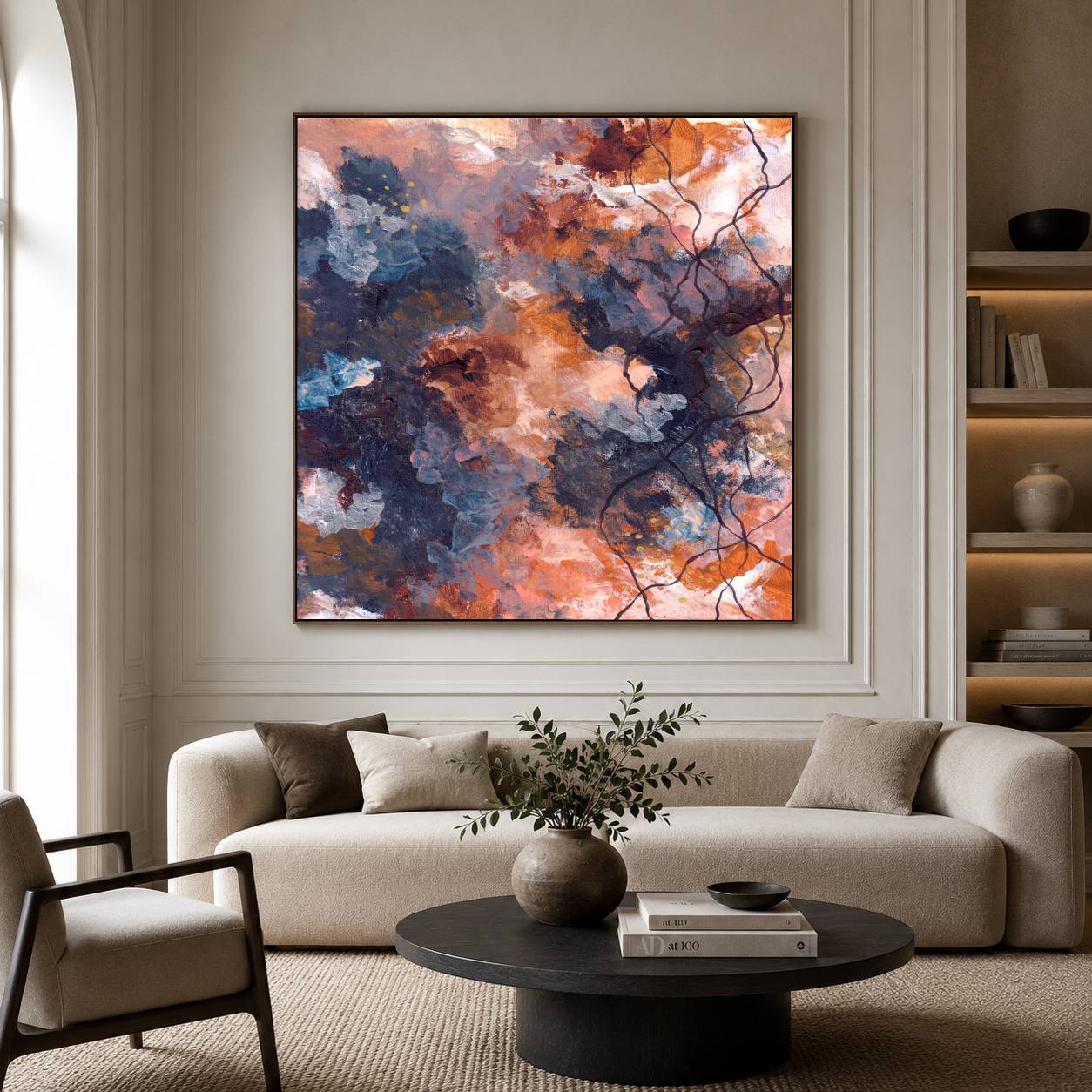
The Difference Between Decorative Art and a Statement Piece
This is where I think people accidentally undersell their own homes. They treat artwork like another accessory. Something to fill a gap. Something to coordinate with the cushions. Something to match the rug.
Personally, I think that’s back to front. The artwork should often be one of the first decisions. Everything else can respond to it. That’s certainly how many interior designers approach a project.
A statement piece gives the room an identity. It creates a palette. It influences mood. It becomes the thing guests remember long after they’ve forgotten where the coffee table came from.
I’ve written in more detail about this in What Makes Collector-Grade Canvas Art Different from Decorative Wall Art, because there is an important difference between buying something to fill a wall and buying something you’ll still want to live with ten years from now.
When people invest in one of my Collector’s Vault pieces, I don’t expect them to redesign the room around it.
I expect the artwork to have enough presence and longevity that it continues to belong as the room evolves around it.
That’s a very different philosophy from chasing whatever colour happens to be fashionable this year.
Should Artwork Match Your Sofa?
This is one of those questions that seems sensible until you stop and think about it. Should your artwork match your sofa? Should it match your curtains? Should it match your cushions?
Personally, I’d say no. Not because matching is wrong, but because it’s limiting.
Some of the most beautiful homes I’ve visited don’t look carefully coordinated. They look collected. They feel as though they’ve evolved over time rather than being ordered from the same showroom in one afternoon.
That’s what gives a home personality.
If your sofa is a soft oatmeal linen, the artwork doesn’t need to contain exactly the same shade of beige. If your sofa is forest green, your painting doesn’t need matching green brushstrokes.
Instead, think about balance.
A room full of warm neutrals might benefit from artwork with richer earth tones and deeper contrasts. A darker room might come alive with lighter compositions that reflect natural light. Likewise, a very minimalist space may need a painting with movement and texture simply to stop the room feeling clinical.
When collectors ask me which piece they should choose, colour is rarely the first conversation we have. We talk about the room. How they use it. How the light changes throughout the day. What they want to feel when they come home. Only then do we start looking at individual artworks.
Because colour is only one ingredient. Atmosphere is the goal.
The Best Rooms Aren't Finished Overnight
There’s another misconception that quietly puts people under pressure. The idea that every room should be “finished.”
As though there comes a magical day when you’ve bought the last lamp, fluffed the final cushion and suddenly your home is complete forever. Homes don’t work like that. The best interiors evolve. A chair might move. Bookshelves fill up. Plants grow. A rug gets replaced after ten years.
Artwork moves from one room to another because suddenly it feels right somewhere else.
That’s normal. In fact, I think it’s healthy.
One of the reasons I love abstract art is because it tends to grow with a home.
Unlike artwork that’s heavily tied to a particular trend, colour scheme or fashion, abstract work often reveals something different each time you live with it.
It quietly adapts. Several collectors have told me that after moving house, the same painting somehow felt completely different.
The artwork hadn’t changed. The conversation around it had. That’s one of the reasons I don’t create work for trends. I create work that people can live with. Hopefully for decades.
Before You Buy Anything, Do This
If there’s one practical piece of advice I could give anyone buying artwork for above a sofa, it’s this.
Don’t guess. Measure. Then get some masking tape. Mark the exact dimensions of the artwork on the wall. Stand back. Sit on the sofa. Walk into the room. Look from the hallway. Look from the kitchen if it’s open plan.
Leave the tape there for a day or two. Live with it.
You’ll be amazed how quickly your perception changes.
What initially looked enormous often begins to feel completely natural after twenty-four hours. Your brain adjusts. Suddenly the smaller size that once felt “safe” starts to look oddly timid.
I recommend this to collectors all the time because it’s simple, costs nothing and removes so much uncertainty.
Buying artwork should be exciting. Not stressful.
If You're Investing in Large Artwork, Buy Once
There’s an old saying: “Buy cheap, buy twice.“
I think something similar applies to art. Not because expensive always means better. It doesn’t. But because compromising on the one thing you already know isn’t quite right often ends up costing more in the long run.
I’ve spoken to people who’ve bought three or four smaller decorative prints over several years because none of them quite solved the room.
Eventually, they bought the large statement artwork they’d wanted in the first place.
The smaller pieces weren’t mistakes. They were stepping stones. If your goal is simply to cover an empty wall, almost anything will do. If your goal is to create a room that feels thoughtful, personal and calm, it’s often worth waiting until you can buy the piece you really want.
That’s exactly why The Collector’s Vault exists.
Rather than creating hundreds of interchangeable designs, I’ve curated a collection of works that are available in substantial, gallery-quality canvas sizes. Pieces that aren’t trying to disappear into the background, but equally aren’t shouting for attention.
They’re designed to become part of the architecture of a room. Not just another accessory.
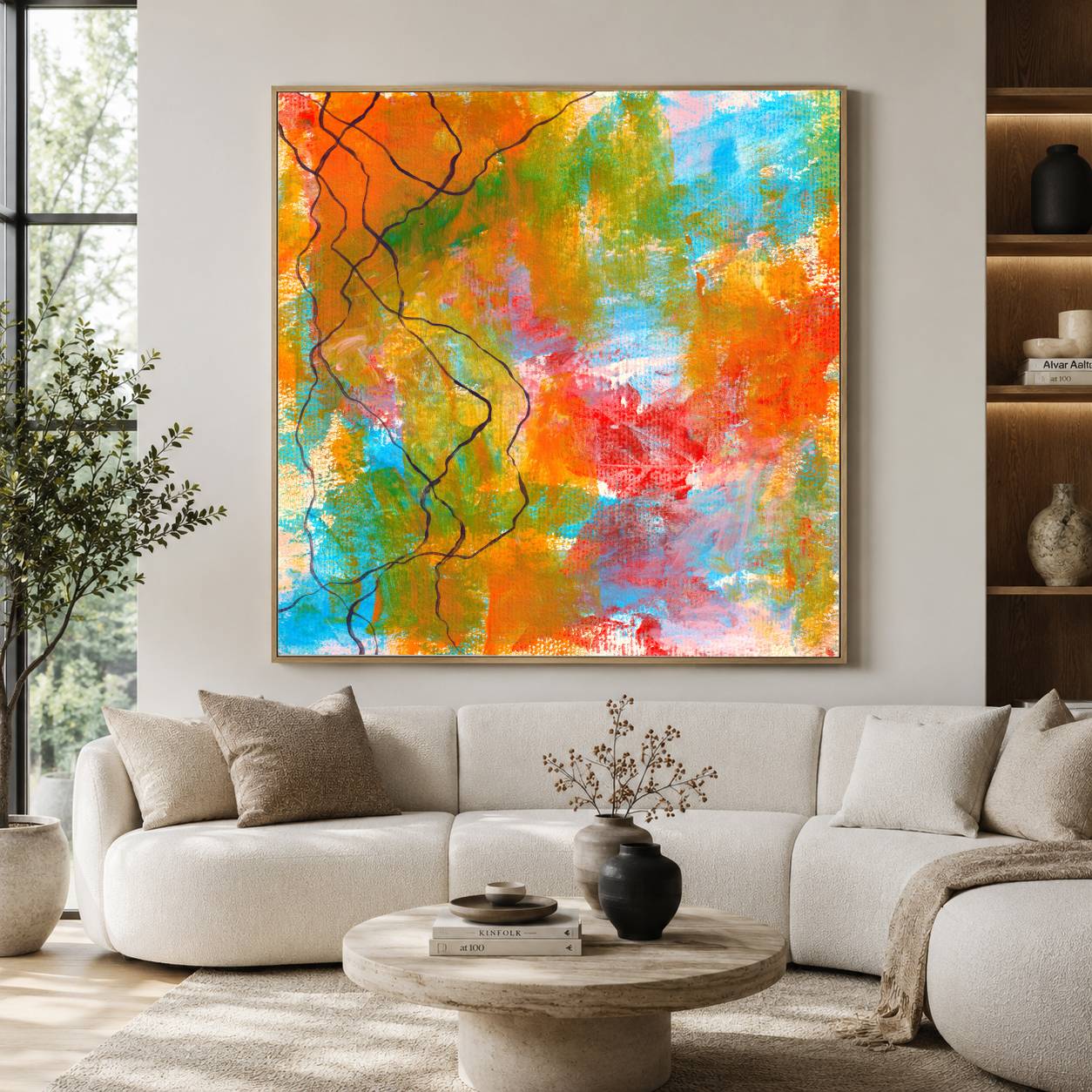
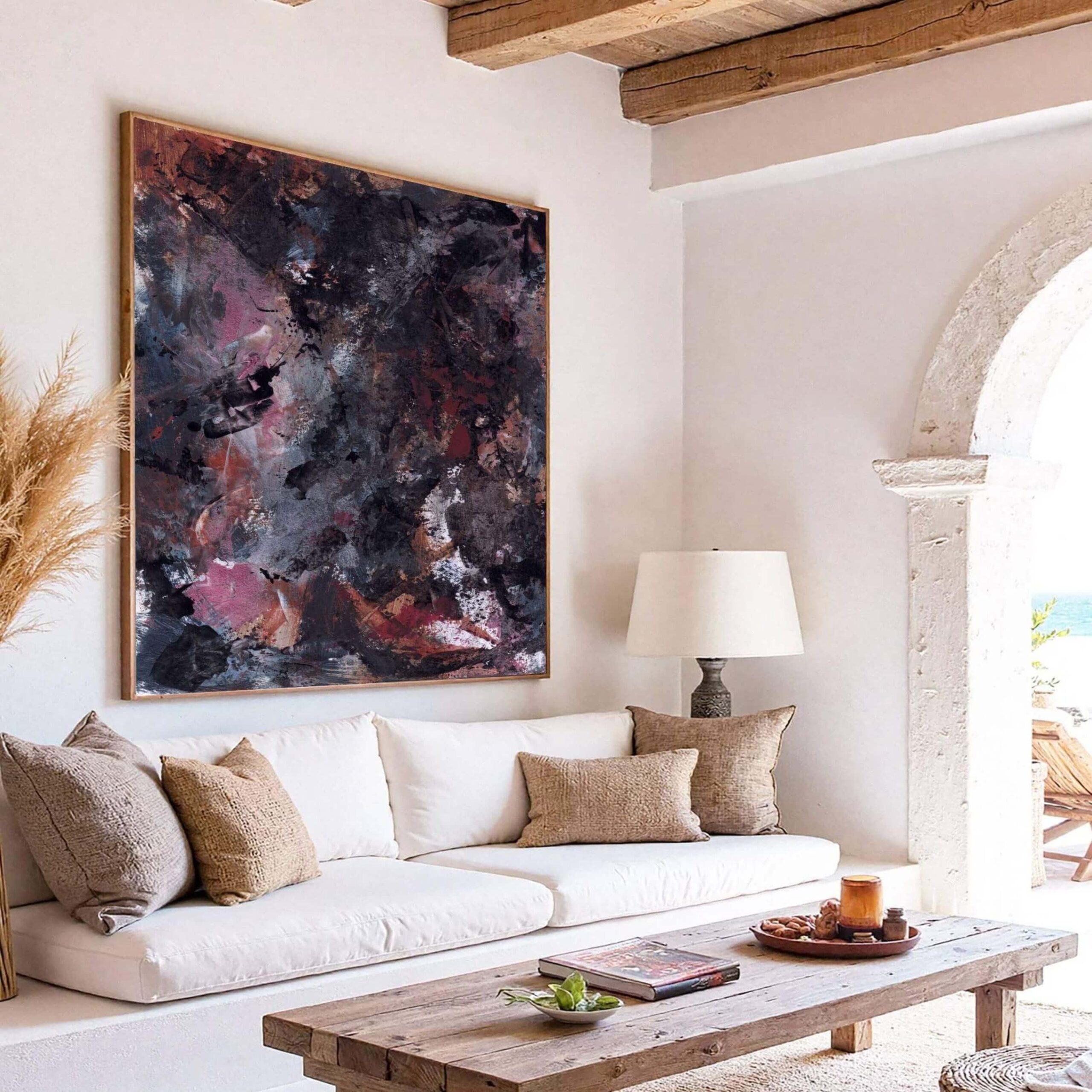
If you’re curious how different scales work in interiors, you’ll find examples throughout the Vault, and in my Selected Works showing the same artwork in different settings and sizes. It’s often the easiest way to judge what those measurements actually look like in a home.
Creating a Room That Feels Like Yours
Ultimately, choosing artwork isn’t really about centimetres. Or ratios. Or interior design rules. Those things are useful because they give us confidence to make decisions. But they aren’t the destination.
The destination is creating a home that feels unmistakably yours. A room where guests immediately sense your personality without you having to explain it. A place where you enjoy drinking your morning coffee, reading a book on a Sunday afternoon or simply sitting in silence after a long day.
Great artwork contributes to that in a way very few objects can. It doesn’t just occupy space. It shapes it. It influences light, colour, atmosphere and emotion all at once.
Which is why I think it’s worth taking your time. Measure the wall. Think about the room. Be braver than feels comfortable.
And if you keep coming back to the larger size, there’s probably a reason. Trust it.
Conclusion
The wall above your sofa is one of the most influential spaces in your home, so it deserves more thought than simply finding something that fits.
As a general guide, artwork that’s around 60% to 75% of the sofa’s width creates balanced proportions, but the numbers are only the beginning. Ceiling height, natural light, furniture, colour and the feeling you want to create all play an important role.
The mistake I see most often isn’t choosing the wrong painting. It’s choosing the right painting in the wrong size.
If you’re investing in artwork you’ll hopefully live with for many years, don’t buy the piece that feels safest. Buy the one your room actually needs.
If you’re exploring large abstract artwork, you’re welcome to browse The Collector’s Vault, where you’ll find collector-grade canvas pieces created specifically for homes where artwork isn’t an afterthought, but one of the defining features of the space.
Continue reading
-
- How Does Colour Affect Mood in Working Spaces?
- Why Do Some Rooms Feel Empty Even When They’re Finished?
- What Makes Collector-Grade Canvas Art Different from Decorative Wall Art?
- How to Buy Large Abstract Art Without Overwhelming a Room
- Why Large Canvas Prints Work So Well in Modern Interiors
- Browse The Collector’s Vault
Key Takeaway
The wall above your sofa deserves more than something that simply fills the space. Choosing artwork with the right scale transforms how the entire room feels, and if you’re deciding between two sizes, the larger option is often the one your room actually needs.
Frequently Asked Questions
A good guideline is to choose artwork that’s approximately 60% to 75% of the width of your sofa. This usually creates balanced proportions while allowing the artwork to become a natural focal point.
It can, although it’s usually more successful when it’s slightly narrower. Artwork that extends significantly beyond the sofa can make the furniture feel disconnected from the rest of the room.
Leaving approximately 15 to 25 centimetres between the top of the sofa and the bottom of the artwork generally creates a comfortable visual relationship.
Neither is inherently better. A single large artwork creates a strong focal point and often suits contemporary interiors, while a gallery wall can showcase a collection of smaller works. The choice depends on the atmosphere you want to create.
In most cases, centre the artwork over the sofa rather than the wall. The sofa acts as the visual anchor, so the artwork should relate to it first.
There is no universal answer, but large abstract artwork is particularly versatile. It adds colour, movement and atmosphere without competing with conversations or becoming tied to a specific interior style.
Not necessarily. Artwork should complement the overall palette and feeling of the room rather than matching individual pieces of furniture. Contrast often creates a more interesting and personal interior.
You don’t always need to replace it. A larger frame, a wide mount, combining it with complementary pieces, or moving it to a smaller wall can all improve the proportions. If you’re buying specifically for above a sofa, however, choosing the correct size from the outset usually creates the strongest result.
If you’re looking for collector-grade abstract canvas artwork designed for modern interiors, you can browse The Collector’s Vault, where every piece is available in large formats created specifically for statement walls and spacious living areas.