
Why Employees Ignore Workplace Wellbeing Initiatives
TL;DR
Employees rarely ignore workplace wellbeing because they are lazy, unmotivated or uninterested in their health. More often, wellbeing initiatives fail because they add friction, feel performative or don’t reflect how people actually work.
There is a reason so many wellbeing initiatives quietly disappear
Almost every organisation has experienced it at some point.
Somebody has a genuinely good idea. They recognise that employees are tired, stressed or spending too much time sitting, so they decide to invest in wellbeing. A programme gets introduced, a launch email is sent, and for a brief period, everybody seems enthusiastic.
Then something interesting happens. Participation slowly begins dropping.
The lunchtime sessions become quieter. Fewer people open the emails. Sign-ups reduce, and eventually the initiative quietly disappears without anybody really discussing why.
This often creates frustration on both sides.
Leadership feels disappointed because they have invested time, energy and money into trying to help their employees. Employees, meanwhile, may feel guilty for not participating despite knowing the initiative was designed with good intentions.
The easy explanation is to assume employees simply don’t care.
That explanation is usually wrong.
Most people care enormously about their health, their energy and their wellbeing. The problem is often that the initiative itself doesn’t fit into the reality of their day.


Employees don't need another task on their to-do list
This is perhaps the biggest mistake organisations make. Workplace wellbeing often becomes another responsibility.
- Attend this webinar.
- Join this challenge.
- Track your steps.
- Complete this survey.
- Sign up for this session.
- Download this app.
None of these ideas are inherently bad, but together they can unintentionally become overwhelming.
The average employee is already juggling deadlines, meetings, emails, projects and personal responsibilities outside work. Even positive activities can begin feeling stressful if they require too much additional effort.
This is one reason simple movement interventions often work so well. They don’t ask people to become different versions of themselves. They simply improve the working day they already have.
The easier something is to access, the more likely people are to use it. It sounds obvious, but it’s a principle many organisations accidentally forget.
Why employees are more exhausted than organisations realise
There is another important piece of the puzzle that organisations sometimes overlook. Employees are often far more exhausted than they appear.
Most people are no longer arriving at work with a full battery every morning. They are already carrying life with them before they even open their laptop. They may have been awake with children, caring for relatives, commuting for an hour, juggling school runs or dealing with dozens of small responsibilities before the working day has even officially started.
Then work begins.
Meetings fill the calendar, emails accumulate, and there is very little opportunity for the brain or body to reset throughout the day. By the time a wellbeing initiative appears, many employees simply don’t have any capacity left to engage with it.
This isn’t a motivation problem. It’s an energy problem. This is one reason movement programmes can work so effectively. They don’t require employees to find another reserve of energy they don’t possess. Instead, they often help people recover some of the energy they’ve already lost throughout the day.
Organisations that understand this tend to approach wellbeing very differently. Instead of asking, “How can we get employees to participate more?” they begin asking, “How can we make the working day less draining in the first place?”
That subtle shift changes a lot.
Good intentions are not the same as good implementation
Most failed wellbeing initiatives begin with excellent intentions.
The problem is that organisations often choose activities they believe employees should enjoy rather than asking what would genuinely help them.
There can sometimes be a subtle disconnect between leadership and everyday reality.
An organisation may proudly introduce a lunchtime wellbeing session without realising that many employees use that time to catch up on emails, eat their lunch, run errands or simply sit quietly for twenty minutes before the afternoon begins.
If participation is low, it doesn’t automatically mean the programme has failed. It may simply mean the timing, structure or delivery doesn’t align with people’s lives.
This is where flexibility becomes incredibly important.
Wellbeing should reduce friction rather than create more of it.
Employees can spot performative wellbeing immediately
People are incredibly perceptive. They can often tell the difference between an organisation that genuinely prioritises wellbeing and an organisation that is simply adding another initiative to a growing list of employee benefits.
Employees don’t expect perfection. Most understand that businesses have budgets, deadlines and operational pressures.
What they do notice, however, is consistency.
If a company encourages wellbeing while simultaneously celebrating long hours, skipped lunch breaks and constant availability, mixed messages quickly emerge.
Trust begins eroding. Wellbeing stops feeling authentic and starts feeling performative. Ironically, employees often don’t need grand gestures at all.
They need organisations to make healthier choices easier within the existing structure of the day.
Sometimes the smallest changes have the biggest impact. A five-minute movement reset can be more effective than a sixty-minute workshop that nobody has time to attend.
One size fits all rarely works anymore
Another reason many workplace wellbeing initiatives struggle is because organisations often assume everybody needs the same thing.
One employee may spend their day sitting in meetings and desperately need movement. Another may be working remotely and feeling isolated. Someone else may already be exercising regularly but be struggling with mental fatigue rather than physical discomfort.
Yet many wellbeing programmes attempt to solve every problem with a single solution.
The reality is that modern workplaces are far more nuanced than that.
Employees don’t arrive at work as blank canvases. They bring different personalities, energy levels, responsibilities and challenges with them every day. Some people love group activities. Others would rather avoid them entirely. Some enjoy social interaction, while others use their breaks to recharge quietly.
This doesn’t mean organisations should create twenty different wellbeing programmes. It simply means there needs to be enough flexibility for people to engage in ways that feel comfortable.
The most successful initiatives often provide options rather than obligations.
Ironically, giving people freedom often increases participation.
Why workplace wellbeing often focuses on symptoms instead of systems
Many organisations are trying to solve the right problem in the wrong place.
They notice employees are tired, so they introduce mindfulness. They notice employees are stressed, so they organise a workshop. They notice employees are struggling with energy, so they encourage healthier habits.
Again, none of these things are bad.
The issue is that they often address symptoms rather than systems.
If employees are sitting for eight hours every day, overwhelmed by meetings and spending their entire afternoon staring at screens without moving, introducing one wellbeing session per month is unlikely to create meaningful change.
The environment itself still hasn’t changed.
The most effective workplace wellbeing strategies often start much earlier. They ask questions such as:
- Where are the pressure points during the day?
- Where are people becoming physically stiff?
- When do energy levels consistently drop?
- Which behaviours have become normal that perhaps shouldn’t be?
Sometimes relatively small adjustments create surprisingly large outcomes. Five minutes of movement integrated into existing routines can be far more effective than a large standalone wellbeing event that only a handful of people attend.
This is also where movement becomes incredibly powerful because it addresses the system itself rather than simply trying to counteract the consequences afterwards.
Movement works because everybody already understands it
Movement works because it already solves a problem employees recognise
Movement often succeeds where other wellbeing initiatives struggle because employees can immediately see why it exists. They don’t need persuading that sitting all day can make them stiff, tired or mentally drained because many of them are already experiencing those things every single day.
The challenge has rarely been awareness. Most employees know that moving more would probably help them feel better. The challenge is figuring out how to make that happen inside an already busy working day without creating another responsibility in the process.
This is where movement has a distinct advantage. It doesn’t need to become another project or another task to complete. Instead, it can simply support the day that already exists.
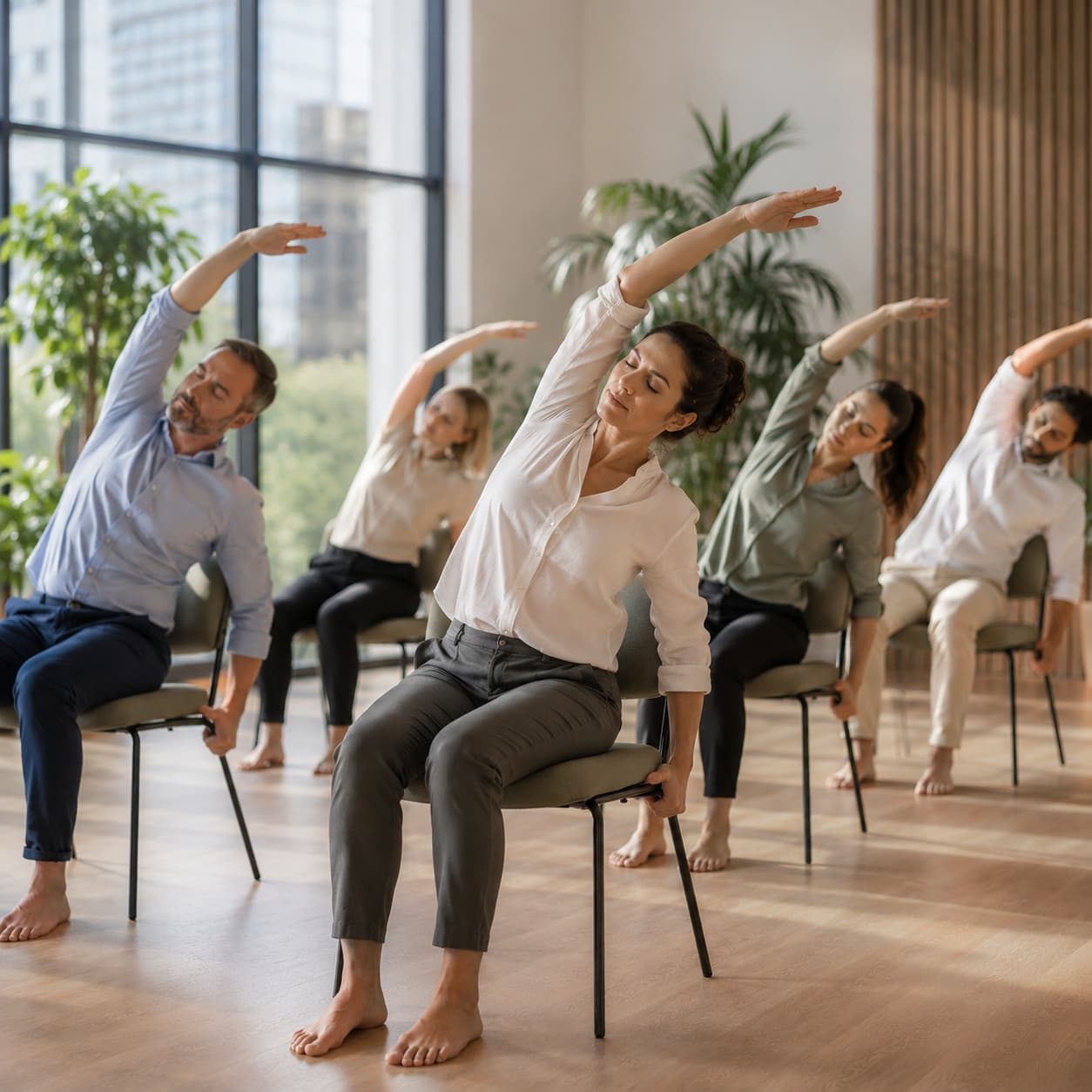
A short reset between meetings, opportunities to stand and move more regularly or integrating movement into workplace culture often feels far more realistic than asking employees to commit to something entirely new. The intervention itself may be small, but over time those small changes can make a surprisingly large difference to how people physically experience work.
Movement is also relevant in a way that many initiatives aren’t. Employees can immediately connect it to their own reality. They know what it feels like when their hips are stiff by 3 pm, their shoulders are tight, or their concentration has disappeared after hours at a desk.
This is also why movement should never sit in isolation. It works best as part of a bigger conversation about how workplaces are designed in the first place. Articles such as Why Information Alone Doesn’t Change Workplace Wellbeing, What Makes a Workplace Movement Programme Effective (and Why Most Fail) and What Is a Corporate Wellness Program? (And What It Usually Misses) explore this idea further because sustainable workplace wellbeing is rarely about one activity. It’s about creating an environment that supports people more consistently over time.

Wellbeing should remove friction, not create it
This is perhaps the simplest test organisations can use. Ask one question.
Does this initiative make employees’ lives easier or harder?
It sounds almost too simple, but it can immediately highlight potential issues. For example, asking employees to travel to another location, block out an hour in their calendar, sign up in advance and complete additional tasks afterwards creates friction.
Meanwhile, introducing a simple movement reset during an existing meeting or integrating a short wellbeing practice into the working day removes friction.
The easier something is to access, the greater the chance people will use it.
This is one reason many organisations are moving away from large annual wellbeing events and towards smaller, consistent interventions throughout the year.
People don’t necessarily need more information. They often need simpler systems.
Wellbeing should support productivity, not compete with it
This is actually one of the biggest reasons wellbeing initiatives quietly fail.
Employees often feel as though they have to choose between looking after themselves and doing their job properly. The moment wellbeing starts feeling like time away from work, organisations have already created a problem.
Think about a fairly ordinary Tuesday. Someone already has meetings in the morning, deadlines looming in the afternoon and fifty unread emails sitting in their inbox. If a wellbeing session suddenly appears in the middle of that, even if it’s genuinely useful, many people will immediately think, “I don’t have time for this.”
Not because they don’t want to attend. Not because they don’t value their health. Simply because they’re trying to keep their head above water.
This is where many wellbeing initiatives accidentally become disconnected from reality. Organisations sometimes build programmes around an ideal employee rather than a real one. The ideal employee has spare capacity, a flexible diary and plenty of mental energy left over at the end of the day.
Real employees often don’t.
That’s why the question shouldn’t be, “How do we fit wellbeing into work?”
The question should be, “How do we make work itself feel healthier?”
Those are two completely different conversations.
When organisations approach it from that angle, the solutions often become much simpler. Small movement breaks, fewer back-to-back meetings, encouraging people to step away from their desk for a few minutes or simply creating a culture where taking care of yourself isn’t seen as slacking off can make a bigger difference than many larger initiatives.
Ultimately, wellbeing shouldn’t feel like an interruption to productivity. It should be one of the things supporting it.
If employees constantly feel depleted, uncomfortable and mentally drained by the end of the day, that doesn’t just affect wellbeing. It affects how people work, how they think, how they collaborate and how sustainable their performance is over time.
The irony is that many organisations already understand this. They’re simply trying too hard to solve it with new programmes instead of making the existing working day feel better.
Why consistency beats occasional big events every time
Many organisations unintentionally treat wellbeing like an annual celebration.
A wellbeing week appears once a year. Everybody is encouraged to participate; there are activities every day, and then everything quietly disappears for another eleven months.
The problem is that human bodies don’t work that way. People don’t become stiff because of one bad day. They become stiff because of the hundreds of days that look very similar.
Likewise, people don’t suddenly become energised because they attended one workshop. Small behaviours repeated consistently are usually what create lasting change. This is why many successful organisations are moving away from large occasional events and towards smaller interventions that simply become part of normal working life.
Consistency is also less intimidating for employees. They don’t have to commit to huge programmes or dramatic lifestyle changes. They simply experience a working day that gradually feels better over time.
Ironically, those smaller interventions often create the biggest results because they stop feeling like initiatives altogether. They simply become how the organisation operates.
The organisations getting it right are simplifying things
The best workplace wellbeing programmes are often surprisingly boring. There are no giant launches. There are no elaborate campaigns. There isn’t a new initiative every month.
Instead, there is consistency.
Employees know what to expect. They know participation is encouraged but not forced, and they understand that wellbeing is being integrated into company culture rather than bolted onto it as an extra benefit.
Most importantly, leadership participates too. That consistency builds trust over time.
When organisations genuinely prioritise wellbeing, employees notice.
This is one reason articles like What Makes a Good Workplace Wellbeing Programme? and Why Workplace Wellbeing Needs Physical Practice, Not Just Advice are becoming increasingly important conversations for employers to have.


Conclusion
Employees rarely ignore workplace wellbeing because they are lazy, disengaged or uninterested in their health.
In fact, the opposite is often true.
Most people want to feel healthier, more energised and more supported at work. They simply don’t want another responsibility added to an already demanding day.
The organisations seeing the greatest success are usually the ones that understand a very simple principle.
Wellbeing should make work feel better.
It shouldn’t feel like more work.
Once businesses start approaching wellbeing from that perspective, participation often stops being a problem altogether because employees no longer feel they’re being asked to do something extra. Instead, they begin experiencing a working day that simply supports them a little better.
If your team spends most of the day sitting, working at screens, moving between meetings and carrying tension through the working day, Sit Happens offers practical workplace movement training designed for real office life.
Start here: Sit Happens
You can also explore the wider movement practice here: Movement
Key takeaway
The best wellbeing initiatives don’t create another task. They make people’s existing working day feel better.
Frequently Asked Questions
That’s incredibly common and it doesn’t necessarily mean your employees aren’t interested. It’s often worth looking at how much effort is required to participate. If people have to sign up, block out extra time or sacrifice their lunch break, engagement naturally drops.
Generally, yes. In many ways, employees are more interested than ever before. What they’re less interested in is wellbeing that feels performative, forced or disconnected from their everyday reality.
Not always, but it can be. For many people, lunchtime is their only opportunity to decompress, eat properly, catch up on tasks or simply have a few quiet minutes before the afternoon begins. It’s worth understanding your team before automatically choosing that slot.
Movement is often one of the easiest places to start because it’s simple, accessible and immediately relevant to most office-based teams. It also supports physical and mental wellbeing simultaneously.
In many cases, yes. If employees constantly feel they have to choose between doing their job and participating in wellbeing activities, the initiative can quickly become another source of stress.
Smaller and more consistent usually wins. Humans respond well to habits and routines. Tiny changes that happen regularly often create more meaningful long-term outcomes than occasional large events.
That’s completely okay. Wellbeing should be available, encouraged and easy to access, but rarely forced. The objective isn’t one hundred percent participation. The objective is creating an environment that supports people better over time.
Stop thinking about wellbeing as something extra. The most effective initiatives are often the ones that quietly improve the existing working day rather than adding another task onto an already busy schedule.
Sit Happens is a movement-based workplace wellbeing programme designed specifically for desk-based teams to support posture, movement, nervous system regulation and physical wellbeing.