Why Cognitive Work Needs Physical Support
Most modern work is cognitively demanding and physically static.
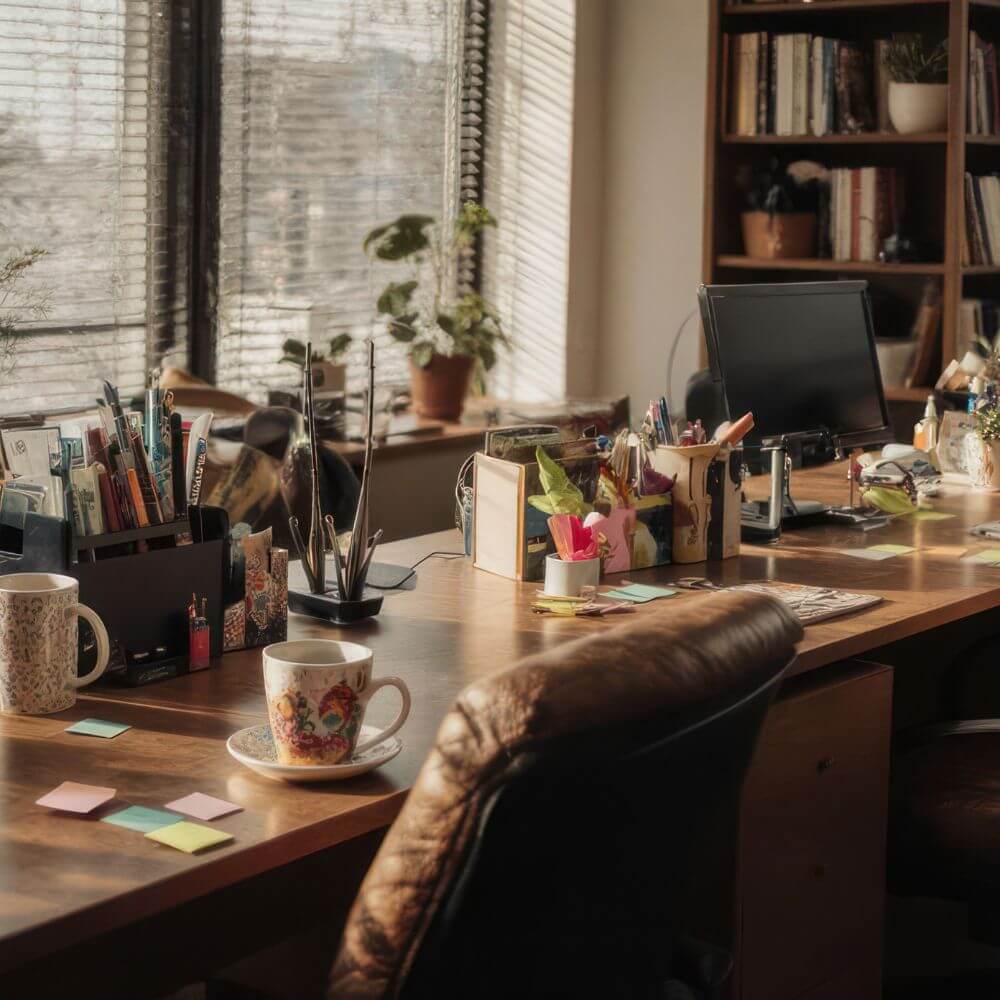
People think all day. They solve problems, manage complexity, hold conversations, make decisions, and switch contexts constantly. At the same time, their bodies barely move. Hours pass in chairs. Spines stay folded. Legs stay idle. Breathing gets shallow without anyone noticing.
This combination has become so normal that we treat it as neutral.
It isn’t.
Sitting all day doesn’t just make people stiff. It quietly changes how capable they feel, how steady their energy is, and how long they can tolerate demand before everything starts to feel like effort.
That gap, between what work asks of the mind and what the body is prepared to support, is where Sit Happens comes from.
If you need the practical overview of delivery formats and UK cost expectations, read: Corporate Wellness Programmes UK: Costs, Formats and What Companies Should Expect.
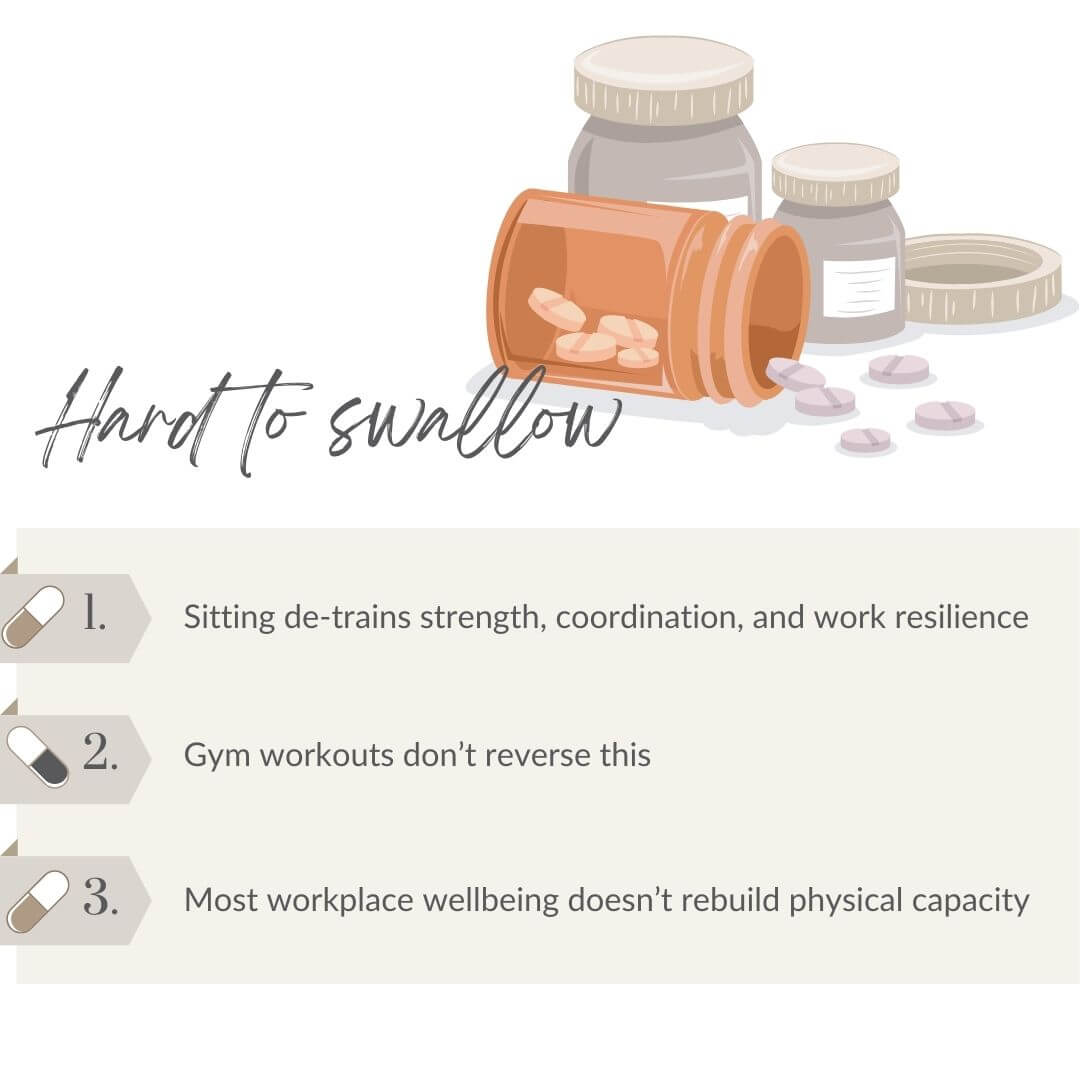
Sitting isn’t passive. It actively de-trains capacity.
There’s a comforting belief that sitting is simply the absence of movement. That nothing much is happening.
In reality, prolonged sitting is active in the wrong direction.
Strength fades in the muscles that support upright posture. Coordination dulls. The body’s ability to organise itself under low-level demand slowly erodes. Over time, even simple transitions like standing up, staying upright in a meeting, or walking with purpose start to cost more than they should.
This isn’t about fitness. It’s about physical capacity.
When capacity drops, the workday becomes heavier. Not dramatically. Just enough to matter. What matters here is not the list itself, but what it removes.
Blame.
This isn’t laziness. It isn’t a lack of discipline. It isn’t people failing to look after themselves. It’s an environment that quietly deconditions the body day after day.
Why this problem stays invisible for so long
One of the reasons sitting is so damaging is that its effects are subtle.
There’s no single moment where someone thinks, “Ah yes, today sitting broke me.”
Instead, people adapt.
They shift in their chair. They lean on one hip. They grip their shoulders without realising. They breathe less deeply. They push through tiredness because that’s what work requires.
The body compensates remarkably well. Until it doesn’t.
By the time discomfort becomes obvious, the underlying loss of support has often been happening for years.
This is why so many workplace wellbeing initiatives miss the mark. They arrive late, address symptoms, and never quite touch the underlying capacity problem.
Why the usual fixes don’t solve what sitting breaks
Most organisations already try to do something about wellbeing.
Gym memberships. Apps. Talks. Workshops. Yoga after work. Mindfulness before bed.
None of these are wrong. They’re just mis-placed.
A gym session a few times a week doesn’t undo eight hours of static posture every day. Stretching doesn’t rebuild coordination. Mindfulness doesn’t restore physical support. Asking people to do more outside work doesn’t change what happens inside the workday.
The issue isn’t effort.
It’s that the damage happens during work, and the solutions are offered everywhere else.
This is where most corporate wellbeing quietly fails.
How reduced physical capacity shows up at work
When physical capacity drops, it doesn’t announce itself loudly.
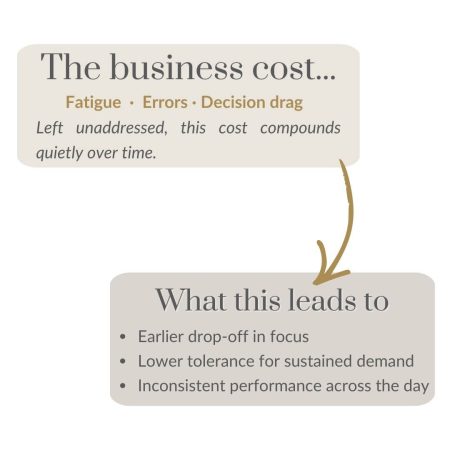
It shows up as energy that fades earlier in the day. Focus that drops off mid-afternoon. Decision-making that feels heavier than it should. Small errors that creep in when people are tired, not careless.
People start the day capable and end it depleted. Not emotionally, necessarily. Physically.
Left unaddressed, this compounds.
This isn’t dramatic burnout. It’s something quieter and more expensive.
Work costing more than it should.
You can explore this further in What Chronic Sitting Does to the Nervous System (And Why Teams Feel Fried by Midday)
The reframe most workplaces miss
We tend to treat thinking as something that happens in the head.
As if focus, clarity, and decision-making float free from the body supporting them.
They don’t.
Cognitive performance is constrained by physical capacity.
If posture is unsupported, breathing is restricted, and movement is absent, thinking is working against friction all day. Not enough to stop work. Just enough to drain it.
If people are expected to think well for long periods, their bodies must support that inside the workday, not just before or after it.
Once this clicks, everything else rearranges itself.
Why movement belongs inside work, not around it
Sit Happens exists because work hasn’t changed, but bodies still have needs.
It’s not fitness. Not therapy. Not a perk.
It’s maintenance.
Movement inside the workday restores support where it’s being lost. It gives the body enough input to stay organised, upright, and responsive under demand.
This is why the program happens:
-
- in work clothes
- in the workspace
- without equipment
- without sweat
- without disruption
It’s not about intensity. It’s about organisation.
Structure matters more than effort
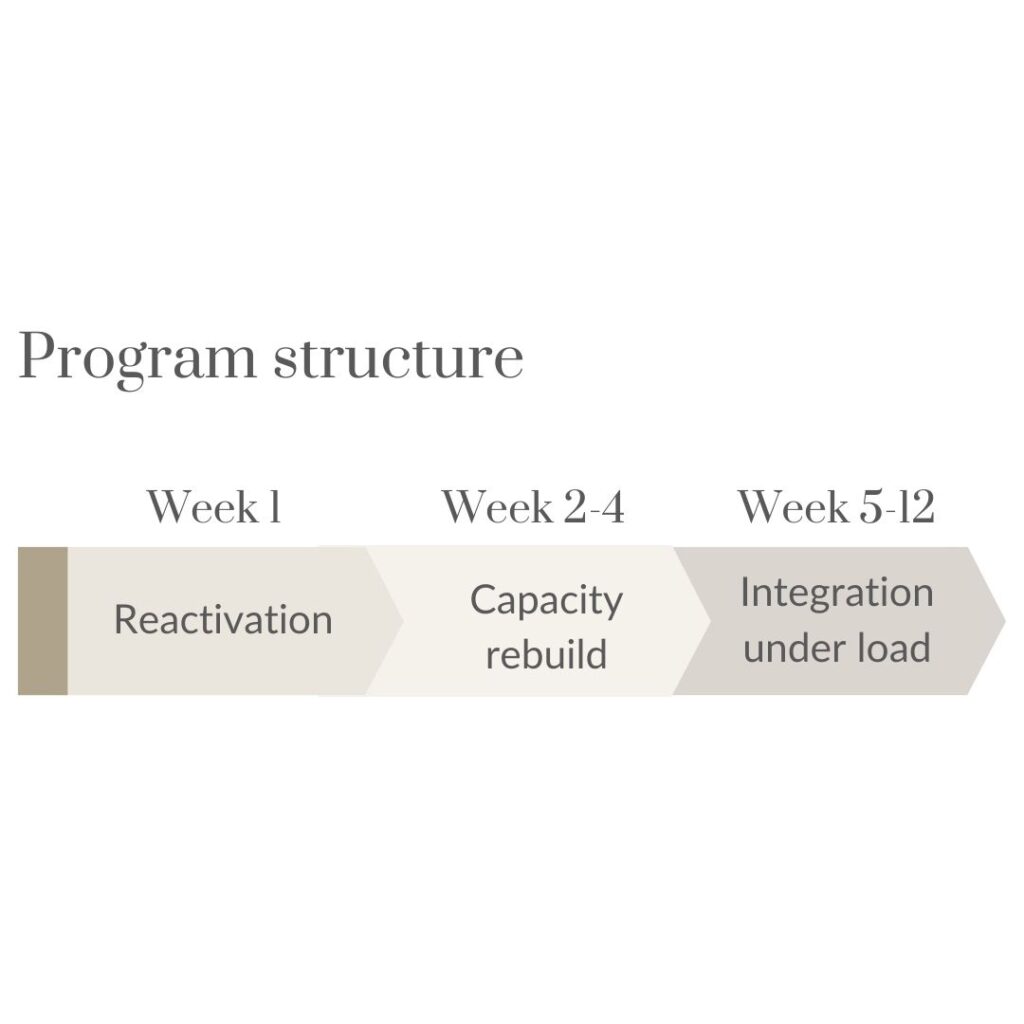
Capacity doesn’t change overnight, which is why Sit Happens unfolds in phases.
Early sessions help people reconnect with their bodies and undo the most obvious effects of sitting. The middle phase rebuilds strength and coordination in ways that support real work positions. The final phase integrates movement back into desks, meetings, and long afternoons.
By the end, movement stops feeling like an interruption.
It just becomes part of working.
Why does this change how work feels
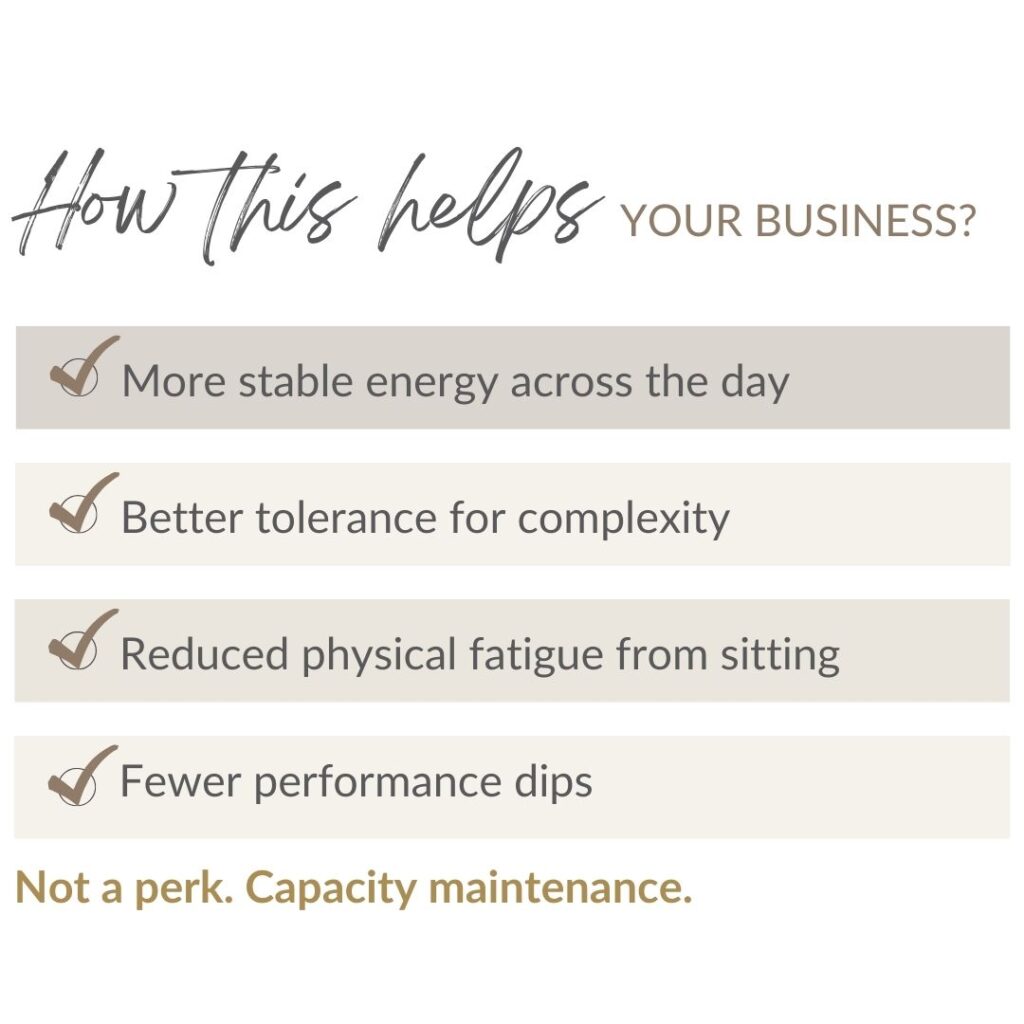
When the body is better supported, everything downstream benefits.
Energy lasts longer. Focus is steadier. Physical discomfort stops pulling attention away from tasks that matter.
People don’t become calmer because they’re passive. They become calmer because work costs less.
This isn’t about doing more. It’s about feeling better while doing what already needs to be done.
Why desire matters more than pain here
This work doesn’t land because people are desperate.
It lands because people recognise themselves in it.
They want:
-
- steadier days
- fewer physical compromises
- work that doesn’t drain them by default
- to feel capable again, quietly
That’s why Sit Happens isn’t sold through urgency or fear. The desire is already there. The work just gives it a structure.
Why this approach lasts
Sit Happens works because it respects reality.
People aren’t going to stop sitting. Work isn’t going to become less demanding. And not everyone wants to optimise themselves, train hard, or track metrics.
This approach fits into the conditions people actually work in. It doesn’t require extra willpower or extra time. It restores something that’s been missing and lets people get on with their day.
Movement with intelligence. Calm with structure. Strength without strain.
If you’re interested in how this sits alongside art, stillness, and attention, you might also enjoy
Once people feel the difference, they don’t need convincing.
They just notice the workday feels more possible.

Frequently Asked Questions
Is this yoga or Pilates?
It uses principles from both, but it isn’t a yoga or Pilates class.
Sit Happens is structured, upright movement designed specifically for the workday. There’s no mat work, no changing clothes, and no gym-style setup. The focus is on restoring physical support, coordination, and ease so people can think and work better, not on learning poses or sequences.
Will people get sweaty?
No.
Sessions are designed to work in normal work clothes, at a normal work pace. People move, breathe, and feel things change in their bodies, but without sweat, exertion, or needing a shower afterwards.
Do people need to be “fit” to take part?
Not at all.
Sit Happens is designed for people who sit most of the day, not for athletes. All movements are adaptable, options are always offered, and people work at a level that suits their body.
This is about restoring function, not pushing limits.
What if someone has injuries or physical limitations?
That’s expected, not unusual.
Participants complete a short wellbeing form before the program begins, and sessions are taught with variations so people can work safely and comfortably. The aim is support, not forcing anyone into shapes that don’t suit them.
Is this suitable for all ages?
Yes.
Because the focus is on coordination, posture, breathing, and intelligent movement, Sit Happens works across a wide age range. It’s not high-impact and doesn’t rely on strength or flexibility as a starting point.
How disruptive is it to the workday?
It isn’t.
Sessions run for 60 minutes, on site, during the workday. There’s no setup, no equipment, and no transition time needed. People return to work feeling more organised and focused, not spaced out or depleted.
Why does it need to happen during work hours?
Because that’s where the problem lives.
The physical strain caused by sitting happens during the workday, so restoring support needs to happen there too. Moving after work doesn’t change what the body goes through between 9 and 5.
How is this different from other workplace wellbeing programs?
Most wellbeing programs focus on stress management, mindset, or lifestyle advice.
Sit Happens focuses on physical capacity. It addresses how sitting affects posture, breathing, coordination, and energy, and restores those foundations so stress and fatigue don’t build as quickly in the first place.
Is this just a one-off experience, or does it actually last?
The program runs for 12 weeks because capacity changes gradually.
Early sessions help people feel immediate differences. Over time, those changes become more stable and start to show up in everyday work tasks like sitting, standing, meetings, and concentration.
The aim is not a temporary reset, but changes that hold.
What does the Intro Session involve?
The Intro Session is a 2.5-hour, on-site session that lets teams experience the work before committing to the full program.
It includes guided movement, breathing, and practical education. People leave feeling calmer, clearer, and usually a little taller. It also gives the company a clear sense of whether Sit Happens is the right fit.
Do we have to do the Intro Session first?
Yes.
The Intro Session ensures alignment on both sides. It lets your team experience the work properly, and it allows me to tailor the twelve-week program to what’s actually needed rather than guessing.
How many people can take part?
Up to 20 people per group, in person.
This keeps the sessions personal enough to adapt to different bodies while still working well in a workplace setting.
Where do sessions take place?
Sessions are delivered at your workplace or workspace.
I currently work within 15 miles of Nottingham. Travel beyond that can be arranged.
Is this about productivity?
Indirectly, yes. But that’s not the starting point.
Sit Happens improves productivity by reducing the physical cost of working. When the body is better supported, focus is easier, energy lasts longer, and people don’t hit the same mid-afternoon wall.
The aim is not to squeeze more out of people. It’s to stop work costing so much.
How do we book?
You can book an Intro Session directly through the website on this link: https://vikithorbjorn.art/sit-happens/#book-your-intro-session.
Once you enquire, I’ll confirm availability, logistics, and next steps by email. There’s no sales call and no pressure.