
Children’s Pilates in West Bridgford: How It Helps Strength, Posture and Confidence
TL;DR
Children’s Pilates in West Bridgford gives children a structured, low-pressure way to build strength, posture, coordination, balance and confidence. It is not an adult Pilates class made smaller, and it is not about children being perfectly still, perfectly flexible, or perfectly anything, thank God.
A good children’s Pilates class helps children understand how their bodies move. It gives them time to practise control, balance, strength and focus without competition, shouting, ranking, or that slightly feral after-school activity energy where everyone seems one snack away from collapse.
For children who are not naturally drawn to competitive sport, or who need a calmer way to build physical confidence, Pilates can be a brilliant option. It supports the body in a steady, practical way, helping children feel stronger, more aware, and more capable in movement.
For local class details, see the main children’s yoga and Pilates page here: Children’s Yoga and Pilates in West Bridgford
Definition: What is children’s Pilates?
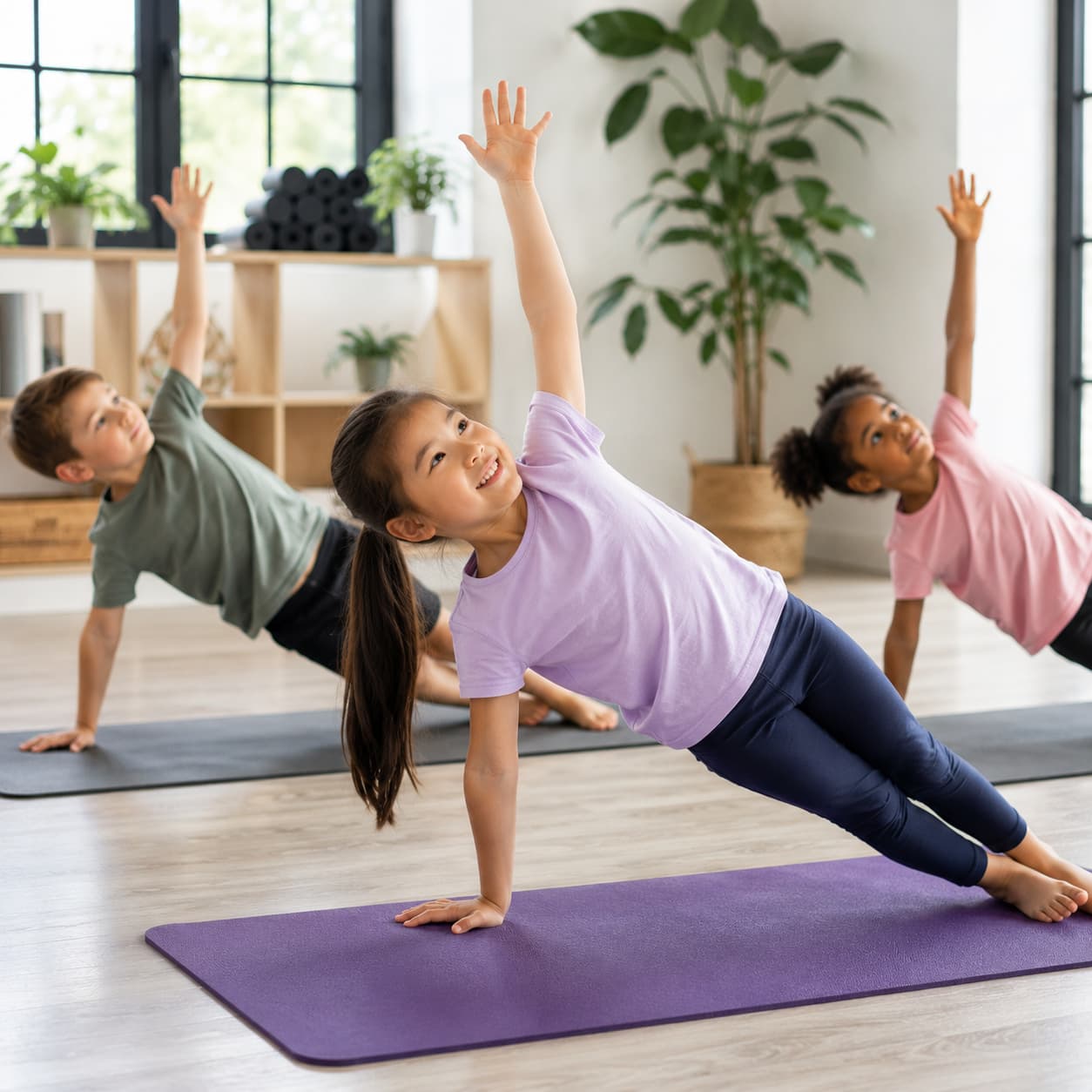
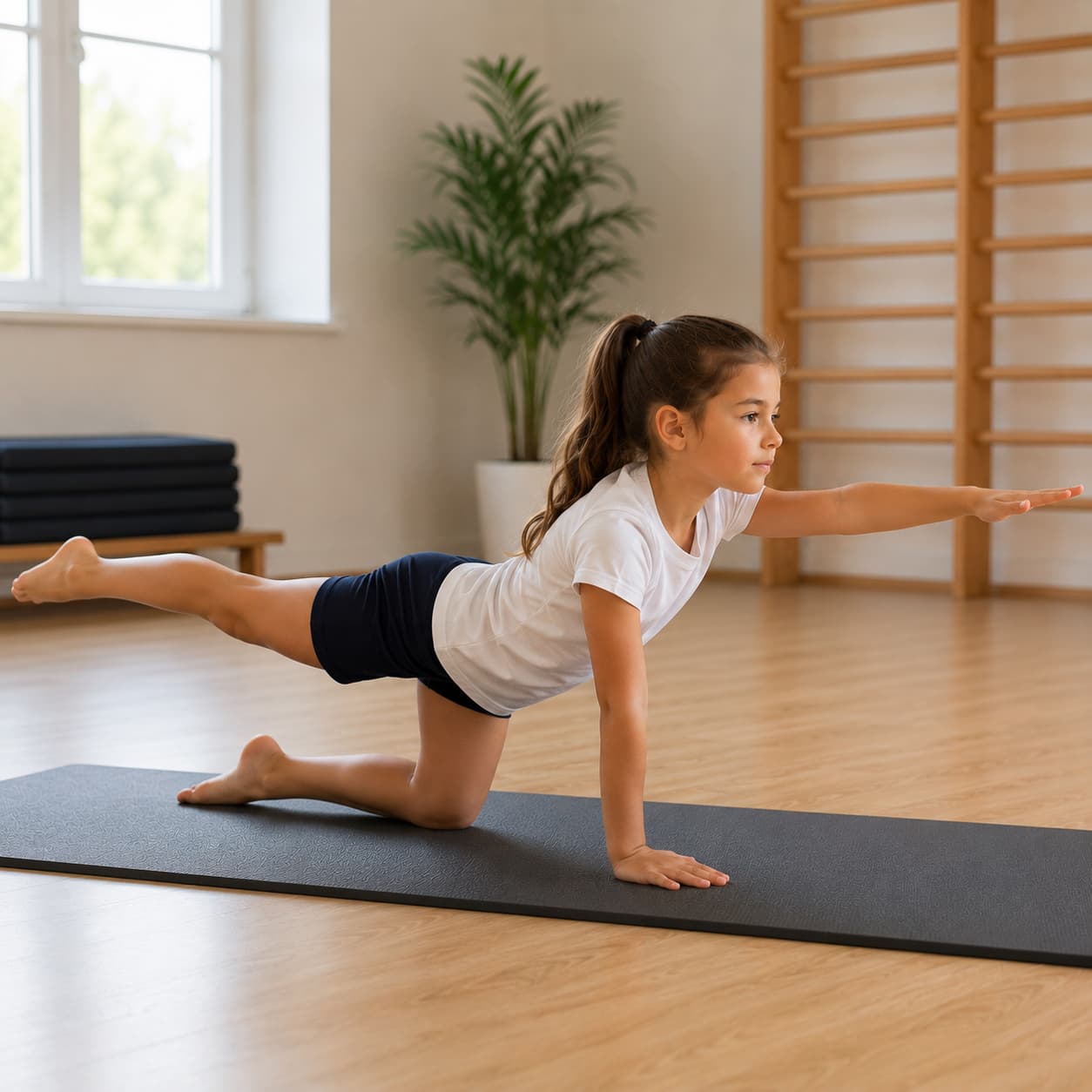
Children’s Pilates is a child-friendly movement class that uses simple, structured exercises to support strength, posture, coordination, balance, mobility, breathing and body awareness. It should be adapted for children’s age, attention span and confidence level, so the class feels clear, engaging and achievable rather than like a tiny adult mat class with less patience and more socks.
Why children’s Pilates is worth considering
Children spend a lot of time being told what to do with their bodies.
Sit still. Line up. Hurry up. Slow down. Concentrate. Stop fidgeting. Carry your bag. Look at the board. Don’t slouch. Don’t run there. Run faster here. Join in. Calm down. Try harder. Be careful. Keep up.
It is a lot, frankly.
Their bodies are growing, changing, learning and adapting all the time, but many children do not get much structured time to actually understand how their body moves. They may do PE at school, they may play sport, they may run around at break, they may go to clubs, but that does not always mean they are building strength, posture, coordination and confidence in a steady, supported way.
That is where children’s Pilates can be useful.
Pilates gives children a different kind of movement experience. It is not about being the fastest, loudest, strongest or most naturally coordinated child in the room. It is not about winning. It is not about performing. It is about learning how to move with more control, more awareness and more confidence.
For some children, that is exactly what they need.
Especially the ones who are not instantly comfortable in sport. The ones who hang back. The ones who feel awkward in their bodies. The ones who are bendy but not strong, strong but not controlled, energetic but not coordinated, or perfectly capable but convinced they are “not sporty” because they have already had a few experiences that made movement feel like a public exam.
Children’s Pilates gives them another route in.
It helps them build physical confidence without making movement feel like a competition. It gives them time to practise. It teaches them that strength is not only about speed or force. It can also be quiet, steady, controlled and deeply useful.
That matters.
Because children do not just need movement to burn off energy. They need movement that helps them understand themselves.
Why this matters for children in West Bridgford
West Bridgford has plenty of active families, busy school weeks and children doing all sorts of clubs, sports and activities. That is brilliant, but it also means many children are already moving through full days with very little time to properly slow down and build the foundations underneath all that activity.
Some children need more than another high-energy club.
They need strength without pressure. Focus without stiffness. Structure without shouting. Movement that helps them feel capable, not exposed.
Children’s Pilates can offer that because it sits in a useful middle ground. It is active, but not frantic. It is structured, but not rigid. It builds strength, but not in a gym-style way. It supports posture, but without nagging children to sit up straight every five seconds like a haunted Victorian governess.
For parents looking for children’s Pilates in West Bridgford, the value is not just that the class is local. It is that the class gives children a practical way to develop the physical confidence they need for school, sport, play and everyday life.
That might mean better balance. Better posture. Better coordination. More core strength. More awareness of how they sit, stand, move and breathe. More confidence in trying things that once felt difficult.
None of this needs to be dramatic. It is the quiet stuff that builds over time.
Decision box: is children’s Pilates right for your child?
| If your child… | Children’s Pilates may help by… | What matters most |
|---|---|---|
|
Struggles with posture |
Building awareness of sitting, standing and moving with support |
No nagging, no shaming, just practical movement |
|
Seems physically unsure |
Helping them practise balance, coordination and control |
Small wins and steady progress |
|
Dislikes competitive sport |
Offering movement without pressure to win, race or perform |
A calm, structured class environment |
|
Has lots of energy but little control |
Teaching slower movement, focus and body awareness |
Clear instructions and repeatable exercises |
|
Is cautious or self-conscious |
Building confidence gradually through achievable movement |
Encouragement without forcing performance |
|
Needs better coordination |
Practising movements that connect arms, legs, core and balance |
Age-appropriate challenge |
|
Spends lots of time sitting or on screens |
Supporting mobility, posture and physical reset |
Movement that counters stillness |
|
Enjoys calm, focused activities |
Giving them structured movement without chaos |
A class that values attention and confidence |
Children’s Pilates is not adult Pilates with smaller people
This is one of the most important points.
Children’s Pilates should not be an adult Pilates class copied onto children. Children are not small adults with slightly worse listening skills and more dramatic relationships with water bottles. Their bodies are still developing. Their attention works differently. Their confidence can change quickly. Their coordination may be uneven. Their emotional response to movement matters.
So the teaching has to be adapted.
A children’s Pilates class should still be structured. It should still build strength, control, posture, balance and awareness. But it also needs variety, clarity, encouragement and a bit of common sense. Children need to understand what they are doing without being overloaded with technical language. They need to feel challenged without feeling embarrassed. They need enough repetition to improve, but not so much that they mentally leave the room and start planning what snack they want later.
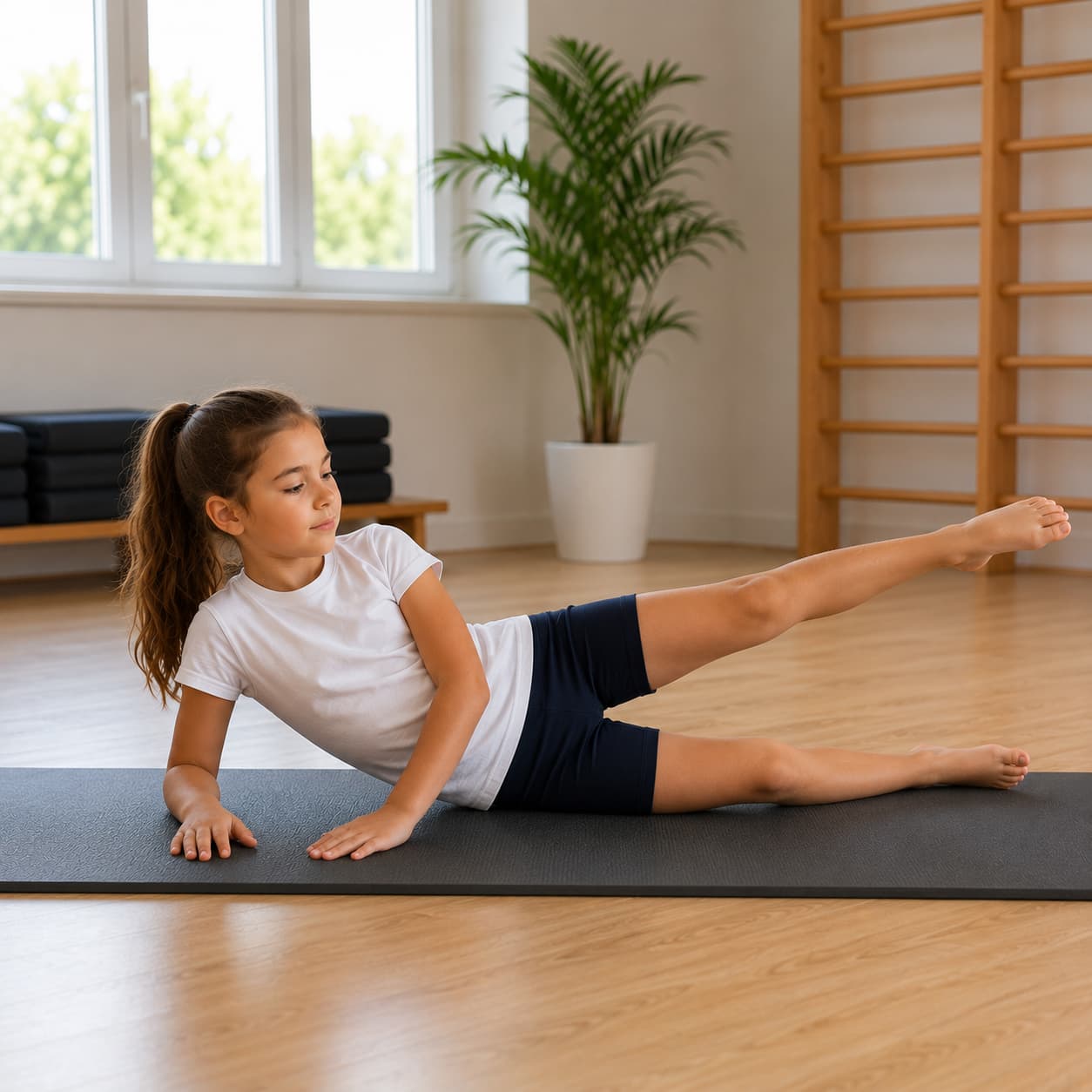
Good children’s Pilates uses simple exercises that help children feel their body working. They might practise balancing, controlled rolling, gentle core work, shoulder stability, spinal movement, breathing, coordination and posture awareness. The movements should feel achievable, but not pointless. Calm, but not boring. Structured, but not joyless.
The goal is not to create perfect Pilates technique.
The goal is to help children become more aware, more stable, more coordinated and more confident in how they move. That is a much better aim.
How children’s Pilates helps strength
Children need strength, but not in the adult fitness sense.
This is not about pushing children into workouts, chasing aesthetics, counting calories, building abs, or importing gym culture into childhood like an absolute lunatic. Children’s strength should be about support, confidence and function.
It is the strength to sit comfortably at school. To stand without collapsing into one hip. To balance. To climb. To run. To carry. To move with control. To try something new without immediately feeling like their body is betraying them.
Pilates helps because it builds strength through control.
Children learn to use their core, back, hips, shoulders and legs in a more organised way. They practise movements that ask them to stabilise, balance, hold, reach, curl, extend and coordinate. This helps them understand that strength is not always loud or fast. Sometimes strength is being able to move slowly. Sometimes it is being able to hold balance. Sometimes it is being able to control the body instead of flinging limbs around and hoping for the best.
That kind of strength is useful everywhere.
It can support sport, dance, school PE, playground movement, posture, confidence and everyday physical comfort. It can help children who are already active become more controlled, and it can help children who are less confident begin to trust their bodies more.
The work is quiet, but it is not soft. There is a difference.
How children’s Pilates supports posture
Posture gets talked about badly.
Children are often told to sit up straight, stop slouching, pull their shoulders back, or stop folding themselves over a screen like a tired prawn. The intention may be good, but nagging posture rarely teaches children anything useful. It usually just makes them sit up for four seconds before collapsing again, now with added irritation.
Pilates approaches posture differently.
Instead of treating posture as one perfect position, it helps children build the strength and awareness that support better posture naturally. They learn how their spine moves. They learn how their core helps them sit and stand. They learn how shoulders, hips, breath and balance all affect the way they hold themselves.
This matters because children’s posture is not just about looking neat.
It is about comfort, support and awareness. A child who understands their body better may begin to notice when they are slumping, twisting, leaning, locking their knees, holding tension in their shoulders, or sitting in a way that feels uncomfortable. They do not need to be corrected every minute. They need tools.
Children’s Pilates gives them those tools through movement.
It can help build postural strength in a way that feels practical rather than punitive. The aim is not to make children sit like statues. The aim is to help them move between positions with more support and control.
Because good posture is not about being rigid. It is about having options.
How children’s Pilates builds confidence
Confidence is not always noisy.
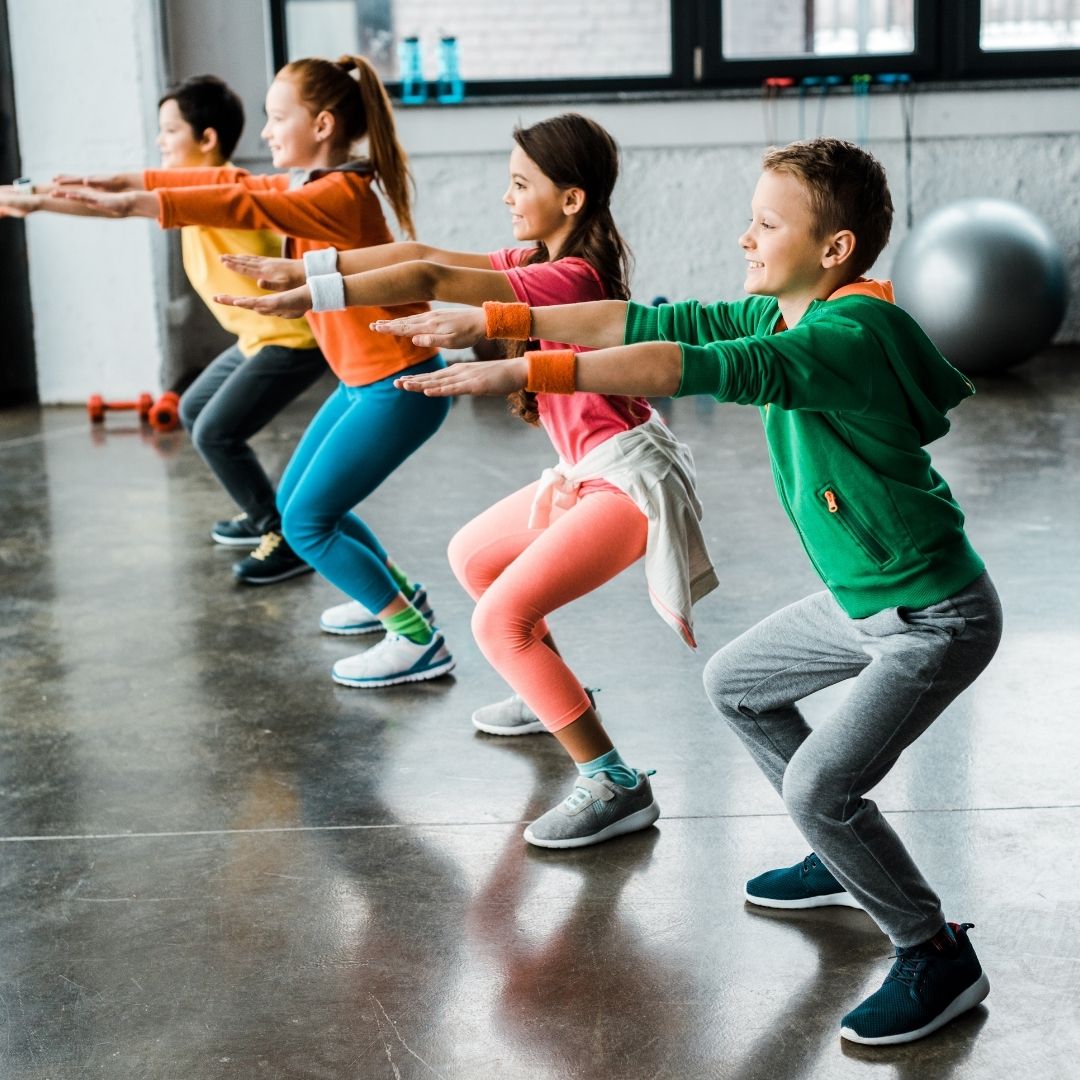
Some children show confidence by jumping straight in, trying everything, laughing when they wobble, and carrying on. Others need more time. They watch first. They hesitate. They worry about getting it wrong. They compare themselves quickly. They may decide they are “bad” at something before they have had enough time to learn it.
Children’s Pilates can be especially useful for those children because the class is not built around winning or performing.
Progress is personal. A child can notice that they held a balance for longer than last week. They can feel that a movement became easier. They can realise they understand an exercise they found confusing before. These small moments are not flashy, but they matter because they give children evidence that they can improve.
That is where real confidence comes from.
Not from adults shouting “amazing” at everything until the word loses all meaning. Not from pretending every child is equally good at everything. Children are not daft. They know when praise is empty.
Confidence grows when a child experiences progress.
Pilates creates lots of opportunities for that. A little more control. A little more balance. A little more strength. A little more understanding. Over time, those small gains can change how a child feels about movement and about themselves.
That is why low-pressure movement matters. It gives children room to become capable without feeling exposed.
Children’s Pilates and body awareness
Body awareness is one of those phrases that sounds a bit abstract until you see what happens when a child does not have much of it.
They bump into things. They rush movements. They struggle to balance. They use too much force or not enough. They find it hard to coordinate arms and legs together. They may not know where their body is in space, which can make movement feel frustrating or awkward.
Pilates helps children build body awareness through clear, controlled movement.
They learn to notice what their body is doing. Can they move one leg without tipping over? Can they reach without collapsing? Can they breathe while holding a position? Can they move slowly instead of rushing? Can they feel the difference between a strong position and a wobbly one?
These are simple questions, but they build useful skills.
Body awareness supports sport, play, school movement, coordination, balance, posture and confidence. It also helps children feel more connected to themselves, which is increasingly important when so much of their attention is pulled into screens, noise and constant stimulation.
A children’s Pilates class gives them time to come back into their bodies.
Not in a floaty, dramatic way. In a practical, grounded way.
Why Pilates can help children who are not drawn to competitive sport
Some children love competitive sports. Some children would rather eat a worksheet. Both are valid.
The problem is that children who do not enjoy competitive sport can sometimes start to believe they are not good at movement at all. That is a shame, because sport is only one form of movement. It is not the whole bloody kingdom.
A child may dislike football, netball, athletics, races, teams, noise, pressure or being watched, but still enjoy moving when the environment feels calmer and more structured. They may need time to practise without being compared. They may need an activity where the goal is not to beat someone else.
Children’s Pilates gives them that.
It offers movement without ranking. Strength without aggression. Challenge without humiliation. Progress without competition.
That can be a huge relief for children who have already decided they are not sporty. Pilates can help them realise they are not bad at movement. They may simply need a different kind of movement space.
That shift can be powerful.
Because once a child starts to feel capable in their body, they may become more willing to try other things too.
Children’s Pilates and emotional regulation
Pilates is not therapy, and it should not be sold as if it can fix every emotional difficulty. That would be nonsense in stretchy trousers.
But movement does affect how children feel.
A calm, structured Pilates class can help children practise focus, patience, breath, effort and recovery. They learn how to slow down enough to notice what they are doing. They learn how to try again when something is difficult. They learn that wobbling is not failure. They learn that stillness does not have to feel like punishment.
This can support emotional regulation because it gives children a physical experience of control.
Not control in a strict or restrictive sense, but the feeling of being able to manage themselves through a task. They can breathe. They can pause. They can adjust. They can try again.
For children who are easily overwhelmed, restless, self-conscious or frustrated, this can be really useful.
The class gives them a place to practise being challenged without being rushed. That is a skill.
Children’s Pilates versus children’s yoga
Children’s Pilates and children’s yoga can both be valuable, but they are not the same thing.
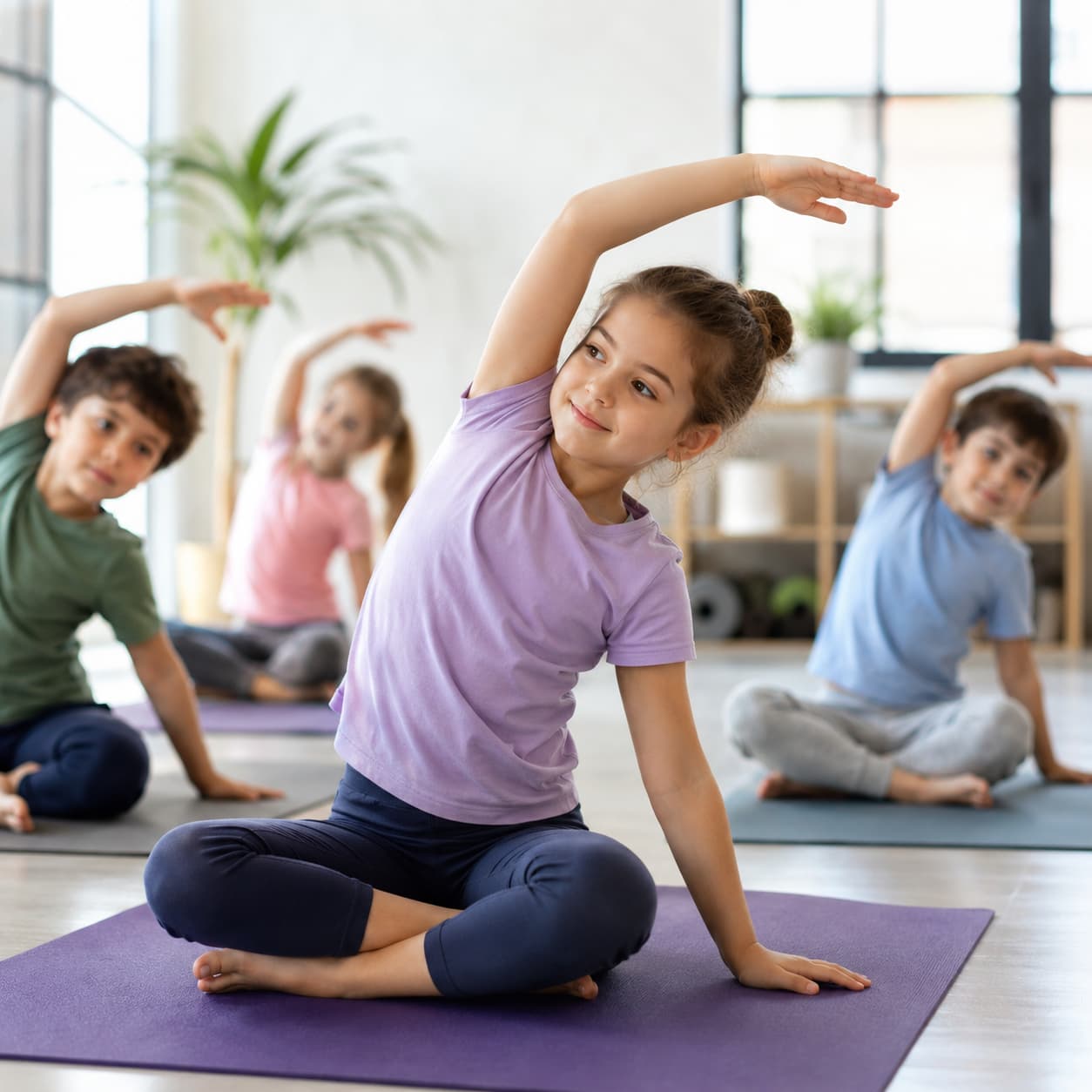
Children’s yoga often includes poses, breathing, relaxation, imagination, mobility, balance and calm focus. It can be especially helpful for children who need to slow down, stretch, breathe and feel more settled.
Children’s Pilates usually has a stronger focus on strength, posture, control, core support, coordination and precise movement. It can be especially helpful for children who need to build physical confidence, postural support and better body awareness.
Some children will prefer yoga. Some will prefer Pilates. Some will benefit from both, because they support different parts of the same bigger picture.
| Feature | Children’s Yoga | Children’s Pilates |
|---|---|---|
|
Main focus |
Calm, mobility, breath, balance and body awareness |
Strength, posture, control, coordination and body awareness |
|
Best for |
Children who need calm, flexibility, focus and relaxation |
Children who need strength, postural support and physical confidence |
|
Style |
Often more flowing, imaginative and breath-led |
Often more structured, controlled and strength-focused |
|
Physical benefit |
Mobility, balance, relaxation and coordination |
Core strength, stability, posture and coordination |
|
Emotional benefit |
Calm, focus, confidence and self-awareness |
Confidence, control, focus and body trust |
|
Pressure level |
Low-pressure when taught well |
Low-pressure when taught well |
|
Suitable for non-sporty children |
Yes |
Yes |
|
Yes, very well |
Yes, very well |
Yes, very well |
You can find the local children’s yoga and Pilates class information here: https://vikithorbjorn.art/childrens-yoga-pilates-west-bridgford
What happens in a children’s Pilates class?
A children’s Pilates class should feel calm, clear and structured, but not stiff.
Children need to know what is expected of them. They need boundaries, rhythm and guidance. But they also need the class to feel engaging enough that they do not mentally disappear after seven minutes and start making a hat out of their socks.
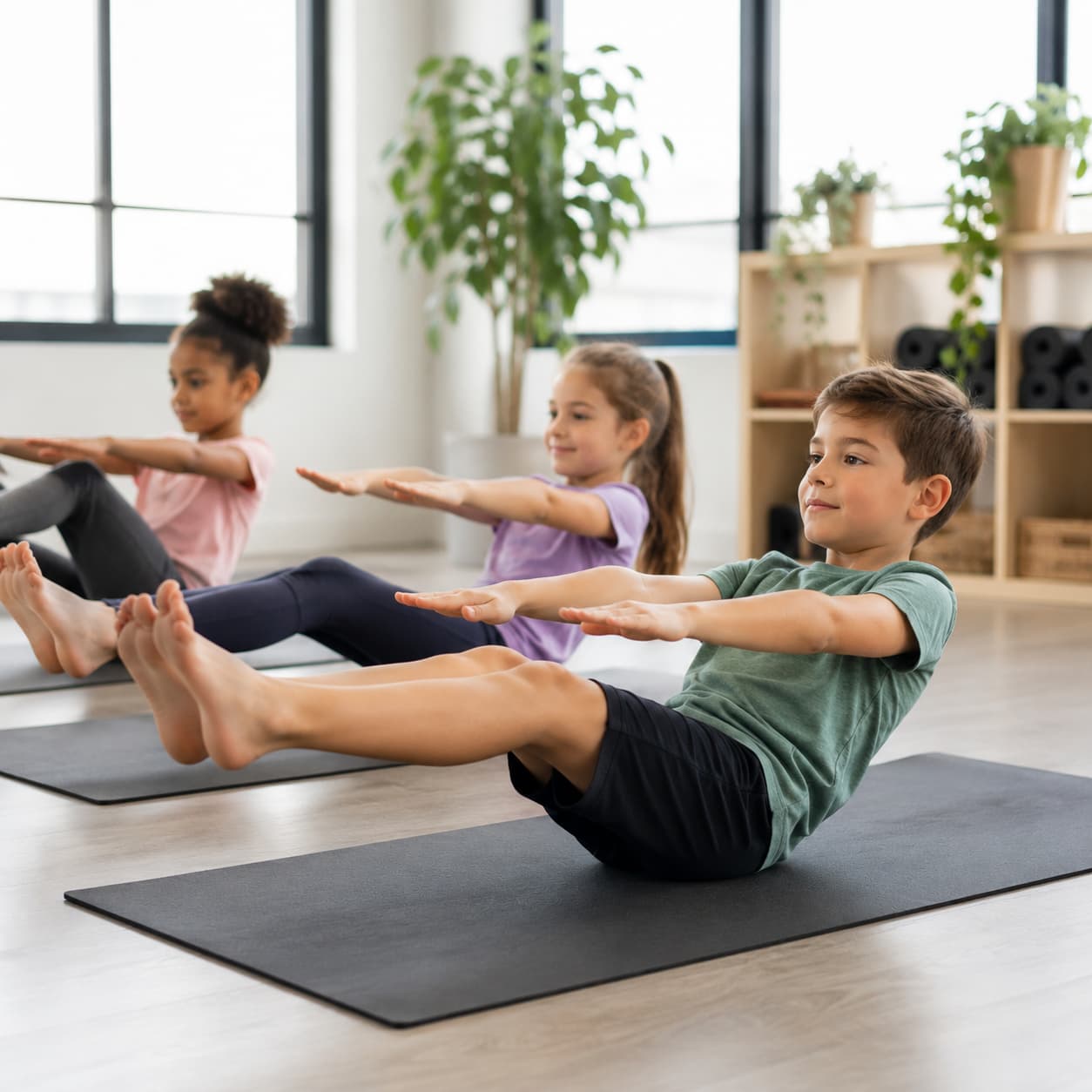
A typical class might include a simple warm-up, balance work, core exercises, posture awareness, controlled movement, coordination tasks, mobility, breathing and a short calm finish. The exercises should be adapted to the age and confidence of the group, with options where needed.
The class should not feel like a test.
Children should be encouraged to try, notice, adjust and practise. Some movements may feel easy. Some may feel wobbly. Some may take time. That is the point. Pilates gives children a safe way to experience challenge without turning it into drama.
Over time, children can begin to recognise their own progress. They may stand taller, balance better, move with more control, or feel more confident joining in.
That is what makes the work valuable.
What parents should look for in a children’s Pilates class
Parents should look for a class that feels structured, age-appropriate and genuinely child-centred.
That means the teacher should understand movement, but also understand children. It is not enough to know Pilates exercises. The teacher needs to know how to explain movement clearly, adapt exercises, manage the room, encourage without pressuring, and create a calm environment where children can participate without feeling embarrassed. A good children’s Pilates class should include:
-
- Clear instructions
- Age-appropriate exercises
- Calm structure
- Options for different confidence levels
- A focus on strength, posture and body awareness
- No pressure to perform
- Encouragement without empty praise
- Safe, sensible movement
- A teacher who understands children’s development
- A class atmosphere that feels steady, not chaotic
The best class will help children feel capable. Not perfect. Capable. That is much more useful.
Practical checklist before booking children’s Pilates
| Question | Why it matters |
|---|---|
|
Is the class designed specifically for children? |
Children need age-appropriate teaching, not copied adult Pilates |
|
Is the teacher qualified to work with children? |
Safety, safeguarding and appropriate delivery matter |
|
Does the class build strength and posture without pressure? |
Children need support, not performance demands |
|
Is the environment calm and structured? |
A steady setting helps children focus and participate |
|
Are exercises adapted for different abilities? |
Children develop at different speeds |
|
Is the class suitable for non-sporty children? |
Movement should feel accessible, not intimidating |
|
Does the class support confidence as well as fitness? |
Physical progress and emotional confidence are connected |
|
Is the location practical for your family? |
Local classes are easier to keep consistent |
|
Does your child need to bring anything? |
Many children’s classes require a mat and water |
|
Is there a clear way to register interest? |
This helps parents stay updated before classes begin |
Why local children’s Pilates can support long-term confidence
The real value of children’s Pilates is not one class.
It is what builds over time.
A child may not transform after one session, and that is fine because children are not before-and-after projects. But with regular practice, they can begin to build stronger movement habits. They may become more aware of how they sit, stand and move. They may feel less awkward trying physical tasks. They may begin to trust their balance, strength and coordination.
This kind of confidence grows quietly.
It is not always visible in a dramatic way. Sometimes it looks like a child standing a little taller. Trying again instead of giving up. Joining in without needing as much reassurance. Laughing when they wobble instead of freezing. Feeling less intimidated by movement.
That matters.
Because confidence in the body often spills into other areas of life.
When children feel more capable physically, they may feel more willing to try, participate and take up space. That is not a small thing.
Final thoughts: children’s Pilates is about useful strength
Children’s Pilates is not about turning children into tiny Pilates adults.
It is about giving them useful strength. The kind that supports posture, balance, coordination, confidence and everyday movement. The kind that helps them feel more at home in their body.
For families in West Bridgford, children’s Pilates offers a calm, structured movement option that sits outside the usual competitive sports model. It gives children a chance to build physical foundations without pressure, noise or performance.
That does not make it soft. It makes it smart.
Children need movement that helps them grow stronger, steadier and more confident. Pilates can do that beautifully when it is taught well.
If you are looking for children’s Pilates in West Bridgford, you can register interest for local children’s yoga and Pilates classes here:
Children’s Yoga and Pilates in West Bridgford: https://vikithorbjorn.art/childrens-yoga-pilates-west-bridgford/
Classes are designed to support strength, posture, coordination, confidence and calm body awareness through structured, age-appropriate movement.
Not every class will work for every child, even if the structure is good. Sometimes the timing is off. Sometimes the group dynamic doesn’t suit them. Sometimes the teaching style just doesn’t land.
You’ll usually feel it within a few sessions. The child resists going, or they come out either completely wired or unusually flat. There’s no real shift over time, just the same pattern repeating each week.
At that point, it’s not about forcing consistency for the sake of it. It’s about recognising that the environment isn’t supporting them in the way it should.
Changing the class does not mean you’ve failed or that the child “isn’t suited” to movement.
It just means you haven’t found the right fit yet. When you do, the difference is obvious. The child doesn’t just participate. They settle into it.
Key takeaways
Children’s Pilates helps children build strength, posture and confidence through calm, structured movement. It is especially useful for children who need physical development without competition, pressure, or the expectation that they should already be sporty before they are allowed to enjoy moving.
Frequently Asked Questions
Yes, Pilates can be suitable for children when it is taught in an age-appropriate way. Children should not be given an adult class with smaller instructions. They need clear, simple movement, enough variety to stay engaged, and exercises that support strength, posture, balance and confidence without pressure.
Children’s Pilates can be adapted for different age groups, but the class needs to match the children’s attention, coordination and confidence level. Younger children usually need more variety and simple instructions, while older children can manage more structured strength, posture and control work.
Pilates helps posture by building strength, awareness and control. Instead of telling children to “sit up straight” every five minutes, it helps them understand how their body feels when it is supported. They learn how the core, spine, shoulders, hips and breath all affect the way they sit, stand and move.
Yes, because it gives children small, achievable movement challenges. They can see and feel their own progress, whether that is better balance, more control, stronger posture or feeling less awkward in movement. That kind of confidence is built through experience, not forced praise.
No. Pilates can be especially useful for children who do not see themselves as sporty. It is not competitive, and children do not need to be fast, loud, flexible or naturally coordinated to benefit. They just need a willingness to try.
No. They overlap, but they are different. Children’s yoga often focuses more on breath, mobility, calm, imagination and relaxation. Children’s Pilates usually focuses more on strength, posture, control, coordination and body awareness. Both can support children well.
It can, yes. Energetic children often benefit from learning how to slow movement down and use control. Pilates gives them a structured way to practise focus, balance and body awareness without expecting them to suddenly become silent little statues.
Children will usually need comfortable clothes they can move in, water, and their own mat if requested. For local class details, check the children’s yoga and Pilates page before attending: https://vikithorbjorn.art/childrens-yoga-pilates-west-bridgford/
No. Children’s Pilates is not competitive. The focus is on personal progress, confidence, strength and movement awareness. Children are not ranked, scored or expected to perform.
You can find local information and register interest here: https://vikithorbjorn.art/childrens-yoga-pilates-west-bridgford/