How Sit Happens Helps Teams Reduce Stiffness, Fatigue and Brain Fog
TL;DR
Sit Happens helps desk-based teams reduce stiffness, fatigue and brain fog by giving employees practical movement tools they can actually use during the working day.
Not vague wellbeing advice. Not another PDF telling people to stretch more while their calendar looks like it was designed by someone with a grudge.
The programme focuses on posture awareness, mobility, breathing, simple strength, nervous system regulation and short movement resets that fit into office life. It helps employees notice tension earlier, interrupt long sitting patterns, move stiff joints, breathe more fully, and reset energy before the afternoon slump turns everyone into damp cardboard with inbox access.
For companies, the value is simple: when people sit for long hours, work at screens, and carry tension through the day, the body starts to affect focus, comfort, energy and mood. Sit Happens gives teams a practical way to work with that, not just talk about it.
You can explore the programme here: Sit Happens.
Definition: what is Sit Happens?
Sit Happens is a practical workplace movement programme for desk-based teams. It combines posture awareness, mobility, breath, simple strength, movement resets and calm regulation tools to help employees reduce stiffness, fatigue and brain fog during the working day. It is designed for real office life, not fitness culture, and supports teams who spend long hours sitting, typing, meeting and working at screens.
Why stiffness, fatigue and brain fog are workplace issues
Stiffness, fatigue and brain fog are often treated like personal problems.
-
- Someone needs to stretch more.
- Someone needs to sleep better.
- Someone needs to drink more water.
- Someone needs to stop slouching.
- Someone needs to “manage their wellbeing,” which is corporate code for “please remain functional while we continue scheduling meetings like we are trying to summon a demon.”
But in desk-based teams, these issues are not just personal. They are built into the working environment.
People sit for long periods. They work at screens. They hold their shoulders while concentrating. They breathe shallowly when under pressure. They move less when workload increases. They switch between calls, documents, messages, meetings and decisions with barely any physical transition between tasks.
The body does not love this.
It was not designed to be parked in a chair for eight hours while the brain is expected to produce clarity, patience, strategy and cheerful Slack replies.
Long sitting and screen-based work create physical patterns. The neck stiffens. The shoulders creep up. The hips get tight. The spine stops moving properly. The breath becomes shallow. The eyes get tired. The nervous system stays mildly switched on. Energy drops. Focus blurs. The whole body starts sending little messages like, “Hello, this setup is shit,” but quietly, because it still has emails to answer.
That is where Sit Happens comes in.
The programme does not pretend that movement fixes every workplace problem. It does not replace proper workload management, decent leadership, good communication or realistic expectations. Let’s not insult everyone’s intelligence.
But it does address something many wellbeing strategies miss: the body is part of how people work.
If the body is stiff, tired, tense and under-moving, that affects how employees feel, focus and function. Sit Happens gives teams practical tools to change that.
Why desk-based teams get stiff
Stiffness is not usually caused by one terrible sitting position. It is caused by repetition and a lack of movement variety.
A person can sit in a “good” chair with a “good” desk setup and still feel stiff if they barely move for hours. Ergonomics can help, but it does not replace movement. A perfect chair does not magically turn the human body into office equipment. It still needs circulation, joint movement, muscular activity, breath, load, release and variation.
Desk-based stiffness often shows up in predictable places:
-
- Neck
- Shoulders
- Upper back
- Lower back
- Hips
- Hamstrings
- Wrists
- Jaw
- Chest
- Ribcage
The body adapts to what it repeats.
If someone sits with rounded shoulders for hours, the body starts to recognise that as familiar. If someone braces through the jaw during stressful calls, that becomes a pattern. If someone barely moves their spine all day, the spine becomes less comfortable moving. If someone holds their breath every time a difficult email arrives, the nervous system learns that work means tension.
This is why occasional stretching is not always enough.
The issue is not simply that one muscle is tight. The issue is that the working day repeatedly asks the body to do very little while the mind does a lot.
Sit Happens helps by interrupting that pattern.
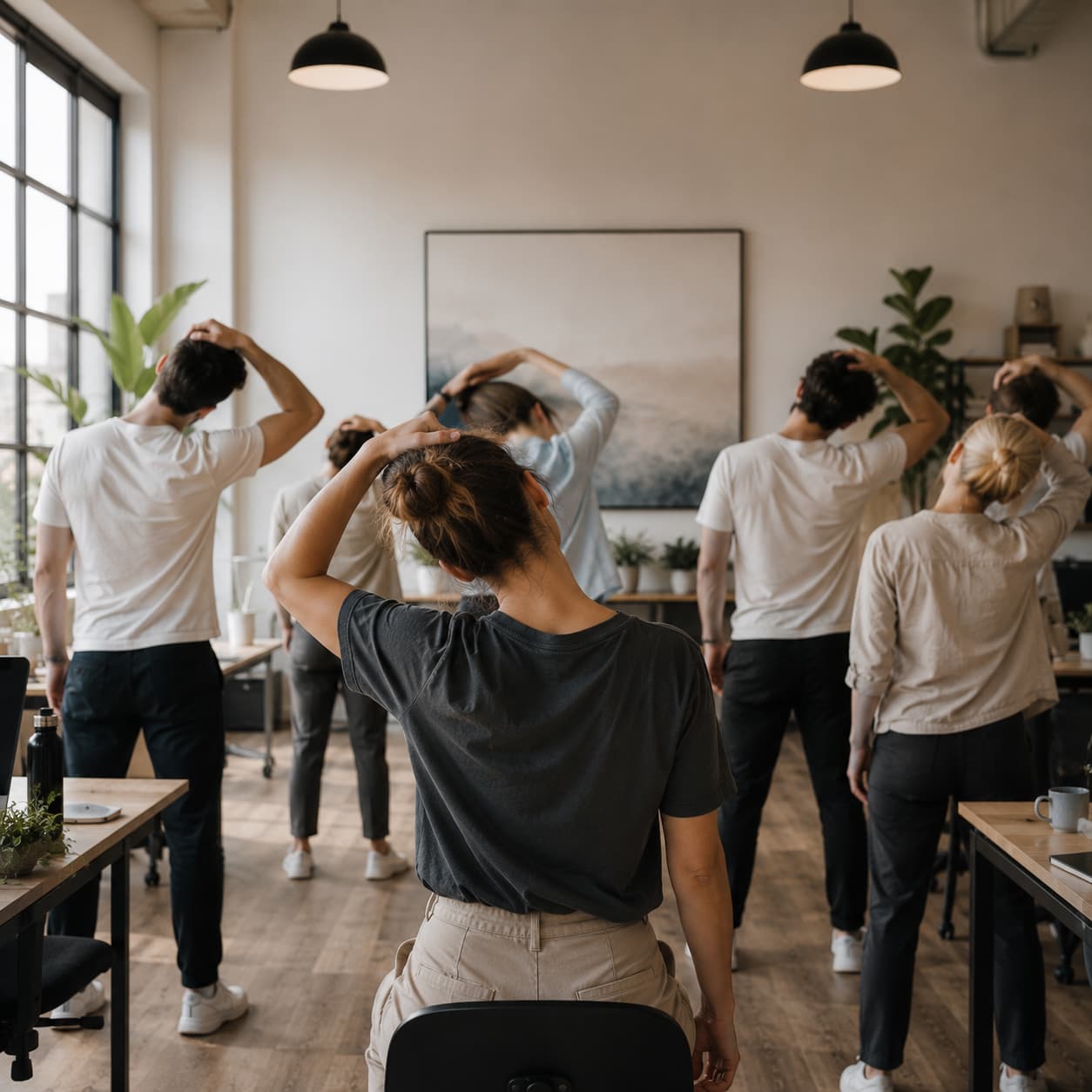
Instead of telling employees to “move more” in a vague way, it teaches specific movement resets they can use during the day. Shoulder mobility. Spinal movement. Hip resets. Breath-led posture awareness. Simple strength and stability. Movements that wake the body up without requiring a full workout, a change of clothes, or a public performance in the middle of the office.
That matters because stiffness is not solved by knowing that movement would help. It is reduced by actually moving.
Why fatigue builds during the working day
Workplace fatigue is not always about lack of sleep. Sometimes it is physical under-stimulation combined with mental overload. That is a delightful little cocktail, isn’t it?
Desk-based work can leave people mentally exhausted while physically stagnant. The brain is busy, but the body is underused. There is pressure, but not enough physical release. There is concentration, but not enough breath. There is stress, but not enough movement to discharge it.
This is why someone can sit all day and still feel drained.
They have not “done nothing.” Their nervous system has been working. Their attention has been pulled in multiple directions. Their posture muscles have been holding low-level tension. Their eyes have been locked onto screens. Their breathing may have been shallow for hours. Their body has been quietly managing the demands of work while receiving very little movement input.
Fatigue often builds when the body has no rhythm.
-
- No transition between tasks.
- No reset after meetings.
- No movement after long sitting.
- No breath after pressure.
- No physical shift between deep work and communication.
- No pause between one cognitive demand and the next.
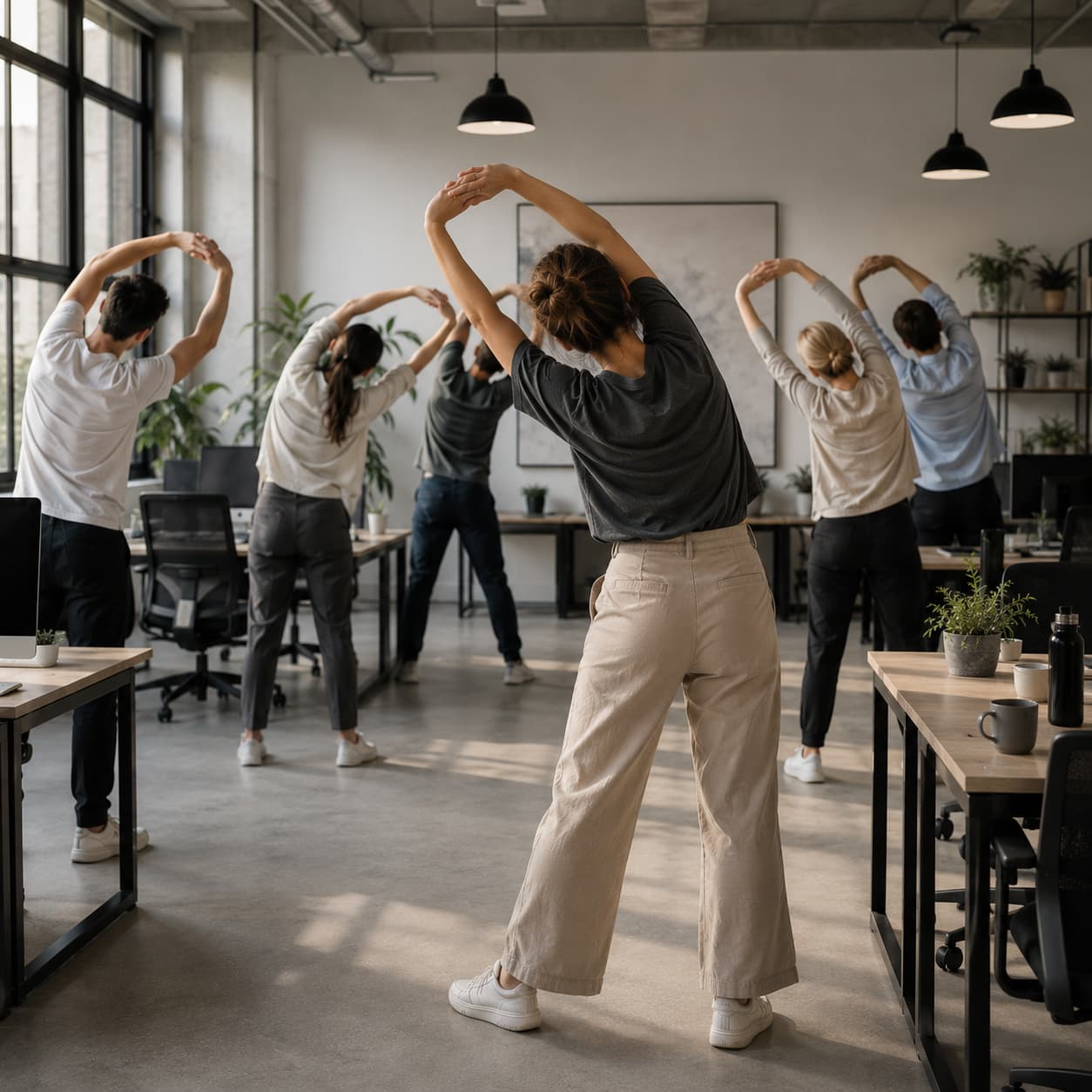
Sit Happens helps teams build small physical transitions into the working day. That might mean a short reset before a meeting, a shoulder and ribcage movement after screen-heavy work, a standing posture reset in the afternoon, or a breath-led movement sequence that helps employees return to the room instead of staying trapped inside the laptop.
The aim is not to make people hyper-productive little machines. The aim is to help the body stop dragging through the day like it has been abandoned under a desk.
Movement can support energy because it changes circulation, breath, posture, alertness and sensory feedback. It gives the body a signal that the day is not just one long seated block of cognitive sludge.
And honestly, most teams need that.
Why brain fog happens at work
Brain fog at work can have many causes, and not all of them are solved by movement. Sleep, stress, nutrition, workload, health conditions, hormones, medication, poor air quality, dehydration and mental overload can all play a role.
So no, Sit Happens does not claim to cure brain fog magically. We are not selling fairy dust in leggings.
But desk-based work patterns can absolutely contribute to the foggy, heavy, unfocused feeling many employees experience during the day.
When people sit for long periods, breathe shallowly, stare at screens, hold tension, skip breaks and move from meeting to meeting without physical reset, the brain does not operate in isolation. The body’s state affects attention. If the body is tense, tired and under-moving, focus often suffers.
Brain fog can feel like:
-
- Slower thinking
- Poor concentration
- Heavy eyes
- Afternoon slump
- Irritability
- Reduced patience
- Difficulty switching tasks
- Feeling mentally “muddy”
- Losing track of simple things
- Needing more caffeine to keep going
Some of this is normal. Humans are not designed to be cognitively sharp for eight straight hours while pretending that sitting still is neutral.
Sit Happens helps by using movement and breath to create a reset.
Movement changes state.
A few minutes of targeted movement can help employees shift from static, tense and foggy into more alert, physically present and focused. It does not need to be dramatic. It does not need to involve burpees, which should never be brought into an office unless everyone has consented and the carpet has done something terrible.
It can be simple.
Spinal movement. Shoulder mobility. Breath. Standing balance. Hip movement. Gentle strength. A reset that gets people out of one fixed position and into a different physical state.
That change in state is often what people need before they can think clearly again.
Decision box: does your team need Sit Happens?
| If your team is experiencing… | What may be happening physically | How Sit Happens can help |
|---|---|---|
|
Neck and shoulder stiffness |
Long screen use, tension habits, shallow breathing |
Shoulder, ribcage and posture resets |
|
Afternoon fatigue |
Mental overload with low physical movement |
Short movement breaks to support energy |
|
Brain fog |
Static posture, screen fatigue, poor transitions |
Breath-led movement and state-shifting resets |
|
Low engagement with wellbeing advice |
Employees are tired of being told what to do |
Practical sessions they can feel immediately |
|
Hybrid working strain |
Inconsistent home setups and long laptop hours |
Tools that work at home or in the office |
|
Meeting-heavy days |
Little physical transition between tasks |
Movement resets between cognitive demands |
|
Poor posture habits |
Repeated sitting patterns and low awareness |
Posture education through movement |
|
Stress held in the body |
Jaw, shoulders, chest and breath tension |
Regulation tools and tension release |
|
Reduced focus |
Physical discomfort affecting attention |
Movement that supports comfort and alertness |
|
Scepticism about wellbeing |
Employees dislike vague wellness language |
Grounded, useful movement without fluff |
Sit Happens starts with awareness, not correction
One of the worst ways to approach posture and workplace movement is to make people feel wrong.
Nobody needs a teacher walking into the office and announcing that everyone’s posture is terrible. People already know they feel stiff. They do not need public shame with a side of shoulder blades.
Sit Happens starts with awareness. That means helping employees notice what is happening in their bodies without turning it into a moral failure.
-
- Where do they hold tension?
- What happens to their shoulders when they concentrate?
- How do they breathe when they are stressed?
- Do they sit more into one hip?
- Does their jaw clench during difficult work?
- Do they stop moving when the day gets busy?
- Can they feel the difference after a reset?
This is important because awareness creates choice.
If someone has no idea they are holding their breath, they cannot change it. If they do not notice that their shoulders lift during every meeting, they cannot release them. If they do not realise they have not moved their spine for three hours, they will probably keep going until their body files a formal complaint.
Sit Happens gives people a way to notice earlier. Not obsessively. Not in a weird hyper-monitoring way. Just enough to catch the pattern before it becomes the whole day. That is where useful change begins.
Movement works because it gives immediate feedback
One reason Sit Happens is effective for desk-based teams is that employees can feel the difference quickly.
They do not have to believe in movement as a concept. They do not have to read a wellbeing theory. They do not have to become the sort of person who says “I’m just really into breathwork now” at parties, unless they want to, in which case, fine, but read the room.
They move, and they notice.
-
- A shoulder reset may reveal how much tension they were carrying.
- A breathing exercise may show how shallow their breath had become.
- A spinal movement may make them realise they had been sitting like a folded receipt for half the day.
- A hip reset may make standing feel different.
- A short sequence may shift energy more than another coffee would.
That immediate feedback matters.
It helps employees understand movement through experience, not instruction. When someone feels a reset work, they are more likely to use it again. That is how practical habits start.
Advice says, “You should move more.” Sit Happens says, “Try this. Feel the difference. Use it when you need it.”
Much better. Less patronising. More useful.
The programme is not fitness culture in office clothing
Sit Happens is not a fitness class disguised as workplace wellbeing. That distinction matters.
A lot of employees feel uncomfortable with workplace fitness. They do not want to sweat in front of colleagues. They do not want to be judged. They do not want to be the least flexible person in the room. They do not want a competitive challenge. They do not want someone shouting encouragement while they silently reconsider every career decision that brought them to this moment.
Sit Happens is different. It is workplace movement training.
That means the movement is designed around the working day, not around performance. It is practical, accessible and relevant to desk-based bodies. The focus is not weight loss, intensity, athleticism or exercise identity. The focus is helping people move better, breathe better, notice tension earlier and use simple resets that support their workday.
The tone matters too.
People engage better when the session feels grounded and intelligent, not fluffy, forced or embarrassing. Sit Happens is built to be useful for real teams, including people who are sceptical, tired, busy, self-conscious or not remotely interested in becoming “wellness people.”
They do not need to become wellness people. They need shoulders that do not feel like concrete by 3 pm.
Reasonable.
How Sit Happens reduces stiffness
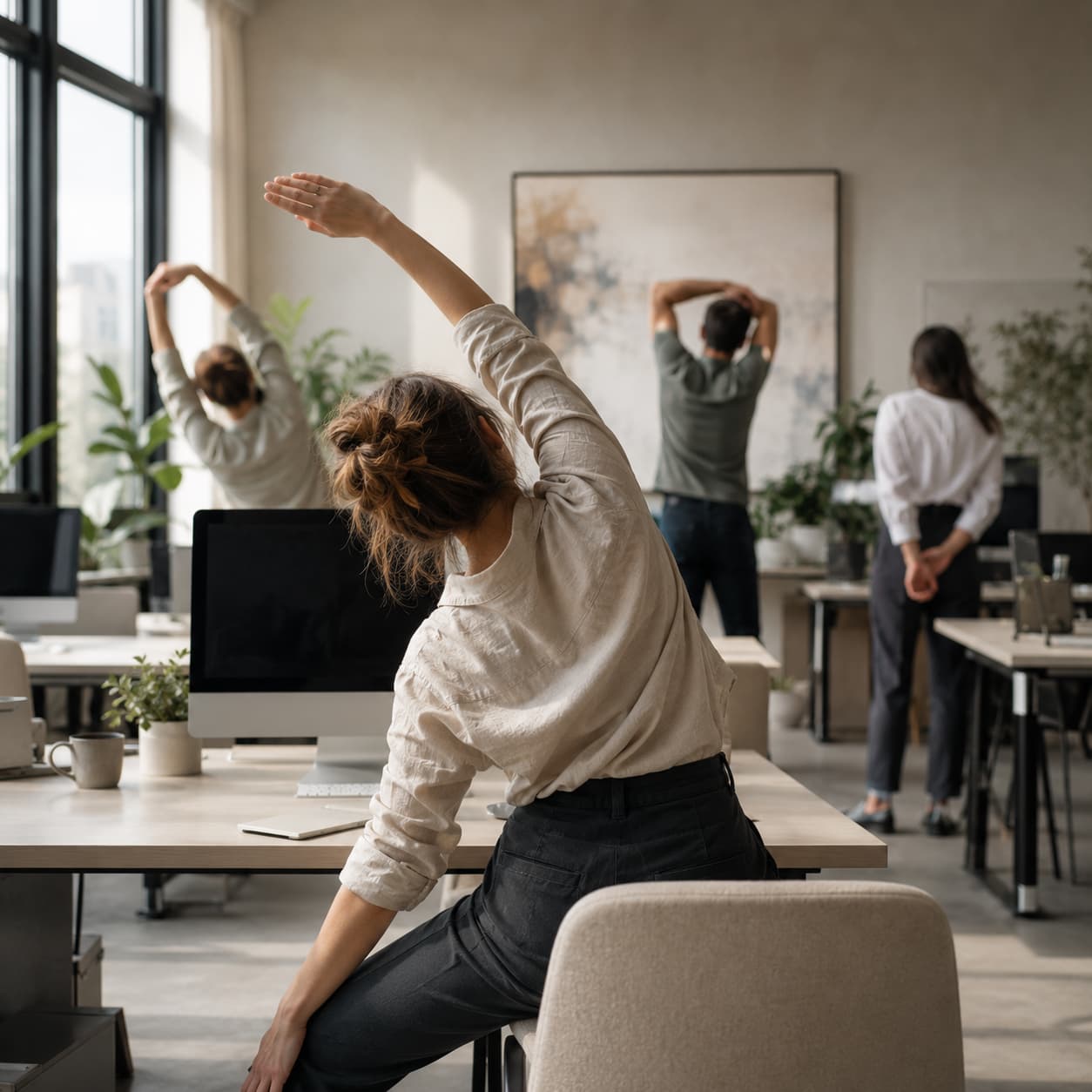
Sit Happens reduces stiffness by helping employees move the areas that desk work tends to lock down.
This usually includes the neck, shoulders, upper back, ribcage, spine, hips and sometimes wrists, feet and legs. The exact focus can shift depending on the team, but the underlying principle stays the same: the body needs movement variety.
Stiffness often builds because people spend too long in fixed positions. Sit Happens uses short, targeted movement to interrupt those positions.
For example:
-
- Shoulder circles and controlled shoulder mobility can help employees notice and release upper-body tension.
- Ribcage and breathing work can help reduce the rigid, braced feeling that often comes with screen work.
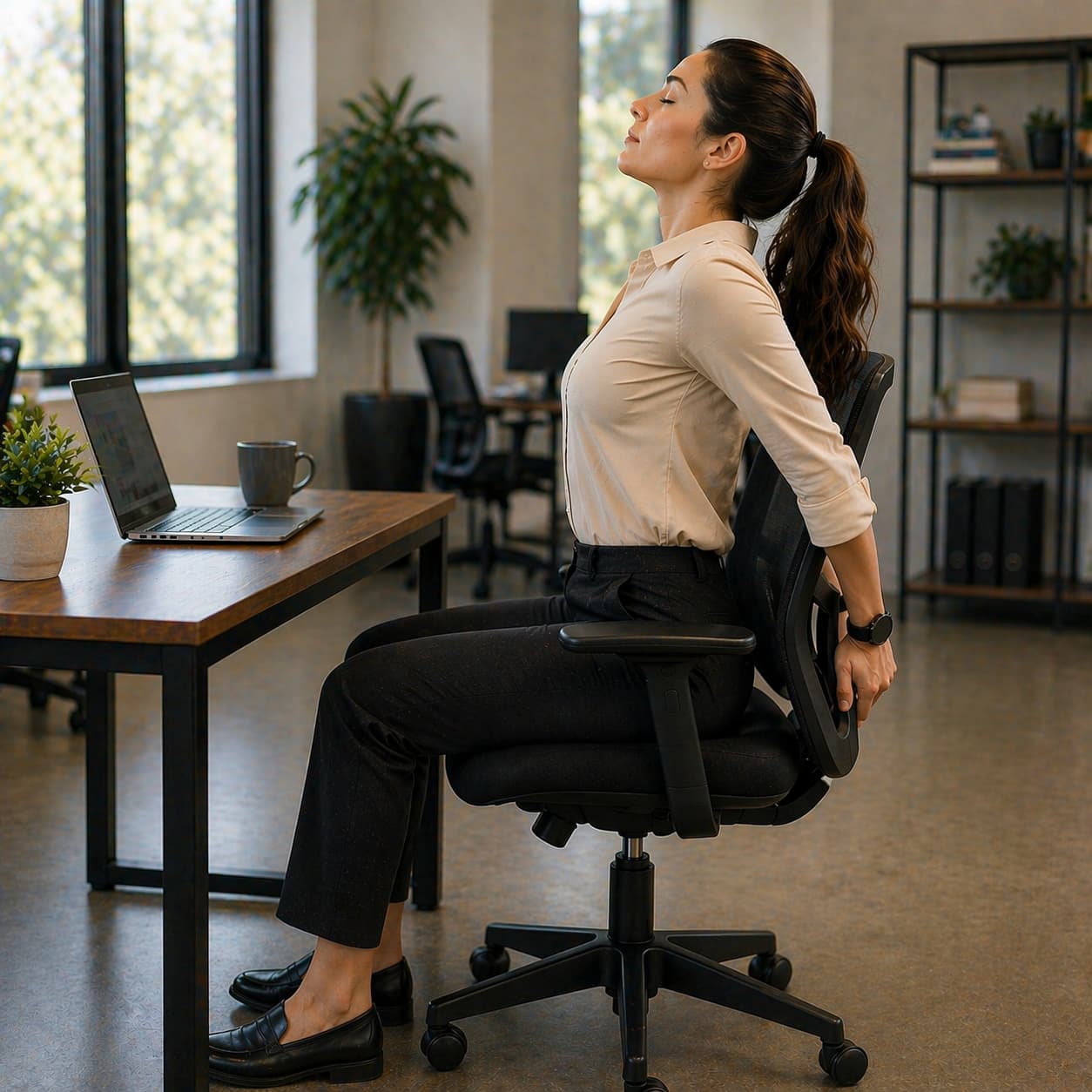
- Spinal movements can help the back move out of one fixed seated shape.
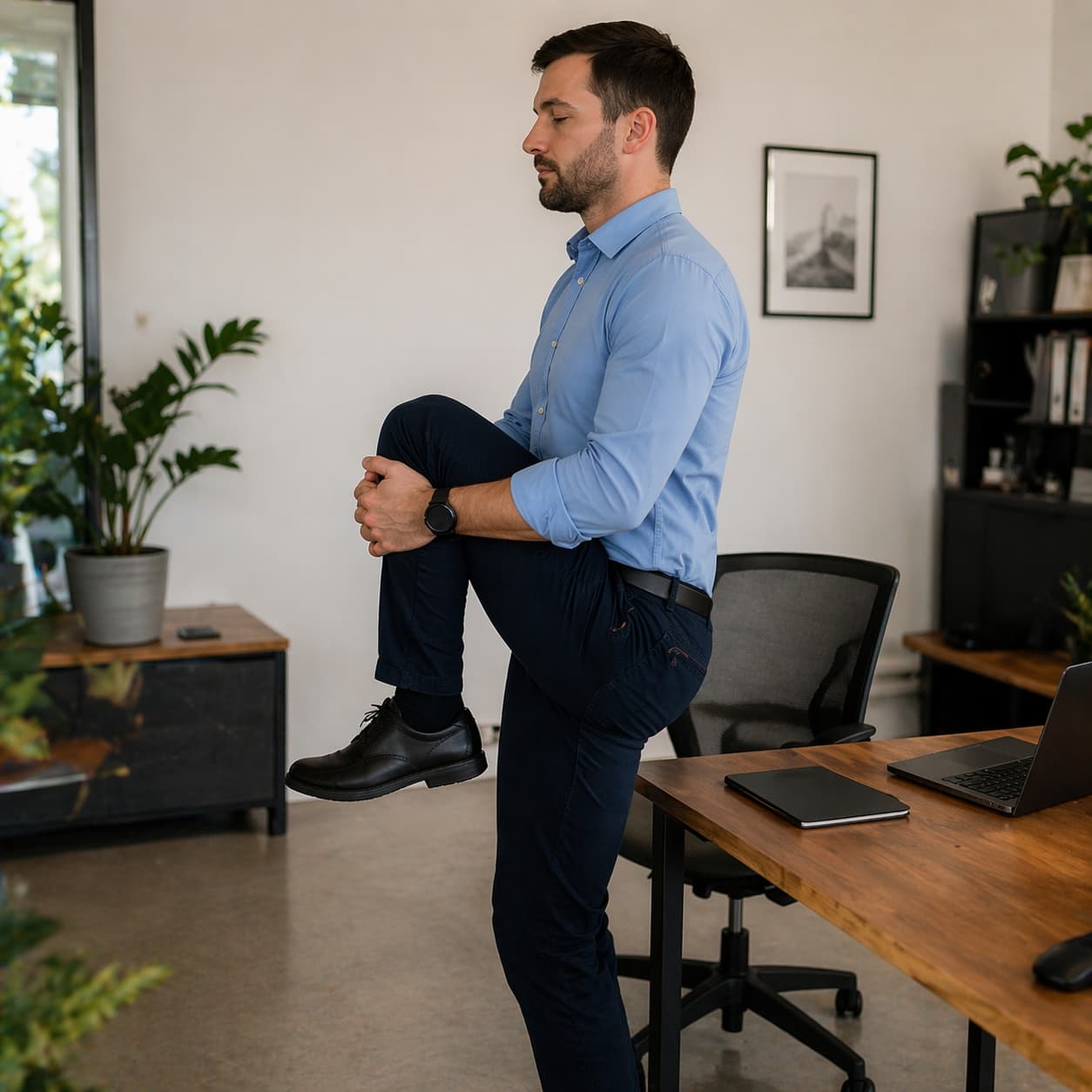
- Hip and leg resets can reduce the heavy, stuck feeling that comes from long sitting.
- Standing movement can help employees reconnect with balance, feet and posture.
- Simple strength work can support better physical confidence and postural endurance.
The aim is not to stretch everything aggressively.
Aggressive stretching in an office is rarely the answer, and also, nobody needs to see someone trying to prove a point with their hamstrings next to the printer.
The aim is to restore movement options. More movement options mean the body is less trapped in one pattern. That is what helps reduce stiffness over time.
How Sit Happens reduces fatigue
Sit Happens reduces fatigue by helping teams use movement as a reset rather than waiting until they are completely drained.
Fatigue often becomes harder to shift when people ignore it for hours. They push through. They stay seated. They drink more coffee. They keep staring at the screen. They answer one more email, then another, then another, until their brain starts buffering like a cheap hotel Wi-Fi connection.
Movement interrupts that downward slide.
A short reset can change breathing, posture, circulation and attention. It gives the body a different input. It breaks the physical monotony of sitting. It creates a pause between tasks. It helps employees feel less trapped inside the same position and mental loop.
Sit Happens teaches teams how to use these resets intelligently.
Not randomly. Not as another thing to remember and then feel guilty about forgetting. The programme helps employees connect specific tools to specific moments in the day.
For example:
-
- Before a long meetingAfter a difficult call
- Between deep work blocks
- During the afternoon slump
- After long screen focus
- Before returning to a task that needs concentration
- At the end of the day to release accumulated tension
This is how movement becomes practical.
It is not “do more exercise.” It is “use this movement here, because this is when your body needs a reset.” That is much more likely to stick.
How Sit Happens reduces brain fog
Sit Happens helps reduce brain fog by shifting employees out of static, tense, low-movement states.
Again, brain fog can have many causes, and some require medical, nutritional, workload or environmental attention. But for desk-based teams, physical stagnation often contributes to the fog.
When people sit still for long periods, breathe shallowly, hold tension and stare at screens, they can start to feel mentally dull. Movement helps create a state change. It brings attention back into the body, increases physical awareness, and gives the nervous system a different signal.
This can support clearer thinking. Not because movement is magic.
Because the body and brain are connected, inconvenient as that may be for workplace cultures that still treat people like floating heads attached to laptops.
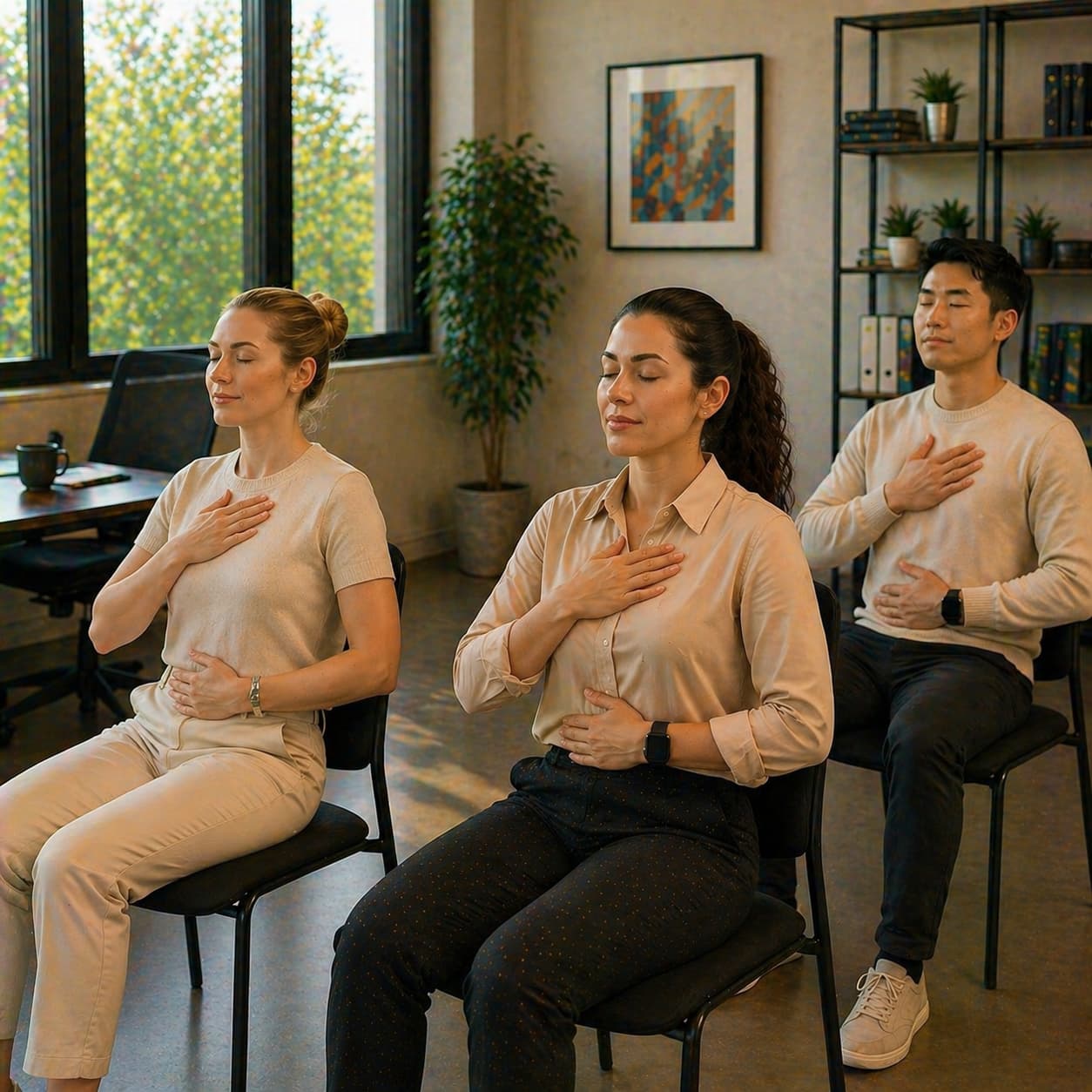
Sit Happens uses breath-led movement, mobility and posture resets to help employees feel more present. This can be especially useful during the afternoon, after back-to-back meetings, or when teams are switching from one kind of work to another.
A reset does not need to take long.
Sometimes, two or three minutes is enough to change how someone feels. Longer sessions build deeper understanding and stronger habits, but the small tools matter because they can be used inside the real working day.
That is the point. The best workplace movement tools are not impressive. They are repeatable.
Why breath is part of the programme
Breath is not added to Sit Happens because it sounds nice. It is there because desk-based work changes how people breathe.
When employees are stressed, focused or tense, breathing often becomes shallow, restricted or held. The ribcage moves less. The shoulders may lift. The jaw may clench. The body starts to brace. Over time, that can contribute to tension, fatigue and a sense of being physically locked.
Breath work in Sit Happens is practical.
It is not about dramatic breathing techniques or making everyone lie down and discover their childhood. Absolutely not. This is a workplace. People have spreadsheets. The aim is to help employees notice and use breath as part of movement.
Breathing can help with:
-
- Releasing shoulder tension
- Moving the ribcage
- Supporting posture
- Creating a pause
- Reducing bracing
- Improving body awareness
- Shifting out of stress patterns
- Helping movement feel calmer and more controlled
Breathing also gives employees a tool they can use quietly.
They do not always need to stand up or move through a full sequence. Sometimes they need a breath reset before replying to an email that should have been a meeting, or after a meeting that should have been an email. Workplace classics. Horrifying genre.
Breathing gives them a small way back into their body.
Why posture is taught through movement
Sit Happens does not rely on the usual “sit up straight” advice. Because frankly, that advice is weak.
Most people can sit up straight for about twelve seconds before their body returns to whatever pattern is familiar. Posture is not solved by instruction alone. It is supported by strength, mobility, breath, awareness, environment and movement variety.
Posture is dynamic.
It changes as people work, think, talk, type, read, listen and get tired. The goal is not to hold one perfect shape all day. The goal is to give the body more options, so employees can move, adjust and support themselves better.
Sit Happens teaches posture through experience.
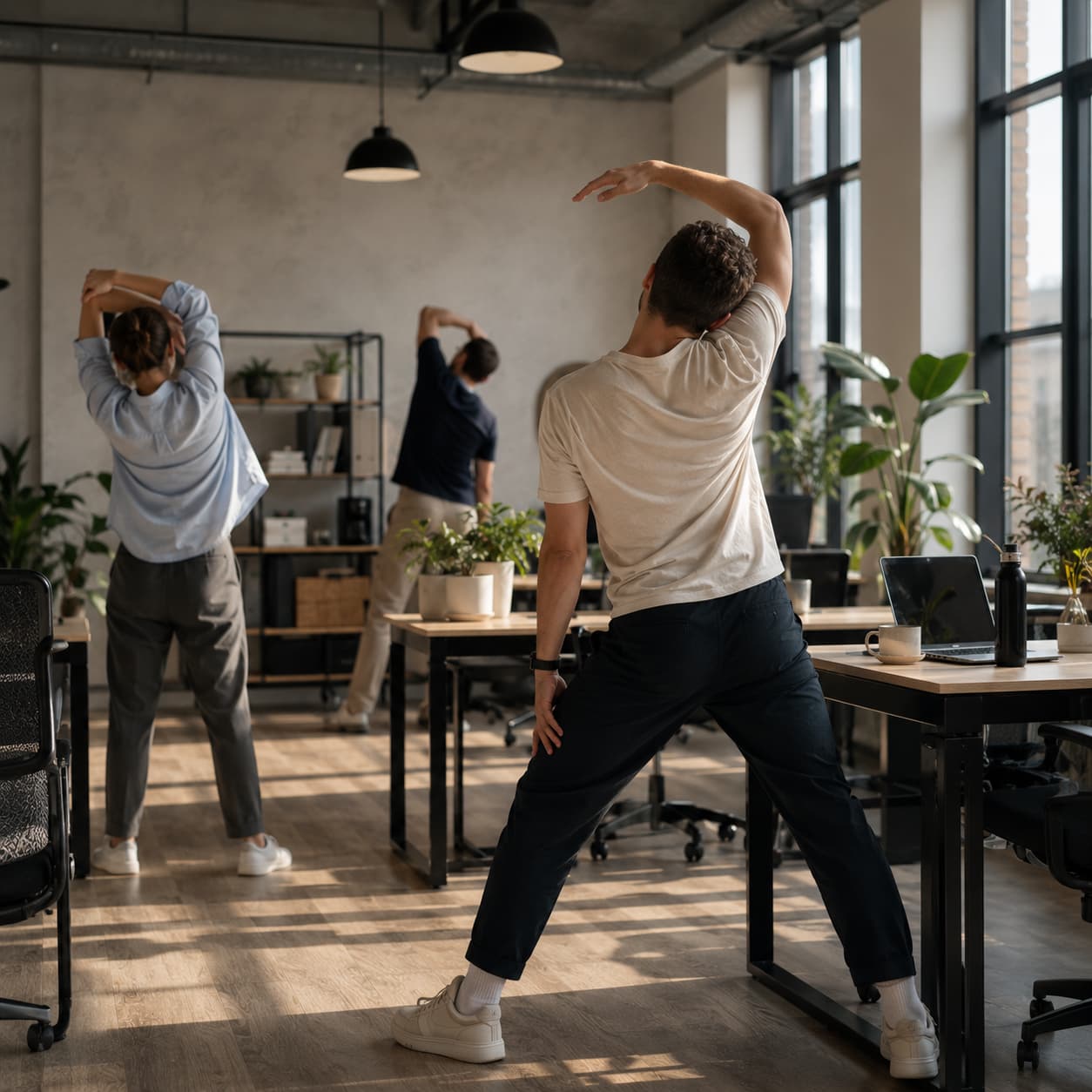
Employees learn how their shoulders, ribcage, spine, pelvis, hips and breath influence how they sit and stand. They feel the difference between collapse, bracing and support. They practise movements that make posture more accessible without turning it into another thing to get wrong.
That matters because posture shame is useless.
People do not need to be corrected like misbehaving furniture. They need to understand their body.
Why simple strength matters
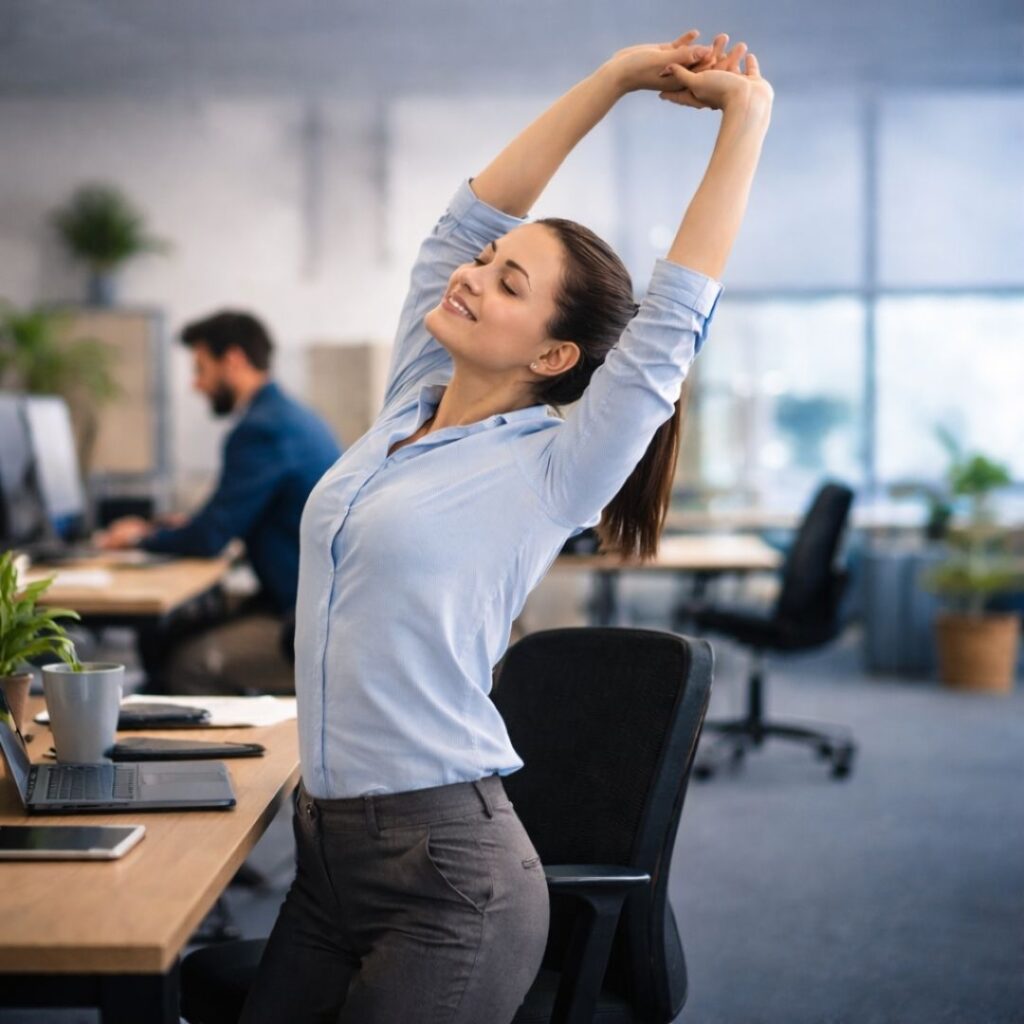
Mobility is important, but strength matters too. Desk-based workers often need more than stretching. They need enough strength and stability to support better posture, movement confidence and physical resilience through the day. That does not mean heavy gym work in the office.
It means simple, accessible strength work that helps employees feel how their body supports them. This might include controlled standing movements, balance, gentle core engagement, shoulder stability, hip strength, or low-intensity movement patterns that build awareness and control.
Strength is especially useful because it helps employees feel capable.
Not in a dramatic fitness way. In a practical “my body can support me better than I thought” way.
That kind of confidence changes how people relate to movement. It also helps prevent workplace movement from becoming just a collection of stretches. Stretching can feel good, but strength gives the body more support.
Sit Happens combines both. Because the body needs both. Annoying, but true.
What a Sit Happens session can include
A Sit Happens session is designed around the needs of desk-based teams, so the exact structure can vary. But the core ingredients are practical, clear and workplace-relevant.
A session may include:
-
- A short explanation of how desk work affects the body
- Awareness of common tension patterns
- Shoulder and neck mobility
- Ribcage and breath work
- Spinal movement
- Hip and leg resets
- Posture awareness
- Simple strength and stability
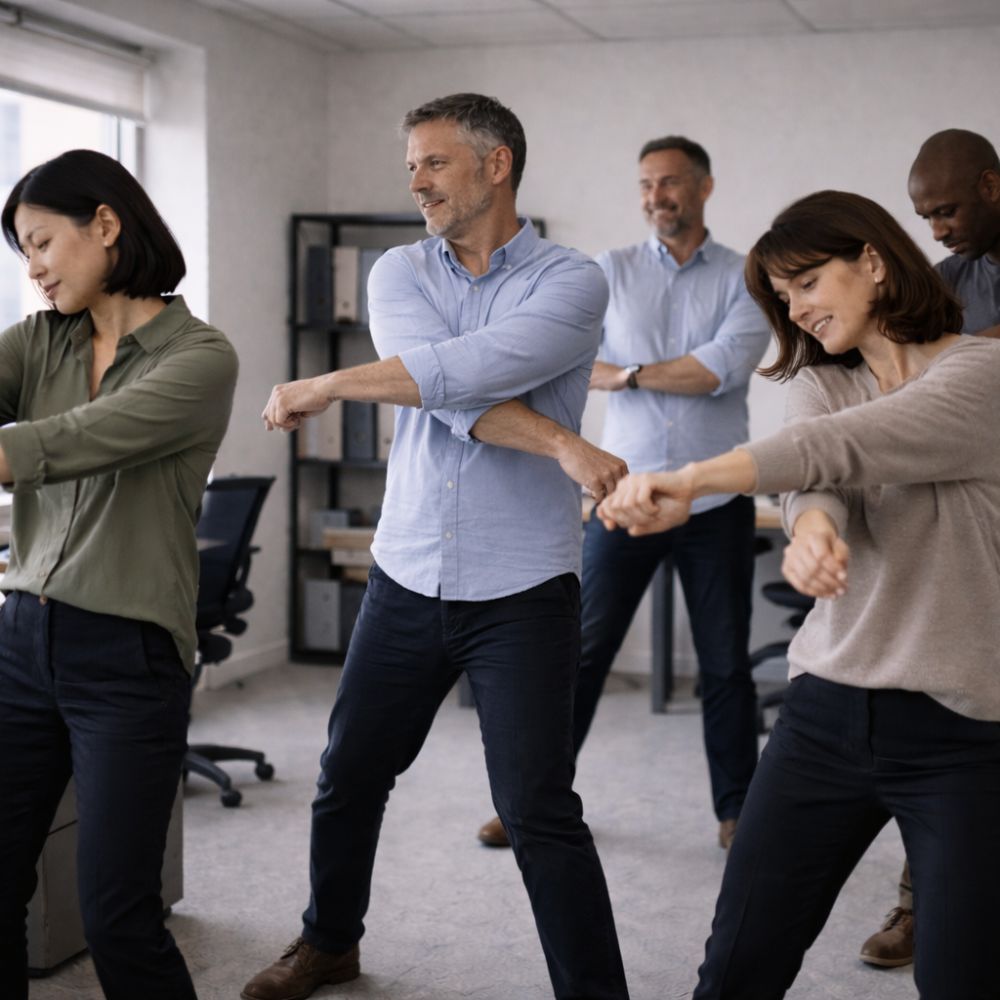
- Desk-based or standing movement options
- Short resets employees can repeat independently
- A calm finish or grounding tool
- Practical takeaways for the working day
The session is not designed to make people exhausted.
It is designed to make them more aware, more mobile, more comfortable and more able to use movement as part of their workday. That distinction is important.
If employees leave sweaty, embarrassed and determined never to attend anything again, that is not a win. If they leave understanding their body better and knowing two or three useful resets they can actually use, that is much more valuable.
Comparison table: common workplace symptoms and Sit Happens tools
| Workplace issue | Common physical pattern | Sit Happens tool |
|---|---|---|
|
Neck stiffness |
Forward head position, screen focus, shoulder tension |
Neck and shoulder mobility with posture awareness |
|
Shoulder tension |
Bracing, shallow breathing, stress holding |
Shoulder circles, ribcage movement and breath |
|
Upper back stiffness |
Long sitting, rounded posture, low spinal movement |
Spinal mobility and upper-back resets |
|
Hip tightness |
Prolonged sitting and limited position changes |
Hip and leg movement resets |
|
Lower back discomfort |
Static sitting, weak support, low movement variety |
Posture awareness, gentle strength and mobility |
|
Afternoon fatigue |
Low movement, mental overload, poor transitions |
Short energising movement breaks |
|
Brain fog |
Static posture, screen fatigue, shallow breathing |
Breath-led movement and state resets |
|
Stress tension |
Jaw, chest, shoulders and breath holding |
Regulation tools and slow movement |
|
Poor posture awareness |
Habitual sitting patterns |
Habitual sitting patterns |
|
Low confidence with movement |
Fear of getting it wrong or feeling awkward |
Accessible, non-performative movement options |
Why Sit Happens works for sceptical teams
Not everyone loves workplace wellbeing. Some people hear “wellbeing session” and immediately prepare to be patronised by a slideshow. Fair enough.
A lot of workplace wellbeing has been made deeply annoying. Too vague. Too fluffy. Too performative. Too full of phrases like “bring your whole self to work,” which sounds lovely until your whole self would rather be at home with a sandwich and no notifications.
Sit Happens works better for sceptical teams because it is practical.
It does not require employees to share feelings, believe in a philosophy, or become enthusiastic about wellness. It gives them something they can test in their own body.
-
- Move the shoulders.
- Breathe differently.
- Reset the spine.
- Stand up and feel the difference.
- Notice the tension.
- Use the tool.
That is it. Sceptical employees often respond well when something is clearly useful and not trying too hard to be inspirational. Sit Happens is not there to sell them a lifestyle. It is there to help them feel less stiff, less foggy and less physically wrecked by the working day.
That is a much easier sell. Because it is real.
Why this matters for managers and HR teams
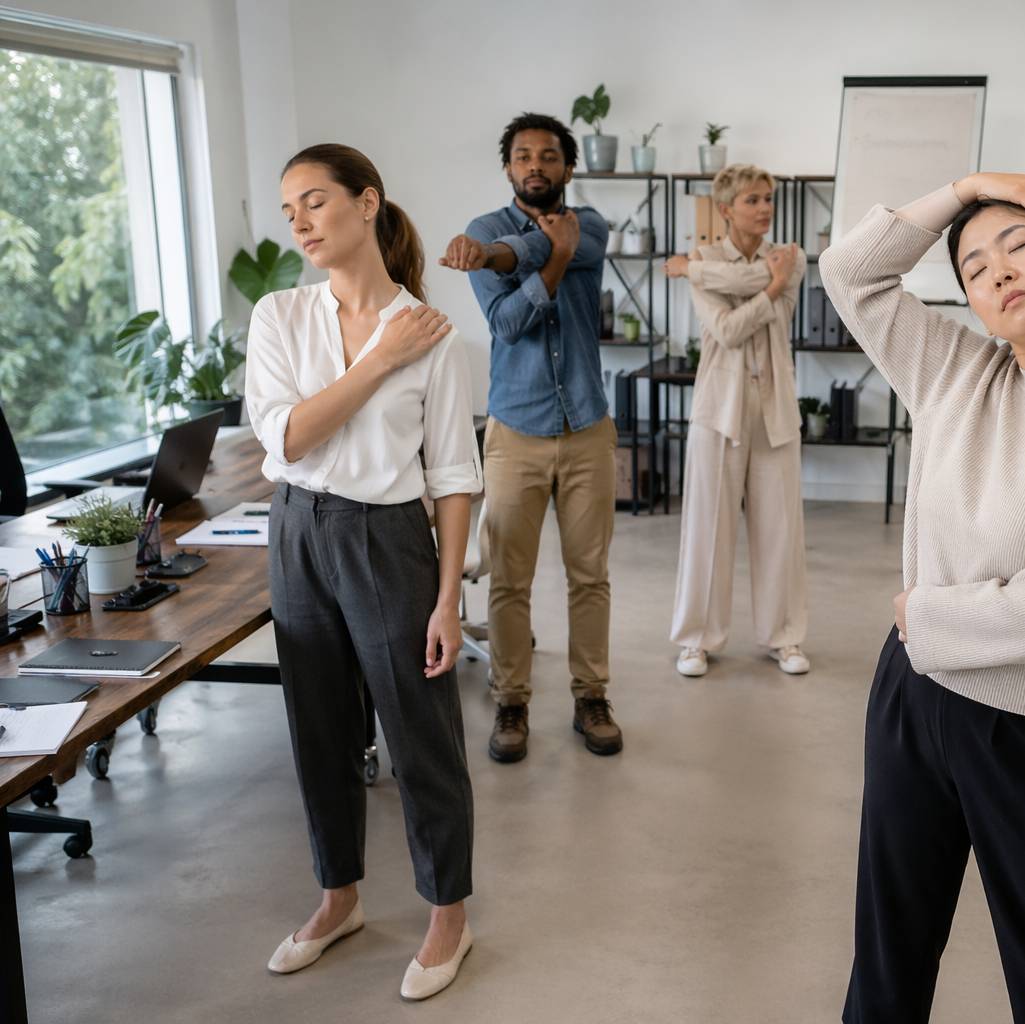
For managers and HR teams, Sit Happens offers a practical way to support employee wellbeing without adding more passive content to an already overloaded workplace. Many teams already have wellbeing resources.
They may have employee assistance programmes, mental health signposting, online portals, webinars, newsletters, policies, benefits and awareness campaigns. Some of that is valuable. But employees can still be physically struggling day to day.
Sit Happens fills a different gap. It supports the physical reality of desk-based work. That makes it useful for:
-
- Wellbeing days
- Staff development days
- Hybrid team support
- Office-based teams
- Screen-heavy roles
- Meeting-heavy departments
- Teams reporting fatigue or tension
- Companies wanting practical wellbeing support
- HR teams looking for measurable engagement
- Managers who want something useful rather than decorative
The programme can also be supported with simple feedback before and after sessions. Employees can report changes in tension, energy, posture awareness, focus and confidence using the tools.
That gives companies clearer insight into whether the session helped. And if something helps, it is worth knowing.
Why one session helps, but repetition works better
A single Sit Happens session can be useful.
It can introduce the team to practical movement, help employees notice tension patterns, and give them simple tools they can use straight away. For a wellbeing day or workplace event, that can be enough to create a strong first experience. But repeated sessions are where habits build.
The body learns through repetition. Employees need time to practise, remember, adapt and apply the tools in different moments of the working day. A longer programme allows the work to develop from awareness into habit.
Over time, a team can build:
-
- Better posture awareness
- More confidence using movement breaks
- More familiarity with breath resets
- More understanding of stiffness patterns
- Better physical transitions between tasks
- More willingness to move during the day
- A shared language around movement and comfort
This is where workplace movement becomes part of culture. Not in a forced way. In a normal way.
People start to recognise that moving for two minutes is not unprofessional. It is sensible. They start to notice when their body needs a reset. They become less awkward about movement at work because it has been introduced properly. That is the real value.
Sit Happens and hybrid working
Hybrid teams need movement support because their working environments vary wildly.
One employee may have a proper desk setup. Another may be working from a kitchen table. Another may be perched on a sofa with a laptop arrangement that looks like it was designed during a power cut. Someone else may have an expensive chair but still sit in the same position for five hours because the chair cannot move their spine for them.
Sit Happens gives hybrid teams tools they can use wherever they work.
The movements do not depend on a perfect office. They can be adapted for home, meeting rooms, desks, standing spaces or small work areas. That makes the programme useful for teams who split time between home and office.
Hybrid working has made physical awareness even more important.
Employees need to understand how to support themselves in different environments, not just rely on an ideal setup.
Sit Happens helps with that. It teaches movement options, not perfect conditions.
Which is useful, because real life rarely provides perfect conditions. It mostly provides a laptop, a chair of questionable moral character, and a meeting starting in four minutes.
What companies should expect from Sit Happens
Companies should expect a grounded, practical movement session or programme designed around real workplace needs.
They should not expect a performance. They should not expect employees to be pushed into fitness culture. They should not expect movement to magically solve structural workplace issues. They should expect employees to leave with a better understanding of how desk work affects the body and practical tools they can use during the day.
A good outcome might include employees saying:
“My shoulders feel better.”
“I did not realise how tense I was.”
“That breathing reset actually helped.”
“I could use that between meetings.”
“I feel more awake.”
“That was less awkward than I expected.”
“I need to move more during the day.”
“I can feel the difference.”
That is the kind of response that matters. Not forced enthusiasm. Useful recognition.
Practical checklist before booking Sit Happens
| Question | Why it matters |
|---|---|
|
Is your team mostly desk-based? |
Sit Happens is designed around sitting, screens and office work |
|
Do employees report stiffness or discomfort? |
The programme can target common tension patterns |
|
Is afternoon fatigue common? |
Movement resets can support energy and alertness |
|
Do people experience brain fog or screen fatigue? |
Breath-led movement can help shift state |
|
Are employees tired of generic wellbeing advice? |
Sit Happens is practical and experience-based |
|
Is your team hybrid? |
The tools can be adapted for home and office |
|
Do managers support movement during work time? |
Culture matters if habits are going to stick |
|
Would a one-off or programme work better? |
One session introduces tools, repetition builds habits |
|
Do you want feedback from staff? |
Simple pre- and post-session feedback can show value |
|
Do you want a grounded, non-performative session? |
Sit Happens is designed to be useful, not theatrical |
How Sit Happens fits into a wider wellbeing strategy
Sit Happens should not replace other wellbeing support. It should sit alongside it.
A strong wellbeing strategy may include mental health support, workload review, leadership training, flexible working, proper breaks, good communication, ergonomic awareness, psychological safety and clear boundaries. Movement does not replace those things.
But movement adds something essential. It brings the body into the conversation.
Too many wellbeing strategies focus heavily on mental health, stress management and advice while underestimating the physical reality of work. Employees are not just thinking their way through the day. They are sitting, typing, bracing, breathing, moving, not moving, holding tension and trying to function in a body.
Sit Happens supports that body. That makes the rest of the wellbeing strategy more grounded. Because if the body is ignored, wellbeing remains incomplete.
Final thoughts: Sit Happens makes workplace wellbeing physical
Sit Happens helps teams reduce stiffness, fatigue and brain fog because it gives the body something practical to do. That sounds simple because it is.
Desk-based teams do not need endless advice about moving more. They need movement that fits the working day. They need tools they can use between meetings, after long screen sessions, during afternoon fatigue, and before stiffness becomes the default setting.
The programme helps employees notice tension earlier, move stiff areas, breathe more fully, reset posture, build awareness and shift out of static work patterns.
It is not a cure-all. It is not a fitness class. It is not corporate wellness fluff wearing better shoes. It is a practical workplace movement for real desk-based bodies.
And for many teams, that is exactly the missing piece.
If your team spends most of the day sitting, working at screens, moving between meetings and dealing with stiffness, fatigue or brain fog, Sit Happens offers practical workplace movement training designed for real office life.
Explore the programme here: Sit Happens
You can also explore the wider movement practice here: Movement
Key takeaway
Sit Happens helps teams reduce stiffness, fatigue and brain fog by making movement practical, repeatable and relevant to desk-based work. It teaches employees how to reset posture, move through stiffness, breathe better, release tension and rebuild physical awareness during the working day, without turning the office into a gym or making anyone perform wellness theatre under fluorescent lighting.
Frequently Asked Questions
Sit Happens helps reduce stiffness by teaching employees simple movement resets for the areas most affected by desk work, including the neck, shoulders, spine, ribcage, hips and back. The aim is to interrupt long sitting patterns and give the body more movement variety during the working day.
Yes, workplace movement can help with fatigue by creating physical resets during the day. Sitting still for long periods while working mentally can leave employees feeling drained. Short movement breaks can support circulation, breath, posture and alertness, which may help people feel less sluggish.
Sit Happens can support employees who experience brain fog linked to long sitting, screen fatigue, shallow breathing and lack of movement. It does not claim to treat medical causes of brain fog, but movement and breath-led resets can help employees shift state and feel more present during the working day.
No. Sit Happens is not a fitness class. It is workplace movement training designed for desk-based teams. The focus is posture awareness, mobility, breathing, simple strength, tension release and practical movement tools employees can use at work.
No. Employees do not need to be fit, flexible or experienced to take part. Sit Happens is designed to be accessible and adaptable. It is not about performance, intensity or exercise ability. It is about helping people move better during the working day.
Yes. Sit Happens can be delivered in an office, meeting room or suitable workplace space. Many movements can be done standing, seated or using minimal space. The session can be adapted depending on the room, team and workplace setting.
Yes. Sit Happens is suitable for hybrid teams because the tools can be used both at home and in the office. This is useful for employees who work from different setups and need practical movement options that do not depend on perfect ergonomic conditions.
A Sit Happens session can be adapted depending on the company’s needs. A shorter session can work well as an introduction, while a longer session allows more time for education, movement practice and takeaways. A repeated programme is usually better for building habits over time.
Sit Happens can include posture awareness, shoulder and neck mobility, ribcage and breath work, spinal movement, hip resets, simple strength, balance, desk-based movement options and practical resets employees can repeat during the working day.
A well-delivered workplace movement session should not feel awkward or performative. Sit Happens is designed to be calm, grounded and practical. Employees are not expected to perform, compete or exercise intensely in front of colleagues.
Companies can use simple pre- and post-session feedback to track changes in stiffness, energy, focus, posture awareness and confidence using movement tools. For longer programmes, they can also track attendance, employee comments and whether staff continue using the resets.
Companies can explore Sit Happens, a practical workplace movement programme for desk-based teams, here: Sit Happens. The wider movement practice is available here: Movement.