
School Movement Programmes in Nottingham: Supporting Focus, Confidence and Physical Development
TL;DR
School movement programmes in Nottingham give pupils a structured, inclusive way to build focus, confidence, coordination, strength, posture, balance and body awareness through movement.
These sessions are not designed to replace PE. They support the physical foundations that help pupils participate more confidently in PE, school life, after-school clubs and everyday movement.
A good school movement programme gives children and young people a different route into physical activity. It is useful for pupils who enjoy sport, pupils who avoid sport, pupils who need more confidence, pupils who need calmer movement, and pupils who benefit from clear structure, repetition and safe challenge.
The sessions can include yoga, Pilates, strength-based movement, mobility, balance, coordination, breath awareness and guided rest, all delivered in an age-appropriate, school-friendly way.
For the main school offer, visit School Movement Programmes in Nottingham.
For local children’s and teen classes outside school, visit Children’s & Teen Yoga and Pilates in West Bridgford.
Definition: what are school movement programmes?
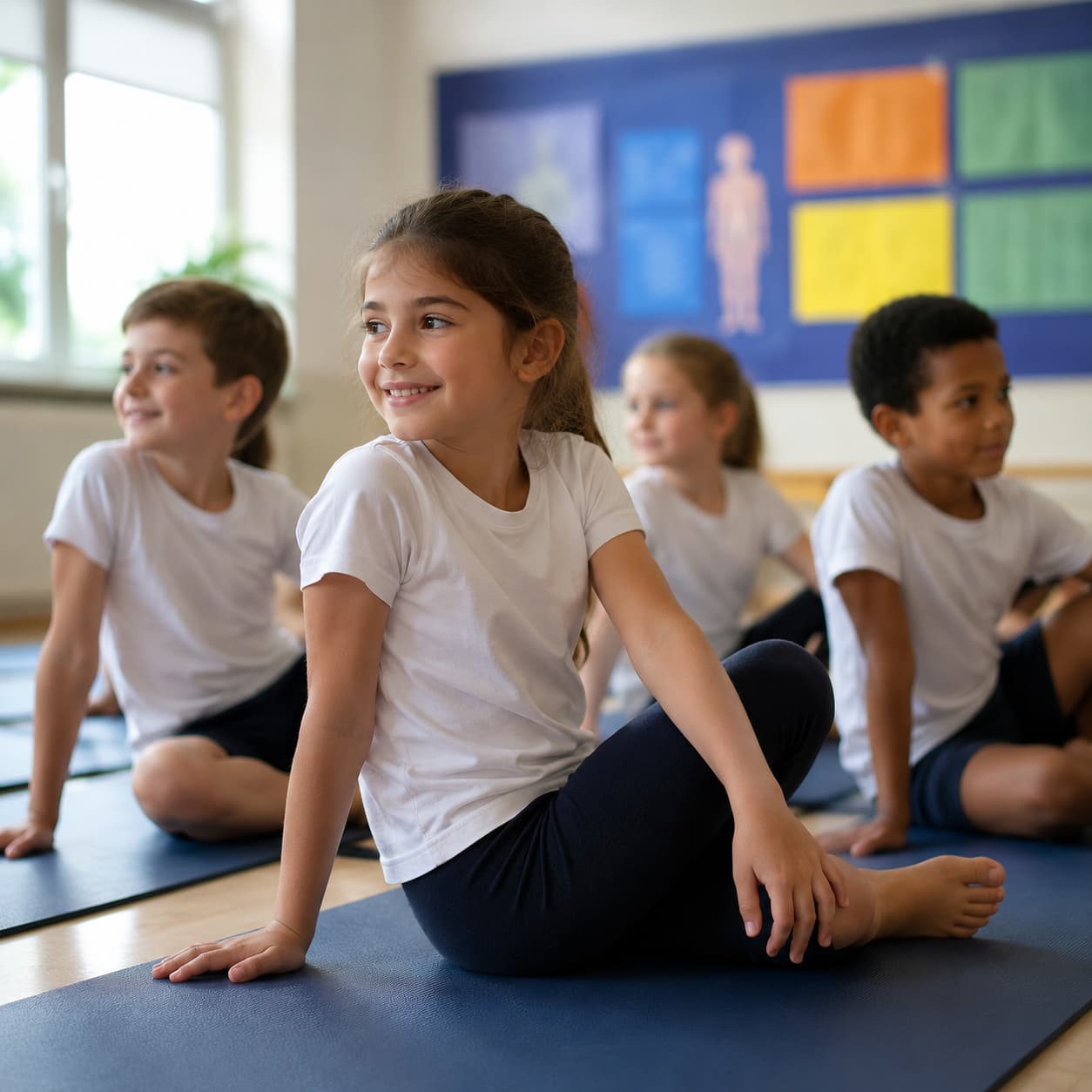
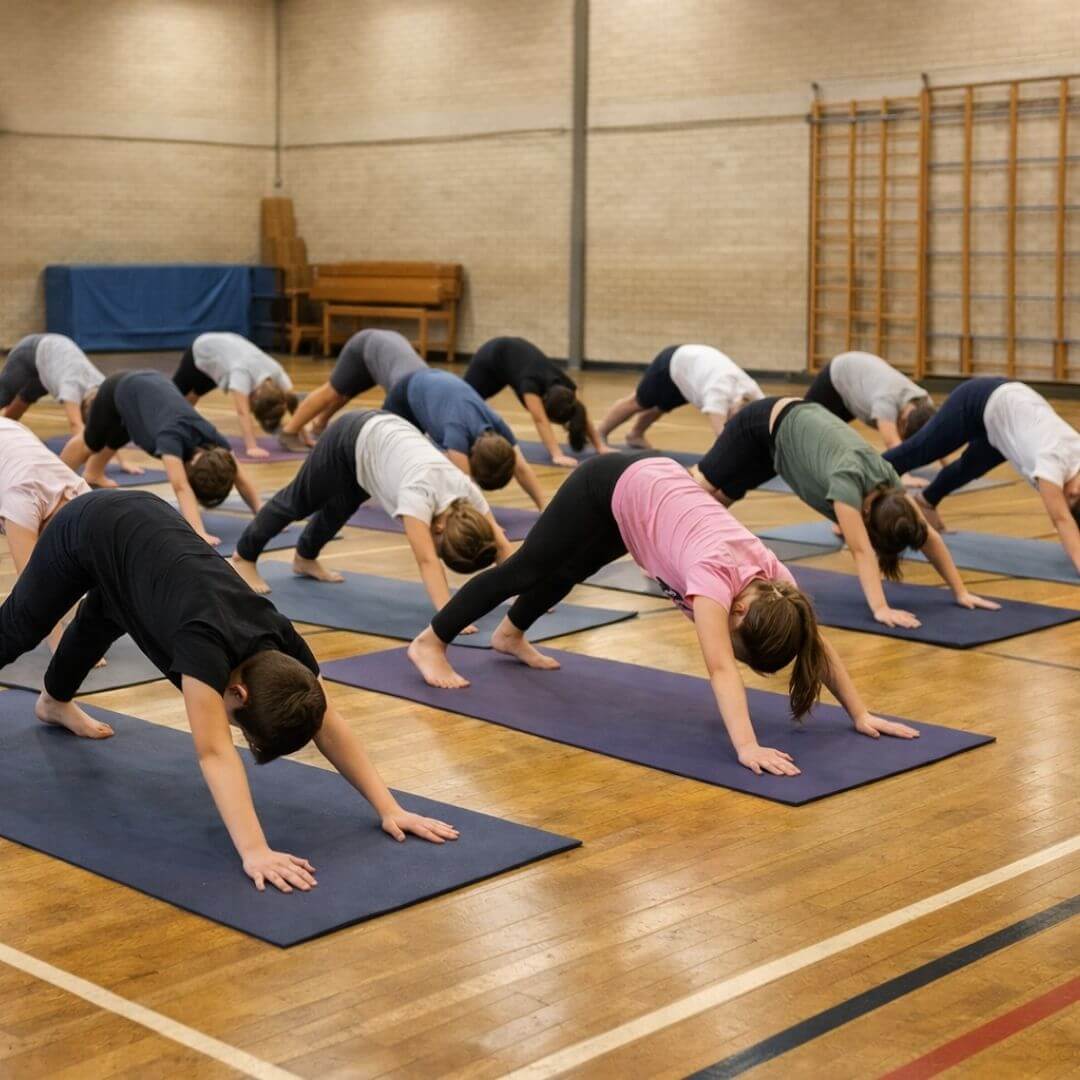
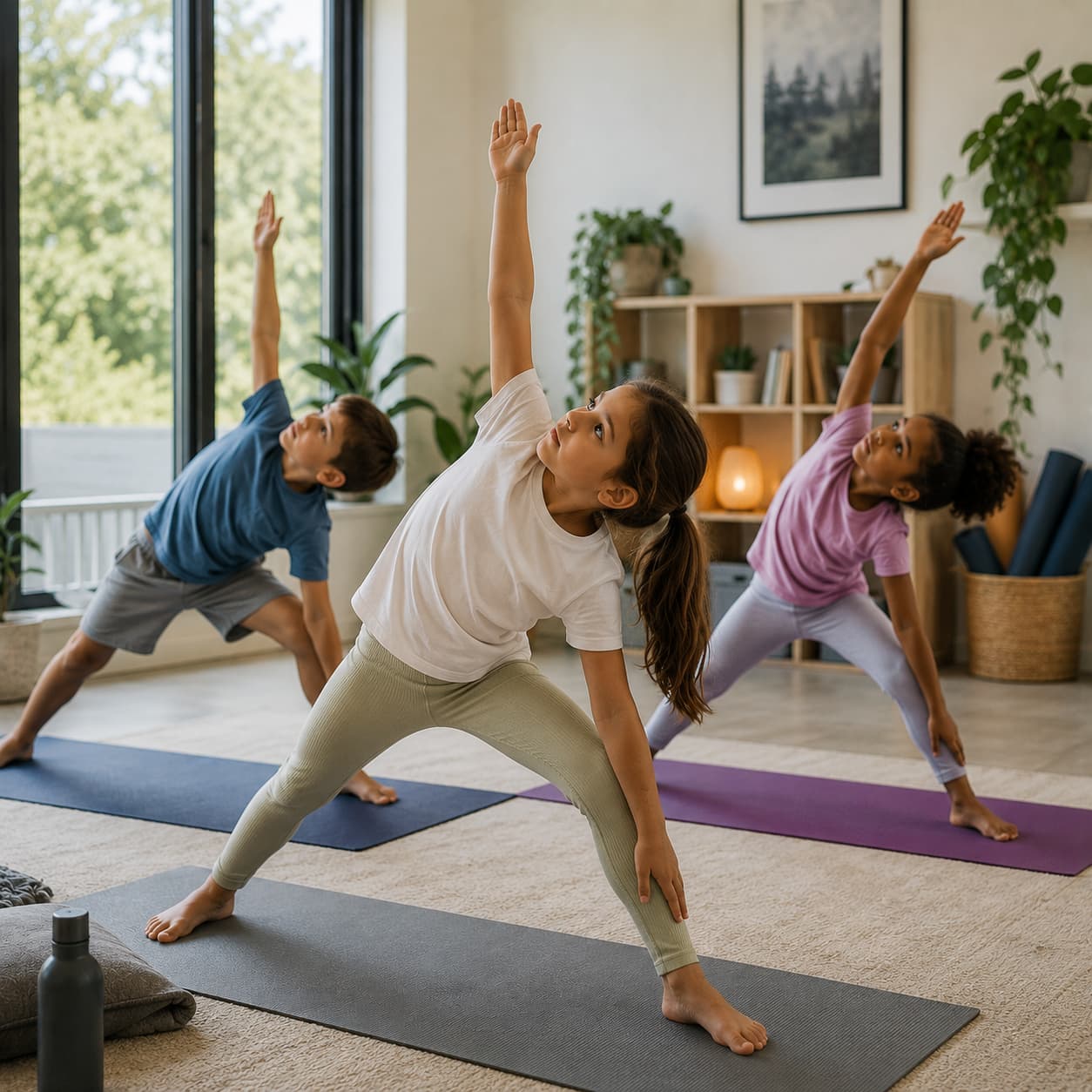
School movement programmes are structured, age-appropriate movement sessions delivered within a school setting. They may include yoga, Pilates, mobility, balance, coordination, simple strength work, posture awareness, breath work and guided rest. The aim is to support pupils’ physical confidence, focus, body awareness and wellbeing through practical movement, not to replace PE or create another competitive environment.
Why school movement programmes matter
Children need movement, but not all children find confidence through the same kind of movement.
Some pupils love PE. They enjoy team games, competition, speed, rules, winning, losing, shouting, running, and the general organised chaos of school sport. Brilliant. That route works beautifully for some children.
But it does not work for all of them.
Some pupils become anxious the second they feel watched. Some dread being picked last. Some are physically capable but lack confidence. Some are flexible but not strong. Some are strong but uncoordinated. Some are quiet and cautious. Some are full of energy but struggle to control it. Some avoid PE because they have already decided they are “not sporty,” which is a horrible little label to carry around when you are still growing into your own body.
School movement programmes offer another route.
They give pupils a structured way to move without ranking, scoring, timing or comparison. The work is still active. It still involves effort. It still builds physical capacity. It is not a soft option where everyone gently waves an arm and calls it wellbeing.
It is movement taught differently.
The focus is strength, balance, coordination, posture, mobility, breath, attention, confidence and body awareness. Pupils are encouraged to notice what they can do, practise safely, try again, and build physical trust over time.
That matters because physical confidence is not just about sport.
It affects how pupils sit, stand, walk, join in, focus, recover from mistakes, manage effort, regulate energy and feel in their own bodies.
A school movement programme gives pupils somewhere to build those foundations.
Why schools need more than standard PE alone
PE is important. Obviously.
A good PE curriculum gives pupils access to sport, skill development, teamwork, physical challenge, coordination, health education and active participation. It matters enormously.
But PE cannot always meet every movement need on its own.
Some pupils need more time with the basics. Some need calmer repetition. Some need movement without competition. Some need support with posture, body awareness and confidence before they can fully participate in more dynamic physical activities. Some need a quieter way into movement because the usual sport-first model makes them shut down before they even begin.
This is where school movement programmes can sit alongside PE.
They do not replace it.
They support it.
Yoga, Pilates and structured movement can help pupils develop the physical foundations that make PE more accessible. Strength, balance, coordination, mobility, focus, confidence and body awareness are not separate from sport. They sit underneath it.
If a child cannot balance well, struggles to coordinate movement, feels physically awkward, lacks core support, or panics when asked to perform in front of others, PE can feel like a public test rather than a place to learn.
A movement programme gives them another space to build capacity. That is not lowering expectations. It is giving pupils better foundations.
Decision box: when does a school movement programme make sense?
| If your school wants to support… | A movement programme can help by… | Useful format |
|---|---|---|
|
Pupils who lack confidence in PE |
Giving them movement without ranking or comparison |
6-week movement block |
|
Focus and attention |
Using structured movement, breath and repetition to help pupils settle |
Weekly sessions or wellbeing provision |
|
Physical development |
Building strength, balance, posture, mobility and coordination |
Curriculum enrichment or PE support |
|
Pupils who avoid sport |
Offering a different route into physical activity |
Small group or after-school club |
|
Transition support |
Helping pupils settle through movement and routine |
Transition day or 6-week programme |
|
Emotional regulation |
Combining movement, breath and calm endings |
Wellbeing sessions |
|
Posture and body awareness |
Teaching pupils how their body moves and supports them |
Pilates-based movement |
|
After-school provision |
Offering a calmer, confidence-building club |
Weekly after-school sessions |
|
Enrichment weeks |
Providing practical, active wellbeing without lectures |
One-off or half-day sessions |
|
Inclusive physical activity |
Creating movement options for different confidence levels |
Adapted school programme |
Movement supports focus because the body is part of attention
Focus is often treated like a purely mental skill.
Sit still. Listen. Concentrate. Pay attention. Stop fidgeting. Face the front. Do the work.
Lovely in theory.
In practice, children are not floating brains in school jumpers. They have bodies. Bodies that get restless, tired, stiff, overstimulated, under-stimulated, anxious, hungry, distracted, excited, and occasionally possessed by the urgent need to swing on a chair despite every adult in the room developing a twitch.
Movement can help because attention is physical too.
A pupil who has been sitting for a long time may struggle to focus, not because they are lazy or badly behaved, but because their body needs a reset. A pupil who is anxious may struggle to listen because their nervous system is busy scanning for threat. A pupil who has poor body awareness may find it hard to sit comfortably, organise themselves physically, or stay present in the room.
Structured movement gives pupils a way to come back into their bodies.
It can help them notice effort, slow down, coordinate movement, breathe more fully, settle after activity, and transition from physical energy into calmer attention.
That does not mean movement magically fixes every focus issue. Schools are complex places, and pupils are not robots with a reset button behind the left ear.
But movement can create better conditions for focus. It gives pupils a physical route into attention rather than simply demanding stillness and hoping for the best.
Movement builds confidence because pupils experience progress
Confidence is not built by telling children to be confident. If only it were that easy. We could all save a lot of time and simply shout “believe in yourself” across the hall like a motivational PE cone. Real confidence grows through experience.
A pupil tries something. It feels difficult. They wobble. They adjust. They try again. They improve slightly. They notice the improvement. They begin to trust that they can learn.
That is the kind of confidence movement can build.
School movement programmes are especially useful because they create repeated, low-pressure opportunities for pupils to experience progress. They may hold a balance for longer, move with more control, understand a breathing pattern, stand taller, coordinate both sides of the body, complete a sequence, or stay with a challenge without giving up immediately.
These moments may look small from the outside. They are not small to the pupil.
For a child who has spent years feeling awkward in PE, a single moment of “I can do this” can matter. For a pupil who avoids physical challenge, trying again without embarrassment matters. For a child who always rushes, learning to slow down matters. For a pupil who is quiet and cautious, joining in without fear matters.
Movement gives confidence somewhere practical to grow. Not as an abstract idea. As evidence in the body.
Physical development needs more than speed and stamina
When schools talk about physical development, the conversation often leans towards fitness, sport, activity levels and health. Those things matter, but physical development is broader than that.
Children and young people also need strength, mobility, balance, coordination, posture, body awareness, control, confidence and the ability to understand effort without pushing into strain. They need movement variety. They need opportunities to practise different patterns, not just run faster, throw harder or compete better.
Yoga, Pilates and structured movement can support this wider foundation. Yoga can help with mobility, balance, breath, focus and calm. Pilates can help with posture, core support, control, strength and coordination.
Structured movement can bring these elements together in a school-friendly way, using age-appropriate exercises that help pupils feel more capable and aware.
This is especially useful for pupils who are still developing basic movement confidence. A child may be active but poorly coordinated. A child may be sporty but stiff. A child may be flexible but lack stability. A child may be strong but struggle to move with control. A child may be physically able but deeply self-conscious.
Physical development is not just about doing more. It is about moving better, understanding the body more clearly, and building confidence in a way that pupils can carry into other activities.
Why yoga works well in schools
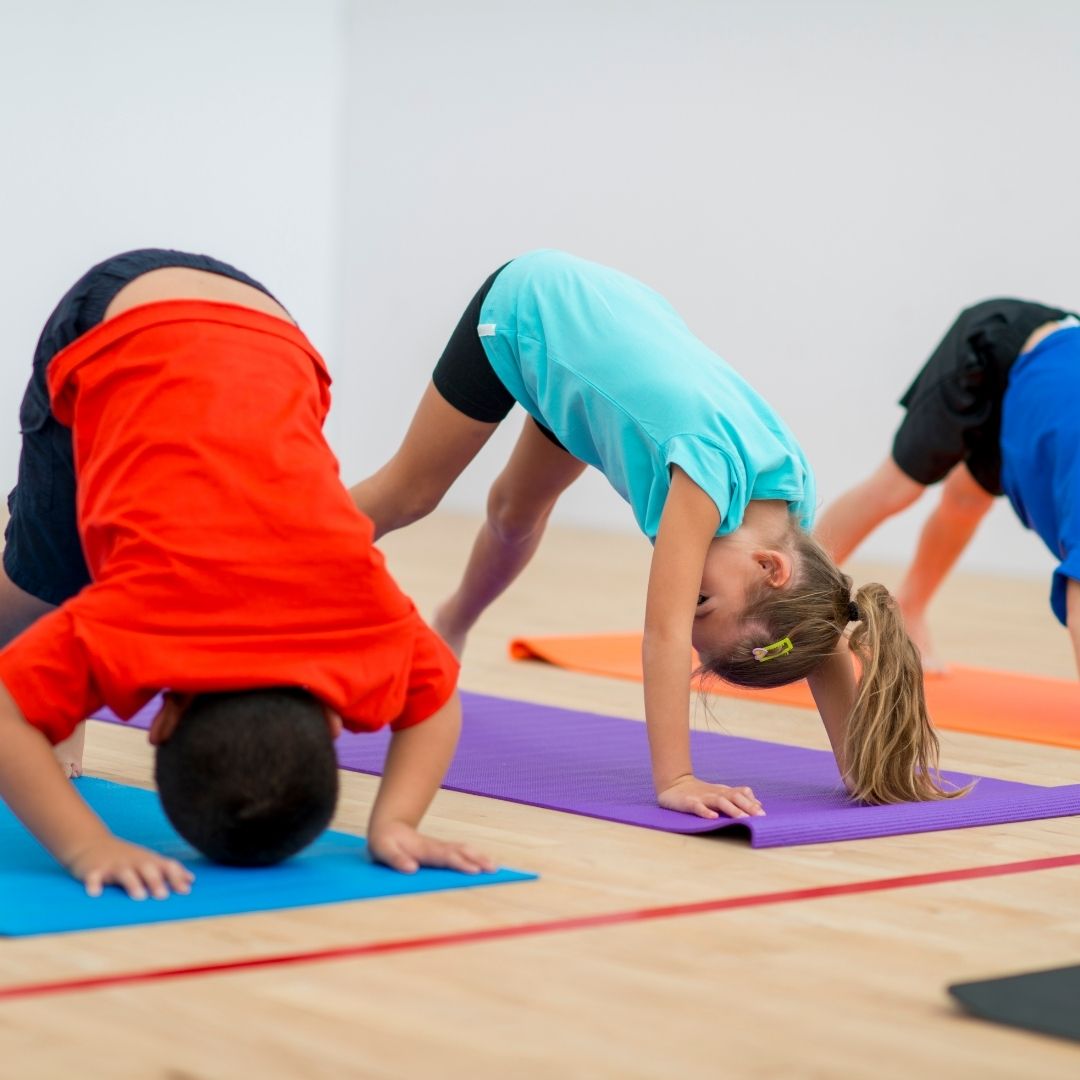
Yoga can work well in schools because it combines movement, breath, balance, mobility, attention and calm.
That does not mean school yoga should be vague, overly soft or full of language that makes half the pupils stare at the floor in spiritual confusion. It needs to be clear, practical and age-appropriate.
Children and young people need to know what they are doing. They need simple instructions, a safe structure, enough challenge to stay engaged, and enough calm to settle without feeling bored or patronised.
When taught well, yoga can help pupils practise balance, coordination, mobility, body awareness and breathing. It can support pupils who need a calmer way into movement, pupils who struggle with transitions, and pupils who benefit from a clear ending that helps them leave the session settled rather than hyped up.
Yoga can also help pupils understand that calm is not something adults simply demand from them. It is something they can practise.
That distinction matters. Being told to calm down often makes children feel controlled. Learning how to settle through movement, breath, and guided rest gives them a skill.
A proper one. Not a laminated wellbeing poster skill. An actual usable skill.
Why Pilates works well in schools
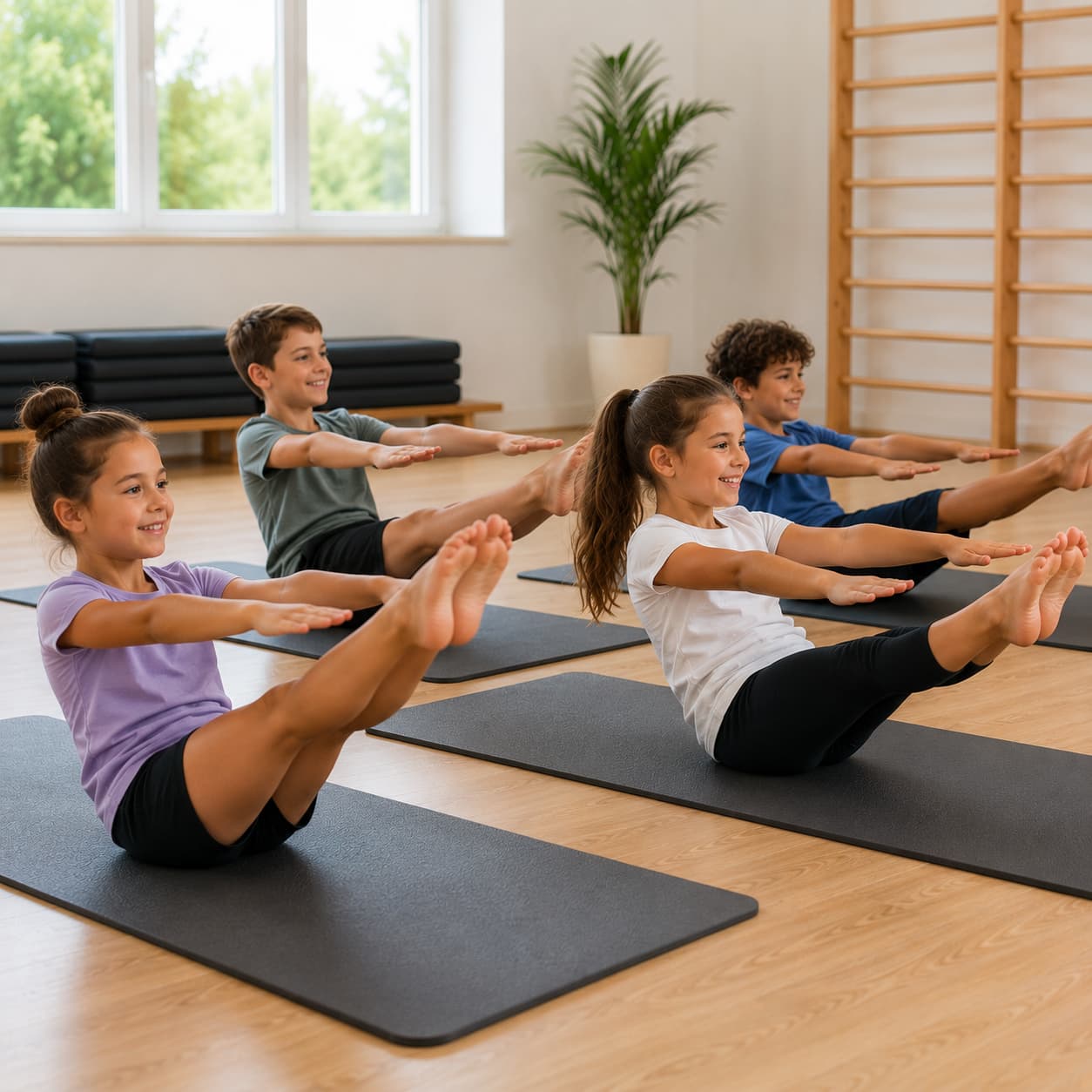
Pilates can work beautifully in schools because it supports strength, posture, control, coordination and body awareness.
It is especially useful for pupils who need help with physical organisation. That might mean pupils who slump, wobble, move quickly without control, lack core strength, struggle with posture, or find it difficult to understand where their body is in space.
Children’s and teen Pilates should not look like an adult class copied badly onto younger bodies. Nobody needs pupils lying on mats while someone says “neutral pelvis” until the will to live leaves the building.
It needs to be practical.
Clear instructions. Simple progressions. Age-appropriate language. Movement that makes sense. Enough challenge to build strength and confidence without making pupils feel exposed.
Pilates-based movement can help pupils feel how their body supports them. They may learn to move more slowly, balance with more control, sit and stand with better awareness, use the centre of the body more effectively, and understand the difference between rushing and controlled effort.
For pupils who are sporty, Pilates can support performance foundations such as stability, coordination and body control.
For pupils who are not sporty, it can offer a quieter route into strength and confidence. That range makes it useful in schools.
Why structured movement supports pupils who do not enjoy PE
Some pupils do not enjoy PE because they do not enjoy being compared.
Some do not enjoy the noise. Some do not enjoy team selection. Some do not enjoy being watched. Some do not enjoy the speed. Some do not enjoy public mistakes. Some have had one too many experiences of feeling physically behind, and their confidence has packed a bag and left.
A school movement programme can help because it removes some of those barriers.
There are no teams.
No winners. No public ranking.
No pressure to be the fastest, strongest, most flexible or most naturally athletic.
Instead, pupils are asked to practise. To notice. To try. To improve. To build strength gradually. To understand movement as something they can learn, not something they are either good at or bad at.
That can be a huge shift.
A pupil who avoids PE may still enjoy movement when the environment feels safer. A pupil who lacks confidence may join in more fully when they are not being compared. A pupil who has labelled themselves as “not sporty” may discover that movement is broader than sport.
That matters because children who disengage from movement early can carry that avoidance for years. Giving them another route in is not a small thing.
Why structured movement also supports sporty pupils
School movement programmes are not only for pupils who avoid PE.
Sporty pupils can benefit too.
In fact, many active pupils need exactly this kind of work because sport does not automatically build balanced movement. A pupil can be fast but stiff, strong but poorly coordinated, competitive but unable to slow down, flexible but unstable, or confident in games but less aware of posture and control.
-
- Yoga and Pilates can support those foundations.
- Mobility can help pupils move more freely.
- Strength and control can help pupils support their joints better.
- Balance can improve body awareness. Breath can support focus and recovery.
- Calmer movement can help pupils learn how to regulate effort rather than always pushing harder.
This is particularly useful for pupils involved in dance, gymnastics, football, athletics, martial arts, swimming or other regular sport. They may already move a lot, but they still benefit from structured movement that supports alignment, control, recovery and confidence.
Movement variety helps children develop better physical options. And better options usually mean better confidence.
What pupils practise in a school movement session
A school movement session gives pupils a practical experience of movement, not a lecture about wellbeing.
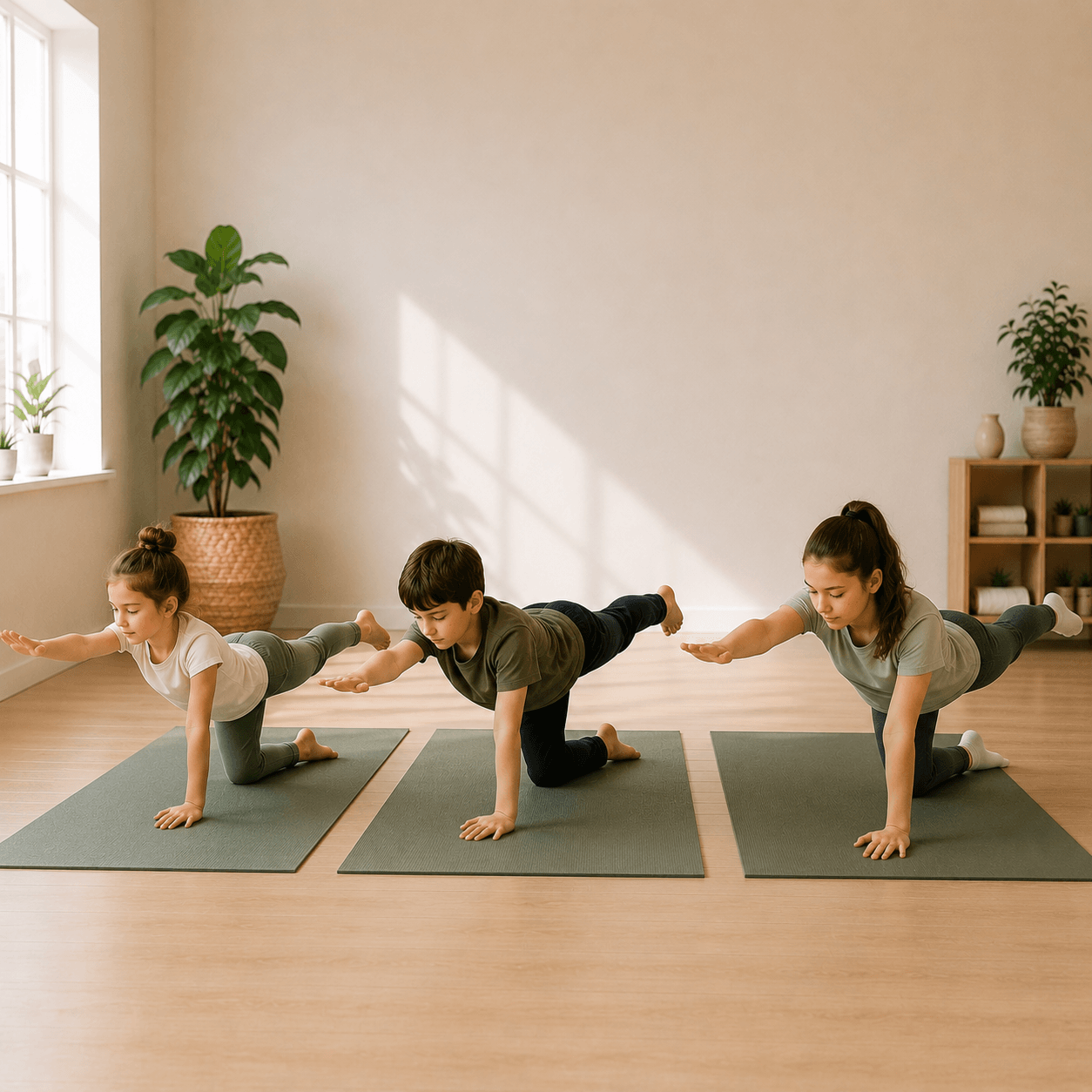
Depending on the age group, setting and programme format, pupils may practise strength patterns, balance, coordination, mobility, postural awareness, core strength, breath awareness, controlled movement, safe challenge, stretching, rest, recovery and focus.
-
- They may also practise things that are harder to measure but just as important.
- Trying again after wobbling.
- Noticing effort without panicking.
- Moving without rushing.
- Respecting personal space.
- Listening to instructions.
- Transitioning from energy into calm.
- Understanding that movement is not only about winning.
These skills matter in school because they support more than physical activity. They support participation, confidence, attention and self-awareness.
Children are not expected to be flexible, strong, calm, confident or coordinated before they begin. That is why the session exists.
What a typical 45-minute school movement session can look like
A 45-minute school movement session works well because it is long enough to create structure and progression, but short enough to fit into a school timetable without causing everyone to start rearranging the entire universe.
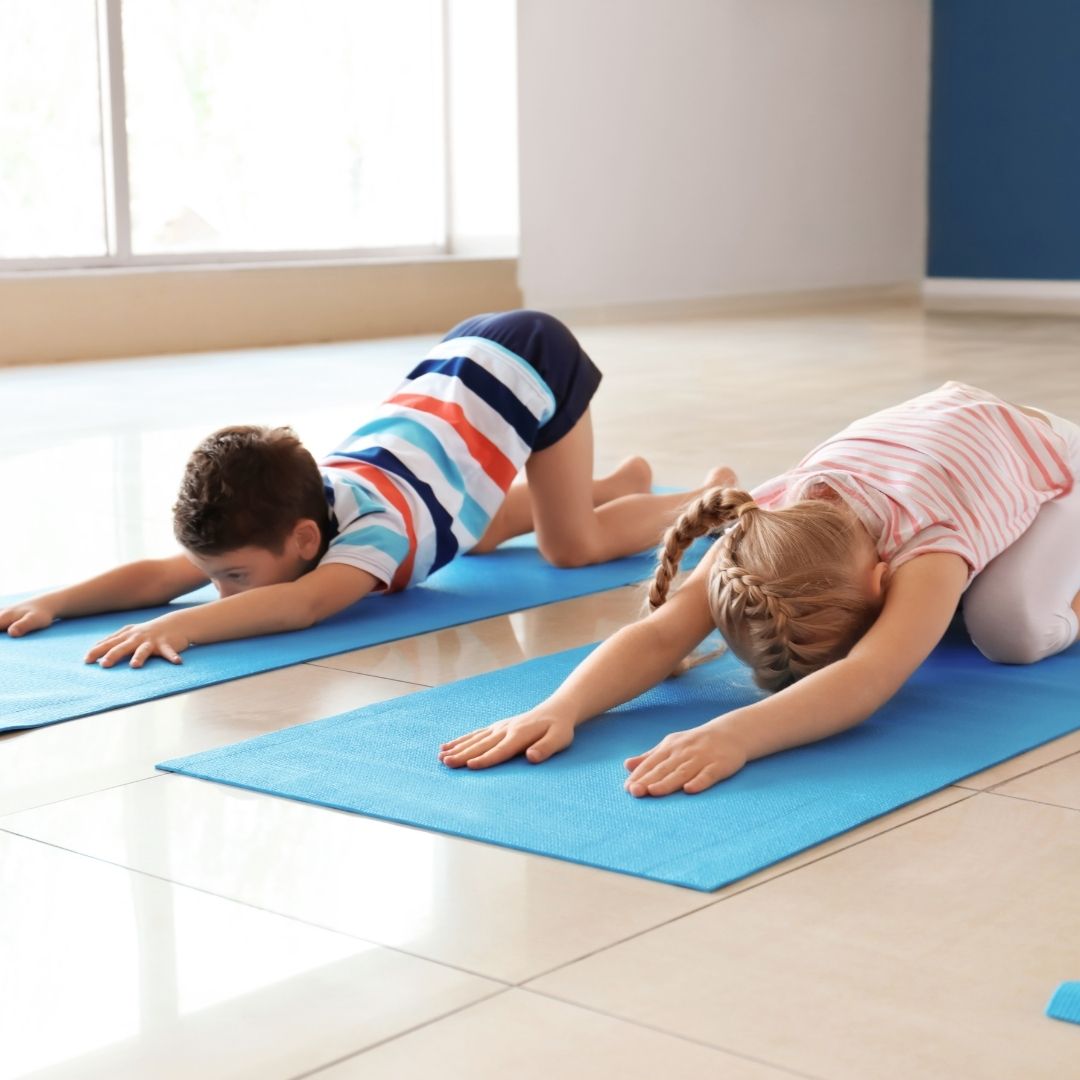
A typical session may begin with arrival and settling, helping pupils understand the focus of the session and transition into the space. This might be followed by warm-up movements that prepare the body through mobility, balance, coordination and gentle pulse-raising work.
The main movement section may include yoga, Pilates and strength-based movement designed to support confidence, control, balance, mobility, posture and body awareness. Pupils might work on standing balance, controlled transitions, simple strength patterns, spinal mobility, shoulder movement, hip mobility, breath-led movement or age-appropriate movement challenges.
The session then usually ends with a cool-down and reset, using stretching, breath awareness, guided rest or quiet reflection so pupils leave settled rather than overstimulated.
That ending matters. A movement session should not send pupils back to class like a shaken fizzy drink. It should help them return steadier.
Programme options for Nottingham schools
Schools may use movement programmes in different ways depending on their timetable, pupils and priorities.
A 6-week programme is often the simplest starting point because it gives pupils enough time to become familiar with the structure, practise safely and begin noticing progress. It also gives the school a clear, manageable way to trial the programme before deciding whether to continue.
Ongoing weekly provision can work well for schools that want consistency across a term, school year or selected pupil group. Regular sessions allow pupils to build confidence, understand the format, develop skills and experience movement as part of school life rather than a one-off event.
After-school clubs can offer a calmer end to the school day, especially for pupils who need movement but do not want another competitive sports club. This can work well for children who benefit from structure, confidence-building and a quieter physical environment.
Wellbeing days, enrichment weeks and transition events can also include movement sessions, especially when schools want something practical and active rather than another talk about wellbeing that pupils politely endure while thinking about lunch.
Each format has a place. The best choice depends on what the school wants to support.
Why a 6-week programme is a strong starting point
A 6-week school movement programme gives pupils enough repetition to settle into the work.
One-off sessions can be useful, especially for wellbeing events or enrichment days, but movement confidence grows through practice. Pupils need time to understand the structure, trust the teacher, learn the movements, notice improvement and feel safe enough to try properly.
Six weeks creates a useful rhythm.
In the first session, pupils are often learning the format. By the second or third session, they begin to recognise the structure and feel less uncertain. By the middle of the block, they may start noticing progress in balance, control, strength, posture or confidence. By the end, the school has a clearer sense of how pupils respond and whether the programme should continue.
This format is practical for schools because it is not an enormous commitment.
It gives enough time for the work to mean something without asking the school to commit to a full year before they have seen how it fits. For many schools, that is the sensible entry point. Not flashy. Useful. Always underrated.
How movement supports transition and settling
Movement can be especially useful during transitions. That might mean transition from primary to secondary school, transition after lunch, transition from classroom learning to after-school provision, or transition for pupils who struggle to settle into the school day.
Transitions ask pupils to shift state.
-
- From noisy to quiet.
- From active to focused.
- From social to independent.
- From anxious to present.
- From one environment to another.
Some pupils manage that easily. Others find it difficult, and that difficulty can show up as restlessness, withdrawal, silliness, irritability, refusal, or lack of focus. Structured movement can help because it gives the body a bridge.
Pupils move, breathe, balance, focus, slow down and reset. The body gets a clear signal that something is changing. The nervous system has a chance to settle. The pupil is not simply told to behave differently. They are given a physical process that helps them arrive.
That is why movement can be so useful in schools. It works with the body instead of treating the body as an inconvenience attached to a timetable.
Why body awareness matters in school
Body awareness is the ability to understand where your body is in space and how it is moving.
It affects balance, coordination, posture, movement control, personal space, handwriting posture, sitting, standing, sport, play, and how comfortable a pupil feels in their own body.
Some pupils naturally develop strong body awareness through play, sport and physical exploration. Others need more support. They may bump into things, struggle with balance, rush movements, avoid physical challenge, find coordination difficult, or seem disconnected from what their body is doing.
Yoga, Pilates and structured movement can help because they slow movement down enough for pupils to notice.
They learn how to move one part of the body at a time. They practise balance. They coordinate arms and legs. They feel the difference between collapse and support. They learn how breath affects effort. They learn how to adjust when something feels unstable.
Body awareness is not a luxury. It is part of physical confidence. And physical confidence affects how pupils participate.
Why posture support should be movement-based
Posture is often handled badly. Adults tell children to sit up straight. Children sit up for seven seconds. Then they collapse again. Everyone repeats this ritual until the end of time.
The problem is not that posture does not matter. It does. The problem is that posture cannot be solved by nagging.
Posture is not one perfect position. It is the ability to support, adjust, move and vary position. Pupils need strength, mobility, body awareness and enough understanding of their own bodies to recognise what support feels like.
Movement-based posture support is more useful because pupils learn through experience.
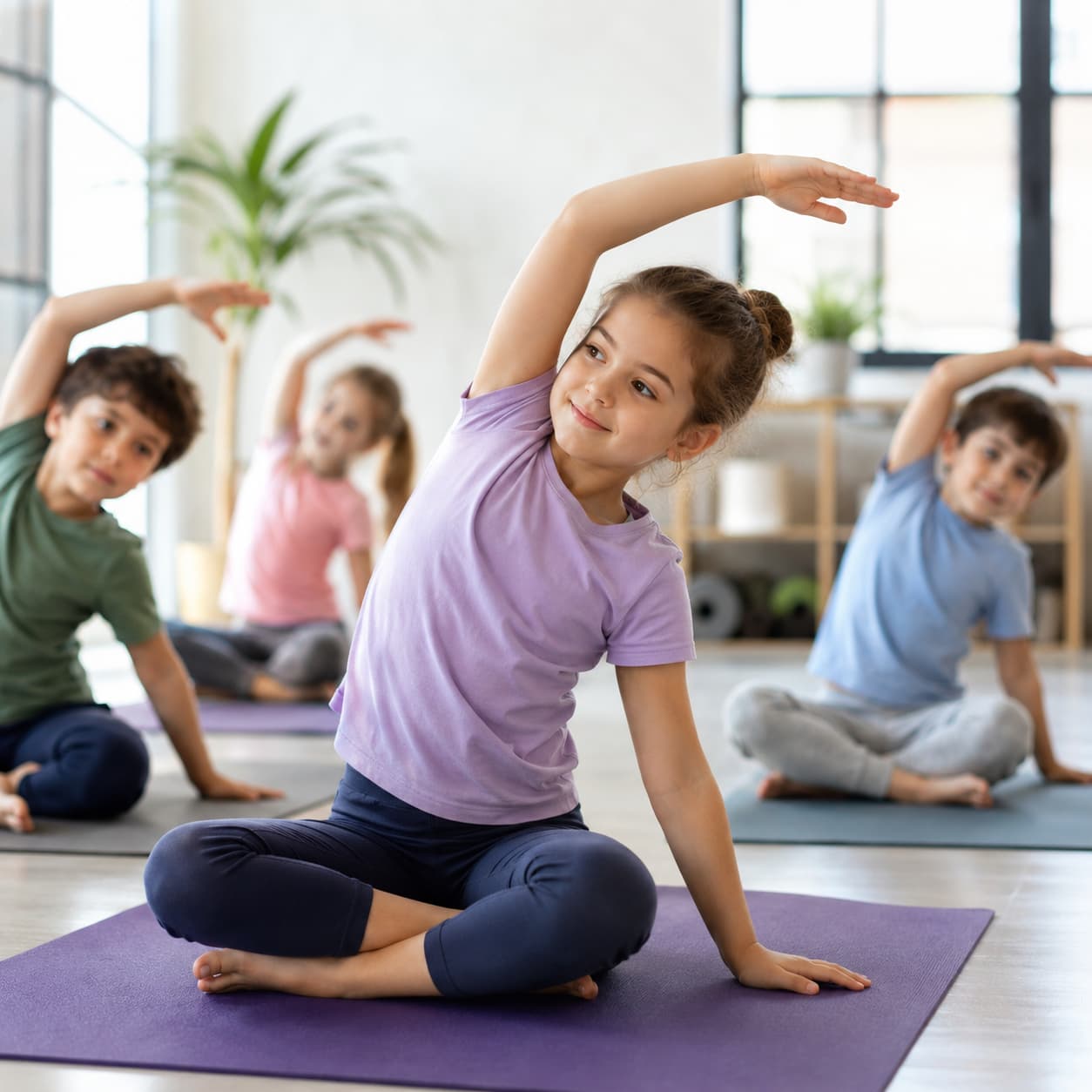
They feel how their spine moves. They practise standing balance. They notice shoulder position. They learn how the centre of the body supports movement. They explore breath and ribcage movement. They feel the difference between slumping, bracing and active support.
This is much better than simply telling them to sit properly. Especially because most adults do not sit properly either, so let’s not pretend the children are the only ones folding themselves like abandoned deckchairs.
Movement, breath and regulation
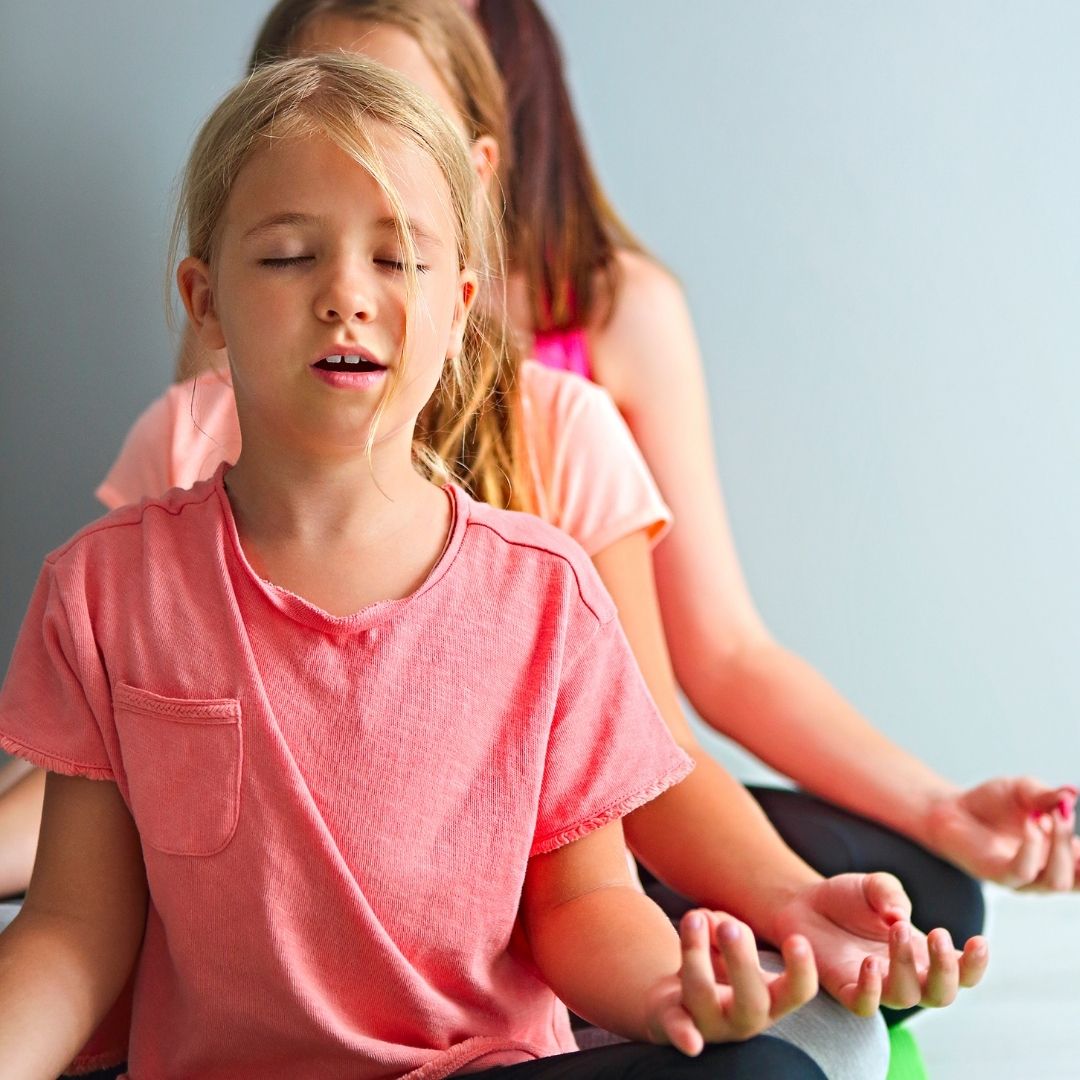
Breath work in schools needs to be practical. It should not be overcomplicated, overly spiritual, or presented in a way that makes pupils feel awkward. It should be simple, clear and connected to movement.
Breath can help pupils notice tension, slow down, recover after effort, settle attention and understand how the body changes state. When breath is taught alongside movement, it becomes easier for pupils to feel why it matters.
-
- They might notice that holding their breath makes balance harder.
- They might notice that slower breathing helps them settle after movement.
- They might notice that exhaling helps release tension.
- They might notice that breath gives them something to return to when they feel rushed or frustrated.
These are small skills, but they can be useful. Not because breath solves everything. Because it gives pupils a tool they can actually use.
What schools should expect from a good movement programme
A good school movement programme should feel structured, safe, inclusive and age-appropriate. It should not feel like a fitness class forced into a school hall. It should not feel like adult yoga copied onto children. It should not rely on vague wellbeing language or make pupils feel embarrassed, exposed or corrected.
The teaching should be clear. The movements should be adaptable.
The class should have enough structure for pupils to feel secure and enough variation for them to stay engaged. The teacher should understand how to hold the room, give simple instructions, manage energy, support confidence and keep the session purposeful.
Schools should expect pupils to be active, but not overstimulated.
-
- They should expect challenge, but not competition.
- They should expect calm, but not boredom.
- They should expect pupils to build confidence gradually through repetition, safe progression and clear guidance.
That is the balance. And it matters.
What schools should not expect
Schools should not expect one movement session to transform every pupil into a calm, focused, posture-perfect little woodland creature. That would be convenient. It would also be nonsense.
Movement takes time. Confidence takes time. Body awareness takes time. Pupils need repetition, consistency and trust before deeper change can happen.
A one-off session can introduce the work and give pupils a useful experience. A 6-week block can begin to build familiarity and progress. Ongoing provision can support longer-term confidence, physical development and movement habits.
Schools should also not expect every pupil to engage in the same way immediately.
Some pupils will join in quickly. Some will watch first. Some will be silly because they feel self-conscious. Some will rush. Some will need reminders. Some will surprise themselves. Some will find calm difficult at first because calm is unfamiliar.
That is normal. A good programme allows pupils to enter the work gradually while still holding clear boundaries and expectations.
How school movement supports wellbeing without becoming fluffy
School wellbeing matters, but pupils do not always need another assembly, worksheet or poster. Sometimes they need to move.
They need to feel their feet. Stretch their spine. Strengthen their body. Balance badly and laugh without feeling humiliated. Breathe after effort. Notice that they can try again. Learn that calm is not a command. Learn that their body is not just something to be judged, compared or dragged through the school day.
Movement makes wellbeing practical. It gives pupils an experience rather than a concept.
This is why school movement programmes can sit well inside wellbeing provision. They support focus, confidence, emotional regulation and self-awareness, but they do it through the body.
No forced sharing. Just structured movement, clear teaching and practical tools pupils can use.
School movement and after-school clubs
After-school movement clubs can be especially useful for pupils who need a calmer end to the school day.
Some children leave school full of noise, tension, energy and unprocessed everything. Another high-energy activity can be brilliant for some pupils, but too much for others. A structured yoga, Pilates or movement club gives children a different option.
It can help them move, strengthen, stretch, balance, breathe and settle before going home.
This can be particularly useful for pupils who do not want competitive sport, pupils who need confidence-building, pupils who benefit from routine, and pupils who need physical activity without the pressure of teams or performance.
After-school clubs can also be a practical way for schools to offer inclusive enrichment that supports both physical development and wellbeing.
They are active. They are structured. They are useful.
And they do not require pupils to be sporty before they begin.
School movement and enrichment days
Movement sessions can also work well for enrichment days, wellbeing weeks, transition days and special school events. The advantage is that they give pupils something experiential. Instead of listening to another talk about health or wellbeing, pupils get to practise movement, breath, balance, strength, focus and calm in real time.
That tends to land better.
Children learn through doing. They understand movement by moving. They understand effort by feeling effort. They understand calm by experiencing a shift from activity into stillness.
An enrichment session can introduce pupils to a different kind of physical activity and help schools see how pupils respond before booking a longer programme.
It is a useful entry point, especially for schools that want to test the fit without immediately building a whole provision plan around it.
Comparison table: school movement formats
| Format | Best for | What pupils gain |
|---|---|---|
|
One-off session |
Wellbeing days, enrichment events, transition days |
Introduction to movement, breath, focus and confidence |
|
6-week programme |
Schools wanting a practical starting point |
Repetition, familiarity, progression and clearer outcomes |
|
Ongoing weekly sessions |
Schools wanting longer-term provision |
Consistency, skill-building, confidence and movement habits |
|
After-school club |
Pupils needing calmer enrichment |
Strength, focus, confidence and a steady end to the day |
|
Small group support |
Pupils who need confidence or body awareness |
More focused support and safer progression |
|
PE enrichment |
Supporting physical foundations |
Balance, coordination, mobility, posture and confidence |
|
Wellbeing provision |
Supporting regulation and focus |
Movement, breath, calm and self-awareness |
Practical checklist for schools
| Question | Why it matters |
|---|---|
|
Do some pupils lack confidence in PE? |
Movement programmes offer another route into physical activity |
|
Do pupils need support with focus or regulation? |
Structured movement and breath can help pupils settle |
|
Would pupils benefit from better posture and body awareness? |
Pilates-based movement can support physical awareness |
|
Are you looking for inclusive enrichment? |
Sessions can be adapted for different confidence levels |
|
Do you want something active but calm? |
Yoga and Pilates can support effort without overstimulation |
|
Would a 6-week block be easier than a long commitment? |
It gives schools a practical way to trial the programme |
|
Do you need after-school provision? |
Movement clubs can offer a calmer alternative to sport |
|
Do pupils need confidence without competition? |
The sessions remove ranking, scoring and comparison |
|
Do you want practical wellbeing? |
Movement gives pupils an embodied experience, not just advice |
|
Do you need documents before booking? |
Programme information can be requested before deciding |
How this connects to children’s classes outside school
School movement programmes and local children’s classes share the same foundation: helping children and young people build strength, posture, coordination, focus, confidence and body awareness through structured movement.
The school setting allows pupils to experience this work as part of their wider education or enrichment provision. Local classes give families another route outside school, especially for children and teens who would benefit from regular yoga, Pilates or movement in a smaller community setting.
For families in and around Rushcliffe, the local class page is here: Children’s & Teen Yoga and Pilates in West Bridgford.
The wider movement practice can also be explored here: Movement.
Why the teacher matters
The teacher matters in school movement work because pupils are not just learning exercises. They are learning how to feel safe enough to try.
A good teacher needs more than technical knowledge. They need clear communication, calm authority, humour, adaptability, safeguarding awareness, emotional intelligence and the ability to hold a room without making pupils feel small.
Children and young people can be self-conscious about movement. They may worry about being watched. They may hide discomfort through silliness. They may avoid trying because they do not want to fail publicly. They may need reassurance, but they also need boundaries. They may need challenge, but not pressure.
That balance is the work.
A good school movement session should feel clear, grounded and respectful. Pupils should understand what they are doing, why it matters, and how to participate safely at their own level.
The aim is not to impress them. The aim is to help them build trust in their bodies.
Why consistency creates better outcomes
Movement confidence grows through repetition.
A one-off session can introduce pupils to the work, but regular sessions allow them to settle, practise, improve and build trust. Pupils begin to recognise the structure. They know what to expect. They become less self-conscious. They notice progress. They understand the language of the class. They start to feel more capable.
That is why a 6-week programme or ongoing weekly provision can be more effective than a single event. Confidence is built through evidence.
-
- “I can balance for longer.”
- “I know this movement now.”
- “I can slow down.”
- “I can try again.”
- “I am stronger than I thought.”
Those experiences add up. And when pupils feel more capable in their bodies, that can affect how they carry themselves elsewhere.
Final thoughts: school movement gives pupils another way in
School movement programmes in Nottingham can support focus, confidence and physical development by giving pupils a structured, inclusive and non-competitive way to move.
They do not replace PE. They strengthen the foundations underneath it.
Yoga, Pilates and structured movement can help pupils build strength, posture, coordination, balance, mobility, breath awareness, focus and physical confidence. They can support pupils who love sport, pupils who avoid sport, pupils who need calmer movement, pupils who struggle with confidence, and pupils who benefit from clear structure and safe repetition.
The point is not to make every pupil flexible, sporty or perfectly calm. The point is to help them feel more capable in their own bodies.
That is a worthwhile aim.
Because when pupils trust their bodies more, they often begin to participate differently. They stand differently. They try differently. They recover differently. They take up space differently.
And sometimes that starts with something as simple as a wobble, a breath, and the chance to try again without being compared to anyone else in the room.
If your school is looking for structured movement sessions in Nottingham that support focus, confidence, physical development and wellbeing, you can explore the full school offer here: School Movement Programmes in Nottingham
Sessions are available for primary and secondary schools across Nottingham and surrounding areas, with 45-minute yoga, Pilates and movement-based formats designed to support strength, confidence, coordination, focus and body awareness.
Key takeaways
School movement programmes in Nottingham can support pupils’ focus, confidence and physical development by giving them structured movement that is active, inclusive and non-competitive. Yoga, Pilates and movement-based sessions help pupils build strength, balance, coordination, posture, body awareness and calmer attention without needing to be naturally sporty, flexible or confident before they begin.
Frequently Asked Questions
School movement programmes are structured movement sessions delivered in schools to support pupils’ strength, balance, coordination, posture, focus, body awareness and confidence. They may include yoga, Pilates, mobility, simple strength work, breath awareness and guided rest.
No. School movement programmes are not the same as PE, and they are not designed to replace it. They support the physical foundations that help pupils participate more confidently in PE and everyday movement, especially strength, balance, coordination, posture and body awareness.
Movement can help pupils focus by giving the body a physical reset. Structured movement, breath and balance work can help pupils settle attention, release restlessness, improve body awareness and transition more calmly between activities.
Yes, when taught in an age-appropriate and school-friendly way. Yoga can support mobility, balance, breath, focus and calm. Pilates can support strength, posture, coordination, control and body awareness. Both can be adapted for primary and secondary pupils.
Yes. These sessions can be especially useful for pupils who do not enjoy competitive sport or traditional PE. The focus is on confidence, movement quality, strength and body awareness rather than winning, ranking, timing or comparison.
Yes. Sporty pupils can also benefit from structured movement because it supports mobility, balance, posture, coordination, breath, recovery and body control. These foundations can support wider physical development and confidence.
A typical school movement session lasts 45 minutes. This allows enough time for arrival, warm-up, main movement work, cool-down and a calmer ending, while still fitting into a school timetable.
A 6-week programme usually includes weekly 45-minute sessions focused on strength, balance, coordination, posture, mobility, breath awareness, focus and confidence. The structure gives pupils time to become familiar with the work and begin noticing progress.
Yes. After-school movement clubs can be offered for pupils who would benefit from a calmer, structured activity after the school day. These sessions can support confidence, strength, focus, body awareness and emotional regulation without competitive pressure.
No. Pupils do not need previous experience. Sessions are designed to be accessible and age-appropriate, with clear instructions and adaptations for different confidence levels and abilities.
School movement programmes can be adapted for primary and secondary pupils. The structure, language, challenge and pace are adjusted depending on the age group, school setting and pupil needs.
Schools can read more and enquire through the main programme page: School Movement Programmes in Nottingham.