
Why Standing Desks Aren’t the Whole Answer
TL;DR
Standing desks are undoubtedly better than sitting all day, but they don’t solve the underlying problem. Your body isn’t designed to stay in any one position for hours at a time, whether that’s sitting or standing. The real solution is regular movement throughout the working day.
Standing desks have become one of the most popular workplace wellbeing investments of the past decade.
On the surface, it makes perfect sense. We’ve all heard that sitting for long periods isn’t ideal, so replacing a traditional desk with one that allows you to stand feels like an obvious improvement. Companies invest thousands of pounds in adjustable workstations, employees feel they’re making a healthier choice, and everyone goes home believing they’ve solved the problem.
Unfortunately, our bodies don’t work quite that way.
Standing is generally better than sitting, but that doesn’t mean standing for eight hours suddenly becomes healthy. In many cases, people simply exchange one static posture for another. Their hips still become stiff, their shoulders still round forwards, their neck still drifts towards the screen and, by late afternoon, they’re often wondering why their lower back has started aching despite spending most of the day on their feet.
The problem was never sitting by itself.
The problem was staying in one position for far too long.
That’s an important distinction because it changes the conversation completely. Instead of asking whether standing desks work, a much better question is whether they encourage people to move more often.
That’s where the real benefits begin.
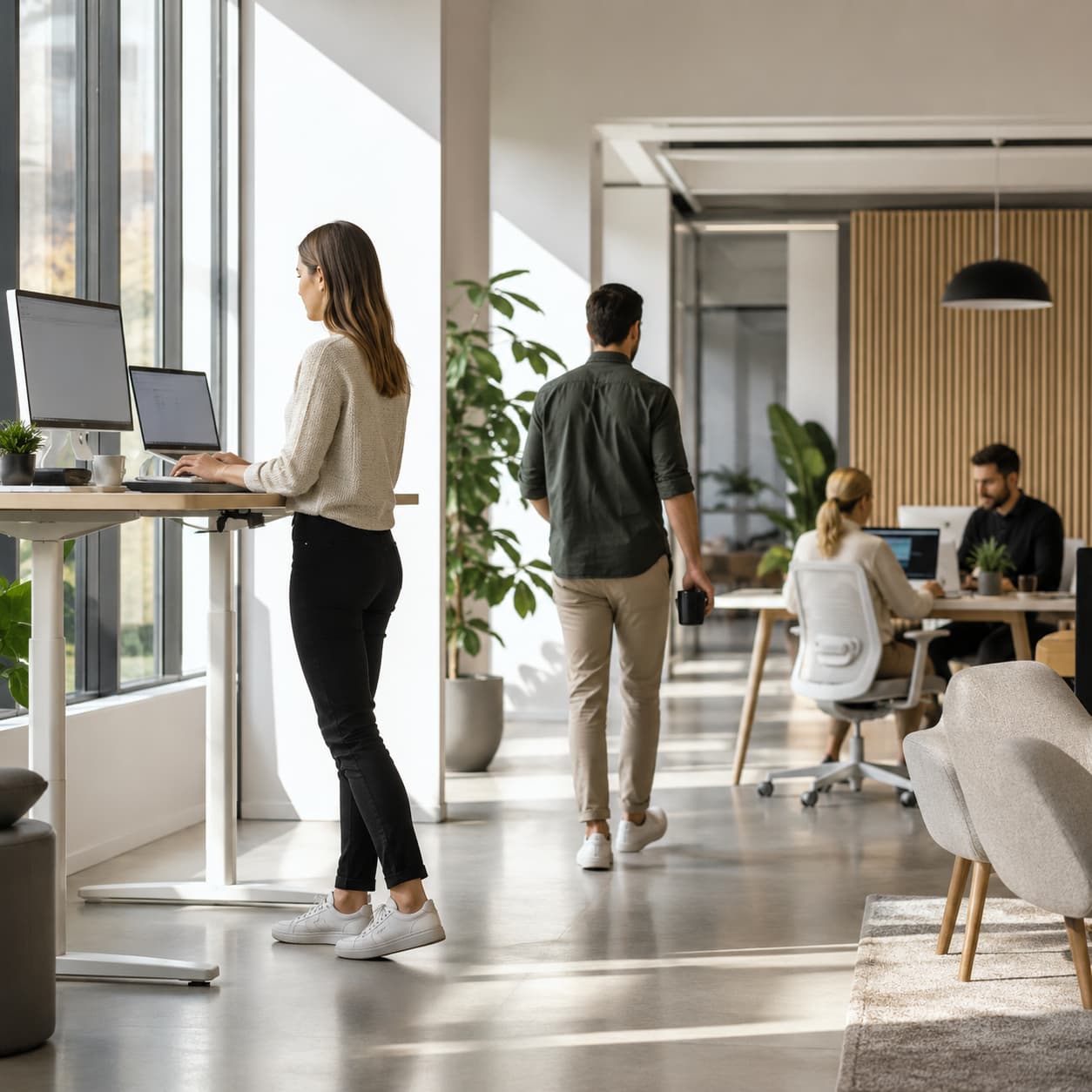

Your Body Doesn't Care Whether You're Sitting or Standing. It Cares Whether You're Moving.
The biggest misconception about standing desks is that they somehow undo the effects of sitting. They don’t. Standing is generally preferable to sitting for eight uninterrupted hours, but the body isn’t keeping score in quite the way people imagine. It doesn’t reward you simply because you’re upright. What it responds to is variety.
Human bodies were never designed to remain in one position for most of the day. We evolved to change position constantly. Walking, reaching, bending down, climbing stairs, carrying shopping, turning around to speak to someone, crouching to tie a shoelace. None of those movements last particularly long before another one naturally follows. That’s how joints stay mobile, muscles share the workload and tissues receive regular changes in load and blood flow.
Modern office work asks us to do almost the opposite. We stay in one place, facing one direction, looking at one screen for hours at a time. Whether that happens in a chair or at a standing desk, the body eventually begins adapting to the position it’s repeatedly exposed to. Muscles that aren’t being used become less active, others end up working far harder than they need to, and the nervous system gradually accepts that posture as your default.
That’s why many people are disappointed after investing in a standing desk. They expected to feel noticeably better within a few weeks, yet they simply swapped aching hips for sore feet or a tired lower back. The discomfort moved, but it didn’t disappear, because the underlying problem never changed.
The issue wasn’t sitting.
The issue was staying still.
Why Standing Still Isn't the Same as Moving
One of the reasons standing desks have developed such a strong reputation is that we often use the words standing and moving almost interchangeably. In reality, they’re completely different things.
Imagine standing in a queue at passport control after a long flight. You’re on your feet, but very few people would describe that experience as physically active. After ten or fifteen minutes you begin shifting your weight from one leg to the other, rolling your shoulders, stretching your neck or looking for somewhere to lean. None of that happens because you’re unfit. It happens because your body is asking for movement.
A standing desk can easily become the office equivalent of that airport queue.
You stand in exactly the same place. Your weight settles onto one hip. Your knees lock. Your shoulders creep forwards as you lean towards the screen. Without realising it, you’ve recreated exactly the same problem you had while sitting, only in a different position.
Movement changes that completely.
Every time you walk to refill your water bottle, take a phone call while pacing around the office, squat to pick something up or simply stretch your arms overhead, you’re changing how forces travel through your body. Different muscles take over, joints move through a greater range of motion and blood flow increases. None of those movements needs to be dramatic. In fact, it’s often the small, frequent changes that make the biggest difference over the course of a working day.
That’s why I prefer talking about movement-rich workdays rather than standing workstations. A standing desk is simply one tool that can help you move more often. It isn’t the destination.
Standing Desks Can Improve Comfort, But They Can't Replace Good Habits
This is where I think many workplace wellbeing conversations lose their way.
They become centred around equipment instead of behaviour.
Standing desks are marketed as though they’re the missing piece of the puzzle. Buy one, adjust the height correctly and suddenly you’re taking care of your health while answering emails. It’s an attractive idea because it suggests there’s a simple solution to a complicated problem.
Unfortunately, bodies are rarely that cooperative.
The best standing desk in the world can’t make you move. It can’t persuade you to take a break after ninety minutes, encourage you to walk over to speak to a colleague instead of sending another Teams message or remind you to stretch after spending an hour concentrating on a report. Those decisions still belong to you.
That’s why I’ve always thought organisations sometimes spend too much money on equipment and too little time helping people develop healthier working habits. Both matter, of course, but one is far more likely to create lasting change than the other.
A standing desk can support healthier behaviour.
It can’t create it.
The Most Healthy Office Workers Aren't Constantly Standing
If you watched someone who worked in a physically healthy way throughout the day, you probably wouldn’t notice anything remarkable about them.
They wouldn’t be stretching every five minutes or disappearing for long walks every hour. They also wouldn’t be standing rigidly behind an adjustable desk all day believing they were doing their body a favour.
Instead, they’d simply change position regularly.
They might spend half an hour sitting while writing a report because it’s the most comfortable position for focused work. Then they’d stand for a video meeting before walking to refill their water bottle. Perhaps they’d take a phone call while walking around the office or climb a flight of stairs instead of sending an email to someone upstairs. None of those decisions feels particularly significant on its own, but together they create a working day that’s full of movement instead of dominated by stillness.
That’s the important difference.
Healthy movement isn’t something that only happens before work or after work in the gym. It should be woven into the working day itself.
When people tell me they don’t have time to exercise, I completely understand. Most working days are busy enough already. What I find more interesting is looking for opportunities to move without asking people to find another hour in the day. Standing up during a meeting, walking while making a phone call or taking sixty seconds to move between tasks might not sound revolutionary, but repeated consistently they often have a greater impact than people expect.
The body doesn’t need perfection.
It needs variety.
Why Workplace Wellbeing Needs to Go Beyond Furniture
This is one of the reasons I built Sit Happens around movement rather than exercise.
Most employees already know they should sit less.
They’ve read the articles. They’ve seen the headlines. Some have standing desks, ergonomic chairs and expensive monitor arms.
Knowledge isn’t usually the missing piece.
The challenge is turning that knowledge into habits that fit naturally into a busy working day.
Telling people to “move more” is a bit like telling someone to “eat healthier”. Technically it’s good advice, but it’s so broad that it rarely changes anything on its own. People need practical strategies that work within the reality of deadlines, meetings and overflowing inboxes.
That’s exactly what Sit Happens is designed to provide.
Instead of expecting employees to squeeze an extra workout into an already busy schedule, the sessions focus on helping people move better during the day they’re already having. Small changes in posture, mobility and movement patterns can make a surprising difference when they’re repeated consistently, and because they fit naturally into the working day, they’re much more likely to become lasting habits.
Workplace wellbeing isn’t really about adding another task to someone’s to-do list.
It’s about changing the way the day itself is experienced.
So, Are Standing Desks Enough?
In isolation?
No.
They’re a useful tool, but they’re only one piece of a much bigger picture.
If a standing desk encourages you to change position more often, take regular movement breaks and become more aware of how you’re working, it’s probably a worthwhile investment. If it simply replaces eight hours of sitting with eight hours of standing, the benefits are likely to be far smaller than many people expect.
The body isn’t interested in whether you’re sitting or standing.
It’s interested in whether you’re moving.
That’s why the healthiest workplaces aren’t necessarily the ones with the most expensive office furniture. They’re the ones where movement is simply part of the culture. People stand when it makes sense, sit when it makes sense and move whenever the opportunity arises.
It’s a much simpler philosophy than most workplace wellbeing programmes suggest.
It’s also one that’s far easier to sustain.
Conclusion
Standing desks deserve their place in modern offices. They give employees more choice, encourage changes in posture and can reduce the amount of time spent sitting during the day. Those are all positive outcomes.
The mistake is expecting them to solve a problem they were never designed to solve.
Human bodies don’t thrive because they’re standing instead of sitting. They thrive because they’re regularly changing position, sharing load across different muscles and moving in ways that feel natural.
That’s why I see standing desks as part of the solution, not the solution itself.
If organisations genuinely want healthier, happier and more comfortable employees, the conversation has to move beyond office furniture. It has to focus on helping people build movement into the working day in ways that are practical, sustainable and realistic.
Standing is better than sitting.
Moving is better than both.

Frequently Asked Questions
Yes, if you see them as a way to introduce more variety into your working day rather than as a cure for back pain or poor posture. A standing desk gives you more choice, which is valuable, but the biggest health benefits still come from changing position regularly and moving throughout the day.
It can. Standing for long periods may lead to tired legs, sore feet or lower back discomfort, particularly if you remain in the same position for hours. Like sitting, prolonged standing becomes a problem when there isn’t enough movement.
There’s no perfect rule because every job is different, but if you’ve been in the same position for around 30 to 60 minutes, it’s probably time to move. That might mean standing up, sitting down, walking to refill your water bottle or simply stretching for a minute.
Generally, yes. Standing increases muscle activity slightly and often encourages better posture than prolonged sitting. However, neither standing nor sitting should dominate your entire working day. Alternating between the two is usually a much better approach.
Moving, without question. Standing changes your posture, but movement changes how your joints, muscles and circulation function. That’s why even short bursts of walking or gentle mobility throughout the day are often more beneficial than standing still for hours.
They can help, but they don’t automatically improve posture. It’s still possible to slump, lean forwards or lock your knees while standing. Good posture isn’t a position you hold all day; it’s the result of changing position regularly.
Not necessarily. Standing desks can be a useful addition, but they’re only one part of a healthy workplace. Encouraging regular movement, creating a culture where people can step away from their desks and providing practical movement education often has a much greater long-term impact.
Stop thinking in terms of sitting versus standing and start thinking about movement. If you can change position regularly, take short walking breaks, stretch between tasks and avoid staying still for long periods, you’re already giving your body far more of what it needs.
Sit Happens is a movement-based workplace wellbeing programme designed specifically for desk-based teams to support posture, movement, nervous system regulation and physical wellbeing.